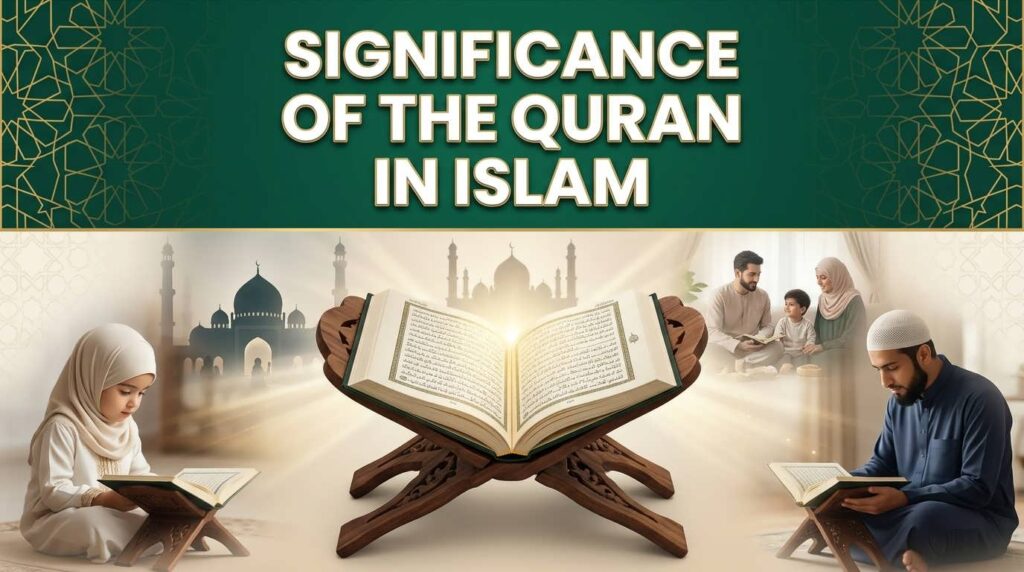
The significance of the Quran in Islam goes far beyond being a religious book that Muslims recite during worship. Muslims believe the Quran is the revealed word of Allah and the primary source of guidance for their beliefs, worship, character, and way of life.
The Quran addresses questions about faith, morality, worship, human responsibility, relationships, patience, justice, and the Hereafter. It guides Muslims toward what is right while reminding them of their relationship with Allah.
The Quran itself describes its guidance clearly. In Surah Al-Isra, Allah says that the Quran guides toward what is most suitable and gives good news to believers who do righteous deeds.
For this reason, understanding the Quran is an important part of Islamic education for children, adults, beginners, and anyone who wants to strengthen their relationship with Allah.
- What Is the Quran?
- Why Is the Quran So Important in Islam?
- 9 Powerful Reasons the Quran Is Significant in Islam
- 5. The Quran Provides Spiritual Comfort
- 6. The Quran Helps Muslims Understand Right and Wrong
- 7. The Quran Connects Muslims With the Prophets
- 8. The Quran Shapes Muslim Daily Life
- 9. The Quran Reminds Muslims About the Hereafter
- What Is the Quran's Role in Islamic Belief?
- Why Is Understanding the Quran Important?
- Is Reading the Quran Enough?
- How Does the Quran Influence Children?
- How Can Adults Build a Stronger Relationship With the Quran?
- What Is the Relationship Between Quran Recitation and Tajweed?
- Why Do Muslims Recite the Quran Regularly?
- Can Someone Learn the Quran Later in Life?
- How Can You Make the Quran Part of Your Daily Life?
- What Is the Best Way to Start Learning the Quran?
- Common Mistakes People Make With Quran Learning
- How Can a Quran Teacher Help?
- The Quran Is Meant to Be Lived, Not Only Read
- Conclusion
- Frequently Asked Questions
What Is the Quran?
The Quran is the central scripture of Islam. Muslims believe it is the revelation from Allah given to Prophet Muhammad ﷺ through the Angel Jibreel (Gabriel).
The Quran was revealed over approximately 23 years and contains 114 Surahs, or chapters.
It covers a wide range of subjects, including:
- Belief in Allah
- Worship
- Prophets and messengers
- Moral conduct
- Family relationships
- Justice
- Charity
- Patience
- Repentance
- The Hereafter
- Paradise and Hell
- Human responsibility
The Quran is not arranged like a conventional textbook where one subject is completed before another begins. Its verses address different aspects of human life while repeatedly returning believers to faith, accountability, worship, and righteous conduct.
You can read the Quran and explore translations and recitations through Quran.com.
Why Is the Quran So Important in Islam?
The Quran occupies a unique position in Islam because it is not simply considered a source of historical information or religious inspiration.
It is a source of guidance.
Muslims turn to the Quran to understand what Allah asks from them, how they should worship Him, how they should treat other people, and how they should approach the temporary nature of worldly life.
The Quran therefore influences both religious practice and everyday decisions.
9 Powerful Reasons the Quran Is Significant in Islam
1. The Quran Provides Guidance for Life
One of the most important reasons for the significance of the Quran in Islam is its role as guidance.
People regularly face difficult decisions.
They may struggle with anger, relationships, financial responsibilities, temptation, grief, fear, or uncertainty about the future.
The Quran provides principles that help Muslims approach these situations with faith and responsibility.
Surah Al-Isra describes the Quran as guiding toward what is most suitable.
This does not mean that the Quran provides a direct answer to every modern situation in the form of a specific instruction.
Instead, it provides foundational principles that help believers distinguish between right and wrong and develop a God-conscious approach to life.
2. The Quran Strengthens Faith in Allah
The Quran repeatedly calls people to recognize Allah as the Creator, Sustainer, and only One worthy of worship.
Its verses encourage believers to reflect on creation, life, death, human responsibility, and the signs around them.
This reflection can strengthen a person’s awareness of Allah.
The Quran does not present faith as something completely disconnected from reflection.
It repeatedly encourages people to think, observe, remember, and understand.
This makes Quran study an important part of developing a stronger relationship with Allah.
3. The Quran Teaches Muslims How to Worship
Islamic worship is closely connected with the Quran.
The Quran teaches fundamental principles related to worship, including prayer, fasting, charity, pilgrimage, remembrance of Allah, and obedience.
It also establishes the importance of worshipping Allah alone.
For example, Surah Al-Isra connects worship of Allah with good treatment of parents and other moral responsibilities.
This demonstrates an important feature of Quranic guidance.
Worship is not presented as something completely separate from character.
A Muslim’s relationship with Allah should also influence how they behave toward other people.
4. The Quran Builds Good Character
Another major aspect of the Quran’s significance is its emphasis on character.
The Quran repeatedly teaches qualities such as:
- Honesty
- Patience
- Justice
- Mercy
- Humility
- Forgiveness
- Gratitude
- Generosity
- Respect for parents
- Care for those in need
For example, Surah Al-Isra instructs believers to treat parents with kindness and humility and also discusses giving the rights of relatives, the poor, and travelers.
This shows that Quranic learning is not only about improving pronunciation or memorizing verses.
It should also influence how a person behaves.
5. The Quran Provides Spiritual Comfort
Life includes difficulty.
People experience loss, disappointment, fear, uncertainty, loneliness, and hardship.
The Quran provides spiritual reminders that can help believers maintain hope and remember Allah during difficult circumstances.
Surah Az-Zumar describes the effect of the Quran on believers’ hearts and connects it with guidance from Allah.
Similarly, Surah Al-Isra describes the Quran as healing and mercy for believers.
This spiritual dimension is one reason Muslims return to Quran recitation and reflection throughout their lives.
The Quran can be a source of reassurance without suggesting that difficult emotions or problems will simply disappear.
Instead, it reminds believers that their lives have purpose and that Allah’s guidance remains available.
6. The Quran Helps Muslims Understand Right and Wrong
Every society has questions about morality.
What is justice?
What is honesty?
How should people treat their parents?
How should wealth be used?
How should people respond to wrongdoing?
How should believers behave when they are angry?
The Quran addresses many of these questions through commands, warnings, examples, stories, and principles.
This provides Muslims with a framework for understanding moral responsibility.
The Quran also repeatedly reminds people that actions have consequences.
That awareness can encourage believers to think beyond immediate desires and consider their accountability before Allah.
7. The Quran Connects Muslims With the Prophets
The Quran contains accounts of many prophets and messengers.
These include:
- Adam
- Nuh (Noah)
- Ibrahim (Abraham)
- Musa (Moses)
- Isa (Jesus)
- Yusuf (Joseph)
- Yunus (Jonah)
- Muhammad ﷺ
These accounts are not included simply as historical stories.
They contain lessons about faith, patience, obedience, leadership, hardship, repentance, and trust in Allah.
For example, the story of Prophet Yusuf teaches lessons about patience, family difficulties, forgiveness, and trusting Allah through hardship.
Learning these accounts can help children and adults understand Islamic values through memorable examples.
8. The Quran Shapes Muslim Daily Life
The Quran’s influence does not end after a person finishes a recitation session.
Its teachings can influence everyday behavior.
A Muslim may think about Quranic guidance when dealing with:
- Parents
- Children
- Spouses
- Neighbors
- Friends
- Business relationships
- Wealth
- Difficult situations
- Personal mistakes
This is why Quran learning should ideally include both recitation and understanding.
Reading the Arabic text is an important act of worship, while understanding the meanings can help a person apply its guidance to daily life.
9. The Quran Reminds Muslims About the Hereafter
One of the Quran’s recurring themes is accountability after death.
The Quran repeatedly reminds people that worldly life is temporary and that human actions have consequences.
This changes the way believers can view success.
Money, status, appearance, and possessions may have importance in worldly life, but the Quran repeatedly directs attention toward the Hereafter.
This perspective can encourage Muslims to prioritize righteous actions rather than judging success only through worldly achievements.
What Is the Quran’s Role in Islamic Belief?
The Quran is central to Islamic belief.
It teaches Muslims about:
- The oneness of Allah
- His attributes
- His creation
- Prophets and messengers
- Revelation
- Angels
- The Hereafter
- Divine accountability
- Human responsibility
The Quran’s teaching about Allah is particularly important.
Islamic belief is built around Tawheed, the oneness of Allah.
The Quran repeatedly calls people away from associating partners with Allah and toward sincere worship of Him alone.
This connects directly with the broader Islamic understanding of monotheism.
Why Is Understanding the Quran Important?
Reciting the Quran is an important part of Muslim life, but understanding its message can deepen the benefit of Quran learning.
A person may memorize a verse without knowing its meaning.
When they understand what the verse teaches, they can begin to reflect on how it relates to their beliefs and actions.
Understanding can help transform Quran reading from a purely repetitive activity into a more reflective experience.
This does not mean every Muslim needs to become a scholar before benefiting from the Quran.
Beginners can start with simple translations and age-appropriate explanations while gradually developing their knowledge.
Is Reading the Quran Enough?
Reading the Quran is extremely valuable, but Muslims are encouraged to engage with the Quran beyond simply moving their eyes across the page.
A complete relationship with the Quran can include:
Recitation: Reading the Quran correctly.
Listening: Hearing accurate recitation.
Understanding: Learning the meanings.
Reflection: Thinking about the message.
Practice: Applying its guidance.
Memorization: Preserving selected passages or larger portions.
These activities can complement one another.
Someone learning Quran should therefore avoid thinking that success is measured only by how many pages they complete.
The effect of Quranic guidance on belief and behavior matters as well.
How Does the Quran Influence Children?
Children who learn the Quran from an early age can develop familiarity with Arabic letters, Quranic recitation, Surahs, Islamic values, and basic religious concepts.
However, children should not be taught Quran only as a memorization task.
They can also benefit from understanding simple meanings and lessons appropriate for their age.
Parents can encourage children by:
- Establishing a regular Quran routine
- Celebrating progress
- Listening to their recitation
- Helping them review memorized Surahs
- Explaining simple meanings
- Connecting Quranic lessons with everyday behavior
If you are building a structured routine for your child, our guide on Quran learning routine for kids provides practical ideas.
How Can Adults Build a Stronger Relationship With the Quran?
Adults may have busy schedules, work responsibilities, family commitments, and other demands.
That does not mean Quran learning has to be abandoned.
A simple routine can be more sustainable than an ambitious schedule.
For example:
10 minutes: Quran recitation
5 minutes: Read the translation
5 minutes: Reflect on one lesson
5 minutes: Review a memorized passage
Even a short daily routine can help maintain consistency.
Adults who are starting from the beginning can also consider structured online Quran classes that provide teacher guidance and regular practice.
What Is the Relationship Between Quran Recitation and Tajweed?
The Quran should be recited carefully and correctly.
Tajweed provides rules and principles that help learners improve pronunciation and recitation.
This is particularly important when a learner is developing their Quran reading skills.
If you want to improve pronunciation and recitation accuracy, our guide on how to improve Tajweed provides practical steps for developing better recitation.
The purpose of Tajweed is not simply to make recitation sound beautiful.
It helps learners pronounce Quranic Arabic more accurately.
Why Do Muslims Recite the Quran Regularly?
Muslims recite the Quran for several reasons.
Recitation is an act of worship.
It allows believers to remember Allah.
It provides an opportunity to reflect on Quranic guidance.
It helps students maintain what they have memorized.
And regular recitation can strengthen a person’s familiarity with the Quran.
Some Muslims recite a small portion every day, while others have longer reading sessions.
The ideal routine depends on the person’s circumstances.
Consistency is often easier to maintain than an extremely demanding schedule.
Can Someone Learn the Quran Later in Life?
Yes.
There is no age limit for beginning Quran education.
Adults who never learned to read the Quran can start with the Arabic alphabet and basic reading skills.
Someone who already reads but struggles with pronunciation can focus on Tajweed.
Someone who memorized Quran years ago may focus on revision.
The important thing is to identify the learner’s current level and choose an appropriate learning path.
Our article Is 50 Too Late to Learn Quran? explores this question in greater detail.
How Can You Make the Quran Part of Your Daily Life?
You do not need to completely redesign your schedule.
Start with something manageable.
You could:
- Read a few verses after Fajr
- Listen to Quran while following the Arabic text
- Read a translation
- Memorize a short Surah
- Review previously memorized passages
- Study one Tajweed rule
- Discuss a Quranic lesson with your children
- Attend a regular Quran class
The goal is to create a relationship with the Quran that can continue throughout your life.
What Is the Best Way to Start Learning the Quran?
The best starting point depends on your current ability.
Complete Beginner
Start with Arabic letters and basic Quran reading.
Basic Reader
Work on fluency and pronunciation.
Fluent Reader
Focus on Tajweed, meaning, and consistent recitation.
Memorization Student
Combine new memorization with regular revision.
Adult Returning to Quran
Assess your current skills and rebuild gradually where necessary.
There is no reason to feel embarrassed about starting at a basic level.
Every learner has a different starting point.
Common Mistakes People Make With Quran Learning
Understanding the significance of the Quran also means recognizing mistakes that can prevent people from benefiting fully from it.
Treating Quran Learning Only as Memorization
Memorization is valuable, but understanding and applying the message are also important.
Reading Only Occasionally
Long gaps can make it difficult to develop consistency.
Focusing Only on Speed
Fast reading is not necessarily accurate reading.
Ignoring Pronunciation
Repeated pronunciation mistakes can become habits if they are not corrected.
Never Learning the Meaning
Even basic understanding can make Quran study more meaningful.
Setting Unrealistic Goals
A routine that cannot be maintained is unlikely to become a long-term habit.
How Can a Quran Teacher Help?
A qualified teacher can make Quran learning more structured.
A teacher can:
- Assess your current level
- Correct pronunciation
- Explain Tajweed rules
- Help with memorization
- Listen to recitation
- Provide feedback
- Adjust lessons to your needs
- Encourage consistent practice
This is particularly helpful for beginners who may not know which skills to learn first.
When choosing an academy or teacher, focus on teaching quality rather than marketing claims alone.
Our guide on how to compare online Quran academies can help parents and adult learners evaluate different options.
The Quran Is Meant to Be Lived, Not Only Read
One of the most important lessons about the significance of the Quran in Islam is that Quranic guidance should influence a person’s life.
Reading the Quran without allowing its teachings to affect behavior misses an important part of its purpose.
If the Quran teaches patience, a believer should strive to become more patient.
If it teaches generosity, that guidance should influence how they treat people in need.
If it teaches respect for parents, that should appear in everyday behavior.
If it reminds people of accountability, that awareness should influence their choices.
Quran learning becomes more meaningful when knowledge leads toward action.
Conclusion
The significance of the Quran in Islam comes from its central role as divine guidance for Muslims.
It teaches believers about Allah, worship, morality, responsibility, the prophets, the Hereafter, and the purpose of human life.
It provides guidance for everyday decisions while encouraging faith, reflection, patience, justice, mercy, and good character.
The Quran also has a deeply spiritual role. It can remind believers of Allah, provide comfort during difficulty, and strengthen their connection with their faith. The Quran itself describes its message as guidance and, for believers, healing and mercy.
For this reason, Quran learning should not be limited to memorizing words or completing pages.
A strong relationship with the Quran can include recitation, listening, understanding, reflection, memorization, and application.
Whether someone is a child learning their first Surah, an adult returning to Quran study, or an experienced reader working on Tajweed, there is always an opportunity to deepen their relationship with the Quran.
Frequently Asked Questions
What is the significance of the Quran in Islam?
The Quran is central to Islam because Muslims believe it is the revelation from Allah and a primary source of guidance for belief, worship, morality, and daily life.
Why is the Quran important to Muslims?
The Quran teaches Muslims about Allah, worship, moral behavior, the prophets, accountability, and the Hereafter. It also provides spiritual guidance and encouragement.
What does the Quran say about its own purpose?
The Quran describes itself as guidance. In Surah Al-Isra, it says that the Quran guides toward what is most suitable, while another verse describes it as healing and mercy for believers.
Is the Quran only for religious worship?
No. Although Quran recitation is an important act of worship, its teachings also address morality, family relationships, justice, personal conduct, patience, charity, and many other aspects of life.
Why should Muslims understand the Quran?
Understanding the Quran allows Muslims to learn the meanings behind the verses and consider how the guidance applies to their beliefs and actions.
Can children learn the Quran?
Yes. Children can begin with Arabic letters, basic reading, short Surahs, Tajweed, memorization, and age-appropriate explanations of Quranic teachings.
Can adults learn the Quran from the beginning?
Yes. Adults can begin at any level, including Arabic letters and basic reading. A qualified teacher can help determine an appropriate starting point.
Does Tajweed matter when learning the Quran?
Tajweed helps learners improve the pronunciation and recitation of Quranic Arabic. It is especially useful for students who want to develop more accurate Quran recitation.
How often should I read the Quran?
There is no single schedule that works for everyone. A small amount of consistent daily reading can be easier to maintain than an unrealistic routine.
How can I develop a stronger relationship with the Quran?
Begin with consistent recitation, learn the meanings, listen to accurate recitation, reflect on what you read, memorize manageable passages, and try to apply Quranic guidance in everyday life.