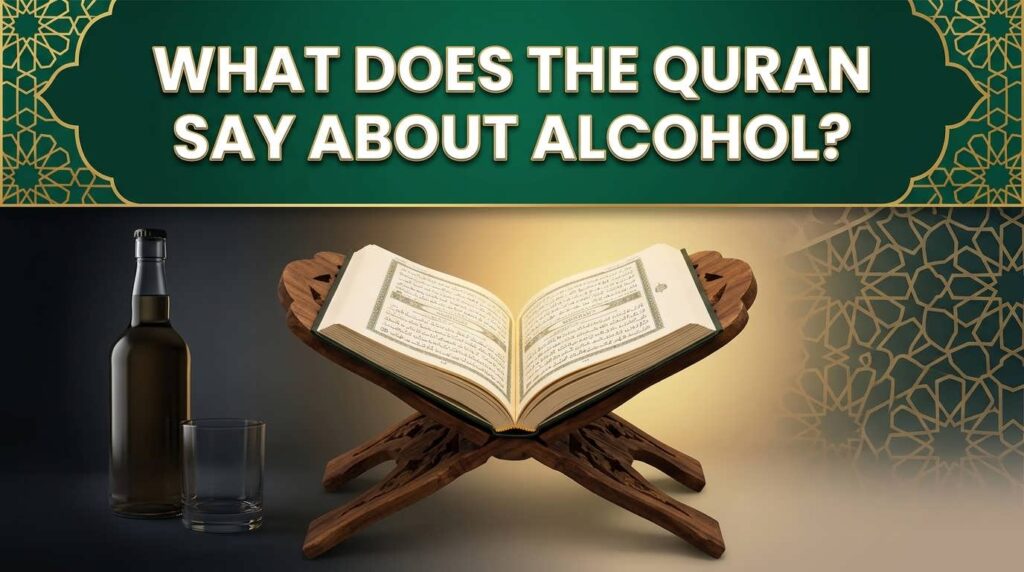
If you are wondering what does the Quran say about alcohol, the Quran addresses intoxicants in several passages and gradually presents a clear Islamic position on them. The Quran acknowledges that alcohol can have some perceived benefits, but it also explains that its sin and harmful consequences are greater.
The Quran ultimately instructs believers to avoid intoxicants, describing them as an abomination from the work of Satan and calling on believers to stay away from them.
Understanding the Quranic guidance about alcohol is important because the subject is not presented through one isolated verse. The relevant verses show a progression from acknowledging the subject to clearly instructing believers to avoid intoxicants.
- What Does the Quran Say About Alcohol?
- 7 Important Quranic Teachings About Alcohol
- Is Alcohol Completely Forbidden in Islam?
- Does the Quran Mention Wine in Paradise?
- Is Alcohol Mentioned as a Punishment?
- Why Does Islam Prohibit Alcohol?
- Does the Quran Say All Alcohol Is the Same?
- What About Small Amounts of Alcohol?
- What If Someone Drank Alcohol Before Becoming Muslim?
- What If a Muslim Has an Alcohol Addiction?
- Does the Quran Mention the Health Effects of Alcohol?
- What Can Muslims Learn From the Quranic Prohibition of Alcohol?
- Is Drinking Alcohol a Major Sin in Islam?
- What Does the Quran Say About Repentance?
- How Should Parents Explain Alcohol to Muslim Children?
- How Should Someone Research Islamic Teachings About Alcohol?
- What Does the Quran Say About Alcohol? A Simple Summary
- Conclusion
- Frequently Asked Questions
What Does the Quran Say About Alcohol?
The Quran uses the Arabic term khamr in its discussion of intoxicants.
In Surah Al-Baqarah 2:219, Allah says that intoxicants and gambling contain some benefit for people, but their sin is greater than their benefit. You can read the verse in context on Quran.com.
Later, Surah An-Nisa 4:43 instructs believers not to approach prayer while intoxicated until they know what they are saying. This verse addresses the effect of intoxication on a person’s ability to perform an important act of worship. (Quran.com)
Then Surah Al-Ma’idah 5:90 gives a much clearer command, describing intoxicants and gambling as impurity from Satan’s work and instructing believers to avoid them. (Quran.com)
The following verse explains another reason for this command: intoxicants and gambling can create hostility, resentment, and barriers to remembering Allah and prayer. (Quran.com)
7 Important Quranic Teachings About Alcohol
1. The Quran Recognizes That Alcohol Can Have Perceived Benefits
One of the first important passages about alcohol appears in Surah Al-Baqarah 2:219.
The verse asks about intoxicants and gambling and explains that they contain some benefit for people, but that their sin is greater than their benefit. (Quran.com)
This is important because the Quran does not pretend that intoxicants have no perceived worldly benefits.
Alcohol can have economic value for producers and sellers, and some people may perceive temporary social or recreational benefits.
The Quran instead directs attention to the larger consequences.
The verse establishes a principle: the existence of some benefit does not make something acceptable when its harm and sin outweigh those benefits.
2. Intoxication Can Interfere With Prayer
The Quran later addresses intoxication in relation to prayer.
Surah An-Nisa 4:43 tells believers not to approach prayer while intoxicated until they know what they are saying. (Quran.com)
This highlights an important concern.
Prayer requires awareness and conscious participation.
A person who is intoxicated may have difficulty understanding their words, maintaining concentration, or performing worship properly.
The verse therefore makes the connection between intoxication and impaired religious responsibility particularly clear.
3. The Quran Calls Believers to Avoid Intoxicants
The clearest Quranic instruction appears in Surah Al-Ma’idah 5:90.
The verse mentions intoxicants and gambling alongside practices such as idols and divining arrows and describes them as impurity from Satan’s work.
Believers are then told to avoid them so that they may succeed. (Quran.com)
The wording is significant.
The instruction is not merely to drink less.
The verse tells believers to avoid intoxicants.
This is the foundation for the Islamic prohibition of alcohol.
4. Alcohol Can Become a Source of Conflict
The Quran also explains why believers should stay away from intoxicants.
Surah Al-Ma’idah 5:91 states that Satan seeks to create hostility and hatred between people through intoxicants and gambling. (Quran.com)
Alcohol can affect judgment and behavior.
A person who is intoxicated may say or do things they would not normally do.
Arguments can escalate.
Relationships can suffer.
Family responsibilities can be neglected.
The Quran therefore connects intoxicants with broader social and spiritual consequences.
5. Alcohol Can Distract People From the Remembrance of Allah
The same passage asks whether intoxicants and gambling will prevent people from remembering Allah and from prayer. (Quran.com)
This is an important part of the Quranic reasoning.
Islam places great importance on dhikr, or remembering Allah.
Anything that regularly interferes with a person’s awareness of Allah and commitment to worship can become spiritually damaging.
The issue is therefore not only what alcohol does to the body.
It can also affect a person’s relationship with worship and spiritual responsibility.
6. The Quran Connects Avoiding Alcohol With Success
Surah Al-Ma’idah 5:90 concludes the command to avoid intoxicants by connecting avoidance with success. (Quran.com)
This gives the prohibition a positive purpose.
Islamic teachings do not simply tell Muslims what they cannot consume.
They also aim to protect faith, reason, relationships, responsibilities, and wellbeing.
Avoiding intoxicants is therefore presented as part of a path toward success rather than simply as a restriction.
7. The Quran’s Guidance Developed Through Stages
The Quranic discussion of alcohol is also notable because the guidance appears in stages.
First, Surah Al-Baqarah 2:219 explains that intoxicants have some benefit but that their sin is greater.
Then Surah An-Nisa 4:43 addresses intoxication during prayer.
Finally, Surah Al-Ma’idah 5:90-91 gives the instruction to avoid intoxicants and explains their potential spiritual and social harms. (Quran.com)
This progression is important for understanding the Quranic approach to certain social practices.
Is Alcohol Completely Forbidden in Islam?
Yes.
The mainstream Islamic understanding is that intoxicating alcoholic beverages are prohibited.
The clearest Quranic command is found in Surah Al-Ma’idah 5:90, where believers are instructed to avoid intoxicants. (Quran.com)
The prohibition is also reinforced by the teachings of Prophet Muhammad ﷺ.
The Sunnah provides additional explanations about intoxicants and their consumption.
For those studying the subject further, Sunnah.com provides access to major collections of hadith in English and Arabic.
Does the Quran Mention Wine in Paradise?
Yes, the Quran mentions wine or drink in descriptions of Paradise.
This can sometimes confuse people.
The Quran describes rivers of wine in Paradise in Surah Muhammad 47:15. (Quran.com)
However, the Quran distinguishes the drink of Paradise from intoxicants in the worldly sense.
The descriptions of Paradise do not mean that Muslims are permitted to consume intoxicating alcohol in this world.
The Quran’s earthly prohibition and its descriptions of Paradise belong to different contexts.
Is Alcohol Mentioned as a Punishment?
The Quran does not present worldly punishment for drinking alcohol in the same straightforward way that it presents the prohibition itself.
This distinction matters.
The Quran establishes the prohibition and explains reasons related to harm, conflict, worship, and spiritual responsibility.
Questions about specific legal punishments require looking beyond a single Quran verse and considering Islamic jurisprudence and the Sunnah.
Therefore, it is better not to claim that the Quran itself specifies a particular worldly punishment for drinking alcohol.
Why Does Islam Prohibit Alcohol?
The Quran gives several reasons that help explain the wisdom behind avoiding intoxicants.
Protecting the Mind
Intoxication can impair judgment and awareness.
Islam places importance on responsible decision-making and accountability.
Protecting Worship
Intoxication can interfere with prayer and remembrance of Allah.
Protecting Relationships
The Quran warns about hostility and hatred associated with intoxicants and gambling.
Protecting Society
Impaired judgment can contribute to accidents, conflict, irresponsible behavior, and other social problems.
Protecting Spiritual Awareness
The Quran specifically warns that intoxicants can become a barrier between people and the remembrance of Allah.
The prohibition can therefore be understood within Islam’s broader emphasis on protecting faith, reason, relationships, and responsible conduct.
Does the Quran Say All Alcohol Is the Same?
The Quran’s prohibition centers on khamr, commonly translated as intoxicants or wine.
Classical Islamic scholarship discusses the broader application of the prohibition to intoxicating substances.
The important principle is that the Islamic prohibition is not limited simply to one historical type of beverage.
Islamic teachings about intoxicants are understood broadly in relation to substances that intoxicate.
For detailed legal questions, Muslims should consult qualified Islamic scholars rather than relying on a single online article.
What About Small Amounts of Alcohol?
The Quran does not create a general exception saying that a small amount of an intoxicating drink is permissible.
The final Quranic command is to avoid intoxicants. (Quran.com)
The Sunnah also contains teachings that are commonly used by Islamic scholars when discussing intoxicants and small quantities.
For this reason, Muslims should not assume that a small amount automatically becomes permissible.
What If Someone Drank Alcohol Before Becoming Muslim?
Islam teaches that a person who sincerely accepts Islam begins a new life of faith.
Someone who converts to Islam is not expected to remain trapped by their past.
Allah’s mercy and forgiveness are central themes in the Quran.
Surah Az-Zumar 39:53 gives believers a powerful reminder not to despair of Allah’s mercy. (Quran.com)
This verse can provide hope to anyone who is sincerely turning toward Allah.
If you are interested in learning more about the process of becoming Muslim, our guide on how to convert to Islam explains the basic steps.
What If a Muslim Has an Alcohol Addiction?
Alcohol dependency can be difficult to overcome.
Someone struggling with alcohol should not assume that repeated failure means they should stop trying to return to Allah.
Repentance remains important.
A person can seek Allah’s forgiveness while also taking practical steps to leave the harmful behavior.
This can include:
- Avoiding situations that encourage drinking
- Removing alcohol from the home
- Seeking support from trustworthy people
- Speaking with a qualified professional when necessary
- Strengthening prayer and Quran study
- Making sincere Tawbah
- Taking recovery one step at a time
Religious guidance and appropriate professional support can work together.
Does the Quran Mention the Health Effects of Alcohol?
The Quran does not present alcohol as a modern medical textbook would.
Its focus is primarily spiritual, moral, social, and behavioral.
The Quran explains that intoxicants have harms that outweigh their benefits and later instructs believers to avoid them.
Modern research can provide additional information about the physical and psychological effects of alcohol, but those medical findings should not be presented as if they were explicitly stated in the Quran.
This distinction is important when discussing Islam and science.
What Can Muslims Learn From the Quranic Prohibition of Alcohol?
The Quranic guidance about alcohol contains broader lessons beyond the specific prohibition.
Think About Consequences
Something can offer a short-term benefit while producing greater long-term harm.
Protect Your Mind
Clear judgment is valuable for faith, family, work, and personal responsibility.
Avoid Harmful Habits Early
A person should not wait until a habit becomes destructive before taking it seriously.
Protect Your Relationship With Allah
The Quran connects intoxicants with being distracted from remembrance and prayer.
Take Islamic Guidance Seriously
The final instruction regarding intoxicants is to avoid them.
Is Drinking Alcohol a Major Sin in Islam?
Yes. Consuming intoxicants is traditionally understood by Muslim scholars as a major sin.
The Quran’s command to avoid intoxicants in Surah Al-Ma’idah 5:90 is clear, while the following verse explains some of the spiritual and social harms associated with them. (Quran.com)
At the same time, committing a major sin does not mean a person is beyond Allah’s mercy.
Islam strongly emphasizes repentance.
A Muslim who sincerely repents should not give up hope in Allah’s forgiveness.
What Does the Quran Say About Repentance?
The Quran repeatedly encourages people to turn back to Allah.
One of the most hopeful passages is Surah Az-Zumar 39:53, where Allah tells His servants not to despair of His mercy. (Quran.com)
This principle is important when discussing alcohol because prohibition and repentance should not be separated.
Islam does not tell someone who has made mistakes that they have no path back.
The person should stop the wrongdoing, sincerely regret it, seek Allah’s forgiveness, and make a genuine effort not to return to it.
How Should Parents Explain Alcohol to Muslim Children?
Parents do not need to make the subject frightening or overly complicated.
They can explain that Islam prohibits intoxicants because they can harm a person’s judgment, relationships, worship, and responsibilities.
As children grow older, parents can introduce more detail.
The focus should be on understanding the wisdom behind Islamic guidance rather than simply saying:
“Because Islam says so.”
Children benefit when they understand that Islamic teachings are connected with protecting faith, character, health, family, and society.
How Should Someone Research Islamic Teachings About Alcohol?
Start with the Quranic passages themselves.
The most relevant passages include:
- Surah Al-Baqarah 2:219
- Surah An-Nisa 4:43
- Surah Al-Ma’idah 5:90
- Surah Al-Ma’idah 5:91
Read the verses in context rather than relying only on isolated quotations.
Then study reliable explanations from recognized scholars.
The Quran should remain the primary reference for understanding what the Quran itself says.
For additional information about Prophetic teachings, Sunnah.com can be used as a searchable resource for hadith collections.
What Does the Quran Say About Alcohol? A Simple Summary
The Quran’s guidance can be summarized in a few points:
- Intoxicants can have perceived benefits, but their sin and harm are greater.
- Intoxication can interfere with prayer and awareness.
- Believers are ultimately instructed to avoid intoxicants.
- Alcohol can contribute to hostility and conflict.
- Intoxicants can distract people from remembering Allah.
- Avoiding them is connected with success.
- Islam also provides a path of repentance for people who have committed sins.
Understanding this progression helps explain the Islamic position more accurately than simply saying that “the Quran says alcohol is forbidden.”
Conclusion
So, what does the Quran say about alcohol?
The Quran addresses intoxicants through several stages of guidance. It first explains that intoxicants may contain some benefit but that their sin is greater. It then addresses intoxication in relation to prayer before giving a clear instruction for believers to avoid intoxicants.
The final Quranic guidance connects intoxicants with spiritual and social harms, including conflict and being distracted from the remembrance of Allah and prayer.
For Muslims, the prohibition of alcohol is therefore not simply about a particular beverage. It is connected with broader Islamic principles of protecting faith, clear judgment, worship, relationships, and responsible behavior.
At the same time, Islam does not close the door of repentance for someone who has made mistakes.
The Quran repeatedly reminds believers of Allah’s mercy and encourages them to return to Him.
Understanding these teachings through the Quran itself, reliable explanations, and authentic Prophetic teachings allows Muslims and those interested in Islam to approach the subject with greater clarity and context.
Frequently Asked Questions
What does the Quran say about alcohol?
The Quran acknowledges that intoxicants can have some benefits but states that their sin is greater. It later instructs believers to avoid intoxicants and explains that they can cause hostility and distract people from remembering Allah and prayer.
Which Quran verse prohibits alcohol?
Surah Al-Ma’idah 5:90 is the clearest Quranic verse instructing believers to avoid intoxicants. The following verse, 5:91, explains some of their harmful effects. (Quran.com)
Is alcohol completely forbidden in Islam?
Yes. The mainstream Islamic understanding is that intoxicating alcoholic beverages are prohibited.
Did the Quran prohibit alcohol gradually?
Yes. The Quranic passages concerning intoxicants show a progression, beginning with a discussion of their harms and benefits, followed by guidance concerning intoxication during prayer, and finally the command to avoid intoxicants.
Does the Quran say alcohol has any benefits?
Surah Al-Baqarah 2:219 acknowledges that intoxicants have some benefit for people but states that their sin is greater than their benefit. (Quran.com)
Why does Islam prohibit alcohol?
The Quran connects intoxicants with harm, hostility, distraction from remembering Allah, and interference with prayer. These concerns form part of the broader Islamic approach to avoiding intoxicants.
Does the Quran mention wine in Paradise?
Yes. The Quran describes rivers of wine among the blessings of Paradise, including in Surah Muhammad 47:15. These descriptions refer to the Hereafter and should not be confused with the prohibition of intoxicants in worldly life. (Quran.com)
What if someone wants to stop drinking alcohol?
They can begin by sincerely turning to Allah, removing access to alcohol, avoiding situations that encourage drinking, seeking trustworthy support, and obtaining appropriate professional help if dependency is involved.
Can a Muslim repent after drinking alcohol?
Yes. Islam teaches that sincere repentance is always important, and the Quran strongly emphasizes Allah’s mercy. Surah Az-Zumar 39:53 tells believers not to despair of Allah’s mercy. (Quran.com)