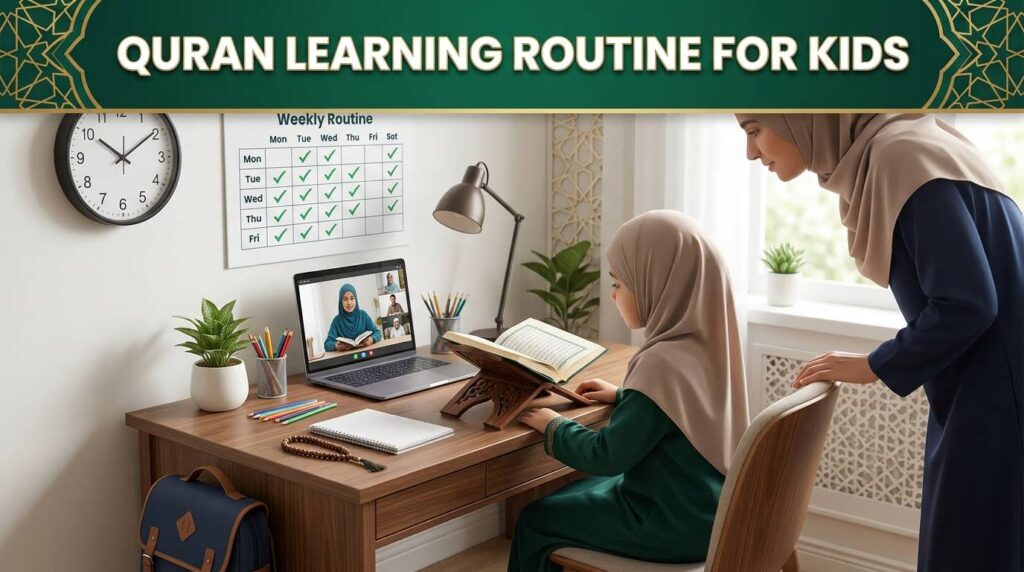
Quran classes for homeschoolers are Quran lessons designed to fit into the flexible schedules of children who are educated primarily at home.
Unlike a traditional school timetable, homeschooling often allows parents to decide when different subjects are taught. This flexibility can make it easier to include Quran learning as a regular part of the child’s education.
Depending on the child’s age and current ability, Quran classes may include:
- Arabic letters
- Noorani Qaida
- Quran reading
- Tajweed
- Quran memorization
- Translation
- Basic Islamic studies
Online Quran classes can be especially convenient because the child can learn from home without adding travel time to an already home-based education routine.
- Why Are Quran Classes Important for Homeschoolers?
- How Can Quran Classes Fit Into a Homeschool Schedule?
- Should Quran Be Taught Before or After Academic Subjects?
- Can Homeschoolers Take Online Quran Classes?
- What Can Homeschoolers Learn in Quran Classes?
- Are Quran Classes Suitable for Homeschool Beginners?
- Can Homeschoolers Learn Tajweed Online?
- Can Homeschoolers Study Hifz?
- How Much Time Should a Homeschooler Spend Learning Quran?
- Can Quran Classes Become Part of a Homeschool Curriculum?
- Should Quran Learning Be Considered a School Subject?
- How Do Online Quran Classes Work for Homeschoolers?
- What Are the Benefits of One-on-One Quran Classes for Homeschoolers?
- Can Siblings Learn Quran Together?
- Can Homeschoolers Learn Quran From a Female Teacher?
- How Can Parents Keep Quran Learning From Becoming Boring?
- How Can Parents Monitor Quran Progress?
- Should Parents Teach Quran Themselves?
- How Can Homeschool Parents Balance Quran and Other Subjects?
- Can Homeschoolers Take Quran Classes in the Morning?
- Can Homeschoolers Take Quran Classes in the Afternoon?
- Can Homeschoolers Take Quran Classes in the Evening?
- What Technology Is Needed?
- How Can Parents Create a Good Quran Learning Space?
- Can Homeschool Quran Classes Work for Children With Different Learning Speeds?
- How Can Quran Classes Support a Child's Homeschool Routine?
- What If a Homeschooler Misses a Quran Class?
- How Can Parents Help Children Practice Between Classes?
- What If a Child Is Forgetting Memorized Quran?
- Can Homeschoolers Use Quran Apps Alongside Classes?
- How Can Older Homeschoolers Study Quran More Deeply?
- What Should Parents Look for in an Online Quran Academy?
- How Many Days Should a Homeschooler Take Quran Classes?
- Can Quran Classes Be Integrated With Islamic Studies?
- How Can Parents Make Quran Learning a Long-Term Habit?
- Start With a Quran Trial Class
- Final Thoughts
- Frequently Asked Questions
Why Are Quran Classes Important for Homeschoolers?
Homeschooling gives parents greater control over their child’s education, but that does not necessarily mean parents need to teach every subject themselves.
Quran learning is one area where many families may prefer guidance from a qualified teacher.
A teacher can listen to the child’s recitation, identify pronunciation mistakes, explain Tajweed rules, and adjust lessons according to the student’s level.
This can complement the academic education the child receives at home.
Rather than treating Quran as an occasional activity, families can make it a consistent part of the homeschool schedule.
How Can Quran Classes Fit Into a Homeschool Schedule?
One of the biggest advantages of homeschooling is flexibility.
A family might schedule Quran lessons:
- Early in the morning
- Before academic subjects
- Between school subjects
- Around lunchtime
- In the afternoon
- In the evening
For example:
9:00 AM: Quran reading and Tajweed
10:00 AM: Mathematics
11:00 AM: Science
1:00 PM: Language studies
The exact schedule will depend on the family’s routine.
The important point is that Quran learning can be deliberately included rather than being postponed until the child has “free time.”
Should Quran Be Taught Before or After Academic Subjects?
There is no single correct answer.
Some children concentrate better early in the day.
Others become more engaged after completing their academic work.
Parents can experiment with different times and observe when the child learns best.
If Quran is scheduled immediately after a difficult academic subject, the child may be mentally tired.
On the other hand, starting the day with Quran may help establish a consistent routine.
Choose the time that matches your child’s energy and attention span.
Can Homeschoolers Take Online Quran Classes?
Yes.
Online learning can be particularly suitable for homeschool families because the child is already accustomed to learning at home.
The student can attend a live class using:
- Laptop
- Desktop computer
- Tablet
- Smartphone
The teacher can conduct the lesson remotely while the child remains in their normal learning environment.
This eliminates the need for parents to drive to a Quran academy.
What Can Homeschoolers Learn in Quran Classes?
A homeschool Quran program can be customized according to the child’s needs.
Noorani Qaida
Beginners can start by learning Arabic letters, pronunciation, and basic reading rules.
Quran Reading
Students can gradually develop fluency and accuracy.
Tajweed
Students can learn the rules needed for correct Quran recitation.
Hifz
Children interested in memorization can work through a structured Hifz program.
Translation
Older students can begin learning the meanings of Quranic verses.
Islamic Studies
Quran learning can also be supplemented with foundational Islamic knowledge.
The exact combination should depend on the child’s age, level, and goals.
Are Quran Classes Suitable for Homeschool Beginners?
Absolutely.
A child does not need to know how to read Quran before joining.
A beginner can start with the fundamentals:
Arabic letters → Harakat → Joined letters → Noorani Qaida → Quran reading → Tajweed
Parents should avoid comparing a beginner with children who have already been studying Quran for several years.
Each student should progress at an appropriate pace.
Families can also read our guide on how to learn Quran from zero for a clearer understanding of the beginner journey.
Can Homeschoolers Learn Tajweed Online?
Yes.
Once a child has developed basic Quran reading skills, Tajweed can become an important part of their learning.
A teacher can help the student work on:
- Makharij
- Letter characteristics
- Madd
- Qalqalah
- Noon Sakinah
- Tanween
- Meem Sakinah
- Rules of stopping
- Correct pronunciation
Online one-to-one lessons can be useful because the teacher can listen closely to the child’s recitation.
For additional practice guidance, parents can also explore how to improve Tajweed.
Can Homeschoolers Study Hifz?
Yes.
Homeschooling can sometimes provide additional flexibility for Quran memorization.
Parents may be able to organize academic subjects around the child’s memorization schedule.
However, Hifz requires more than attending a live lesson.
The child also needs regular revision.
A typical routine might include:
Teacher session: New memorization
Daily practice: Repeat the new portion
Revision: Review previously memorized portions
Next lesson: Teacher listens and corrects
The exact workload should be appropriate for the child’s age.
How Much Time Should a Homeschooler Spend Learning Quran?
There is no universal number of minutes.
A younger child may benefit from shorter, focused lessons.
An older student may be able to manage longer sessions.
The schedule should consider:
- Age
- Attention span
- Quran level
- Memorization goals
- Academic workload
- Family routine
A shorter lesson that the child attends consistently can be more beneficial than a long lesson that becomes exhausting.
Can Quran Classes Become Part of a Homeschool Curriculum?
Yes.
Parents can treat Quran learning as a regular component of the child’s weekly education.
For example:
| Subject | Possible Frequency |
|---|---|
| Quran Reading | 3–5 days |
| Tajweed | 2–3 days |
| Hifz | Daily revision |
| Mathematics | Several days |
| Science | Several days |
| Language | Several days |
| Islamic Studies | 1–3 days |
The exact structure is entirely flexible.
Some families may want Quran every school day, while others may prefer fewer teacher-led lessons combined with independent practice.
Should Quran Learning Be Considered a School Subject?
For many Muslim homeschooling families, Quran learning can naturally become one of the core areas of their child’s education.
However, it does not have to feel identical to mathematics, science, or language studies.
Quran learning can involve:
- Reading
- Listening
- Memorization
- Recitation
- Reflection
- Understanding
- Practical application
This makes it possible to create a learning experience that is both structured and meaningful.
How Do Online Quran Classes Work for Homeschoolers?
A typical lesson may follow a simple process.
Step 1: Student Joins the Class
The child connects from home using a suitable device.
Step 2: Teacher Reviews Previous Work
The teacher checks what the student practiced.
Step 3: Student Recites
The child reads or recites the assigned material.
Step 4: Teacher Corrects Mistakes
The teacher identifies pronunciation or Tajweed problems.
Step 5: New Material Is Introduced
The student learns the next lesson.
Step 6: Practice Is Assigned
The teacher explains what should be reviewed before the next class.
This gives parents a clear structure without requiring them to become Quran instructors themselves.
What Are the Benefits of One-on-One Quran Classes for Homeschoolers?
One-on-one lessons can provide focused attention.
The teacher can adjust the lesson based on the child’s:
- Reading ability
- Pronunciation
- Learning speed
- Age
- Memorization progress
- Strengths
- Weaknesses
This can be particularly useful when a child has a different learning pace from their siblings or peers.
Group classes may also be appropriate for some children, but parents should consider whether each student receives sufficient opportunity to read and interact with the teacher.
Can Siblings Learn Quran Together?
They can, but it depends on their levels.
If siblings have similar abilities, a small group lesson may work well.
If one child is a beginner while another is already reading fluently, separate classes may be more effective.
The teacher should be able to give each student appropriate material rather than teaching everyone at the same level.
Can Homeschoolers Learn Quran From a Female Teacher?
Yes.
Families who prefer female Quran instruction can look for a qualified female teacher who has experience teaching children.
The teacher should ideally have:
- Strong Quran reading skills
- Tajweed knowledge
- Teaching experience
- Patience
- Good communication
- Experience working with children
Parents can learn more about what to look for in qualified female Quran teachers.
How Can Parents Keep Quran Learning From Becoming Boring?
Children learn differently.
A Quran lesson should not feel like endless repetition without explanation or interaction.
Parents and teachers can keep children engaged by:
- Setting achievable goals
- Celebrating genuine progress
- Varying practice activities
- Asking questions
- Allowing the child to read aloud
- Reviewing previously learned material
- Connecting lessons with everyday life
The teacher’s approach also matters.
A patient and encouraging teacher can make a significant difference.
Parents can find additional strategies in how to motivate kids to learn Quran.
How Can Parents Monitor Quran Progress?
Homeschool parents are often closely involved in their child’s education, so progress tracking can become part of the overall routine.
Parents can keep track of:
- Lessons completed
- Surahs read
- Tajweed rules learned
- Memorized portions
- Common pronunciation mistakes
- Areas needing revision
The teacher should also provide feedback.
Parents do not need to test the child every day.
A simple weekly or monthly progress review can be enough to identify whether the child is moving forward.
Should Parents Teach Quran Themselves?
Some parents may have strong Quran reading and Tajweed skills and may be comfortable teaching their children.
Others may prefer professional instruction.
There is no requirement that homeschooling parents personally teach every subject.
A qualified Quran teacher can provide specialized guidance while parents continue managing the child’s broader education.
This can be especially useful for Tajweed and pronunciation, where direct listening and correction are important.
How Can Homeschool Parents Balance Quran and Other Subjects?
The key is realistic scheduling.
Avoid filling every hour of the child’s day.
A balanced homeschool routine should include:
- Academic learning
- Quran education
- Breaks
- Physical activity
- Family time
- Independent reading
- Rest
Quran should become part of the routine without creating unnecessary pressure.
Can Homeschoolers Take Quran Classes in the Morning?
Yes.
Morning classes can work particularly well for children who have strong concentration early in the day.
A family might begin with Quran before moving into mathematics or other academic subjects.
This can also help prevent Quran lessons from being repeatedly pushed aside when the afternoon becomes busy.
Can Homeschoolers Take Quran Classes in the Afternoon?
Yes.
Afternoon lessons can work for families who prefer to complete academic subjects first.
However, parents should observe the child’s energy level.
If the child becomes tired after several hours of study, a short break before Quran class may be helpful.
Can Homeschoolers Take Quran Classes in the Evening?
Yes.
Evening classes can work when the family prefers Quran learning after the main academic schedule.
However, parents should avoid scheduling the class too close to bedtime if the child is likely to become tired.
The best time is the one that allows the student to remain attentive.
What Technology Is Needed?
The technology requirements are usually simple.
A homeschool Quran student generally needs:
- Laptop, tablet, or smartphone
- Reliable internet connection
- Headphones if necessary
- Quran or Noorani Qaida
- Quiet study area
A larger screen may be more comfortable for younger children because Quranic text can be easier to see.
Parents should test the audio and video before the first class.
How Can Parents Create a Good Quran Learning Space?
The learning environment can influence concentration.
Create a space that is:
- Quiet
- Well-lit
- Comfortable
- Free from unnecessary distractions
- Equipped with the required materials
Keep the Quran, Qaida, notebook, and other learning materials nearby.
The child should not have to leave the lesson repeatedly to find something.
Can Homeschool Quran Classes Work for Children With Different Learning Speeds?
Yes.
One advantage of individualized online learning is that lessons can be adjusted to the student.
A child who needs additional practice can spend more time on a specific concept.
A child who progresses quickly can move forward without waiting for an entire group.
The teacher should assess the child regularly and adjust the lesson accordingly.
How Can Quran Classes Support a Child’s Homeschool Routine?
A Quran class can become a fixed anchor in the weekly schedule.
For example:
Monday: Quran reading
Tuesday: Tajweed
Wednesday: Quran reading
Thursday: Hifz and revision
Friday: Quran review
This creates structure without making the entire homeschool schedule rigid.
The exact routine should be customized according to the child’s needs.
What If a Homeschooler Misses a Quran Class?
Occasional absences are normal.
If a child misses a class, parents should:
- Inform the teacher.
- Ask what material was covered.
- Review the assigned material.
- Continue from the correct point.
If missed classes become frequent, reconsider whether the scheduled time fits the homeschool routine.
How Can Parents Help Children Practice Between Classes?
Parents do not need to conduct another full lesson.
They can simply encourage short practice sessions.
For example:
- Read the assigned passage together.
- Ask the child to repeat difficult words.
- Listen to their recitation.
- Review recently learned Tajweed rules.
- Encourage memorization revision.
The goal is reinforcement rather than replacing the teacher.
What If a Child Is Forgetting Memorized Quran?
Forgetting can happen when memorized portions are not revised regularly.
Hifz should therefore include a clear revision system.
A child may need to review:
- New memorization
- Recent memorization
- Older memorized portions
The teacher can help establish an appropriate revision schedule.
Parents who want to understand this issue further can read why people forget their Hifz.
Can Homeschoolers Use Quran Apps Alongside Classes?
Yes.
Digital Quran resources can be useful for independent reading, listening, and revision.
For example, Quran.com provides access to Quran text, translations, and recitations that students can use for supplementary practice.
However, digital resources should complement teacher instruction rather than replace personalized correction.
How Can Older Homeschoolers Study Quran More Deeply?
Older students can gradually move beyond basic reading.
Depending on their ability, they may study:
- Tajweed
- Translation
- Vocabulary
- Tafsir
- Hifz
- Quranic Arabic
- Thematic Quran study
The goal should be age-appropriate progression.
A child who has mastered basic reading should not remain at the same level simply because the curriculum has not been updated.
What Should Parents Look for in an Online Quran Academy?
Before choosing a program, ask:
- Are teachers qualified?
- Are classes live?
- Are lessons one-on-one or group-based?
- Is the curriculum structured?
- Can the schedule fit homeschooling?
- How is progress monitored?
- How are pronunciation mistakes corrected?
- Are teachers experienced with children?
- Are female teachers available if preferred?
- Is there a trial class?
Parents should also consider whether the academy understands the flexibility required by homeschooling families.
How Many Days Should a Homeschooler Take Quran Classes?
It depends on the child’s goals.
For basic reading, a few teacher-led lessons per week may work well.
For Tajweed improvement, more frequent practice can be beneficial.
For Hifz, regular memorization and revision are especially important.
A practical schedule could include two to five teacher-led sessions per week combined with independent practice.
The exact frequency should be based on age, goals, and attention span.
Can Quran Classes Be Integrated With Islamic Studies?
Yes.
Quran learning can naturally connect with Islamic studies.
For example, after reading a Surah, an older student may explore:
- Its main themes
- Historical context
- Key vocabulary
- Lessons and values
- Practical applications
This can help children see Quran learning as more than simply reading Arabic words.
How Can Parents Make Quran Learning a Long-Term Habit?
Start small and stay consistent.
Instead of setting unrealistic daily targets, establish a routine the child can maintain.
For example:
Regular lesson → short home practice → revision → next lesson
Over time, this can become a natural part of the child’s education.
Consistency is often more sustainable than trying to make every lesson intensive.
Start With a Quran Trial Class
Before committing to a regular program, a trial class can help parents and children understand whether the teacher and learning approach are a good fit.
During the trial, look at:
- The teacher’s communication style.
- How the child’s level is assessed.
- Whether mistakes are corrected clearly.
- Whether the child remains engaged.
- Whether the class fits the homeschool routine.
- Whether the learning plan seems appropriate.
Families can book a Quran trial class and evaluate the experience before choosing a regular schedule.
Final Thoughts
Quran classes for homeschoolers can provide a structured way to include Quran education within a flexible home-based learning routine.
The biggest advantage is not simply convenience.
It is the ability to build Quran learning around the child’s individual needs.
A homeschool family can choose a suitable time, learning frequency, teacher, and curriculum without having to work around a traditional school timetable.
Whether a child is starting with Noorani Qaida, improving Tajweed, reading Quran, or beginning Hifz, a qualified teacher can provide guidance while parents continue managing the child’s overall education.
The most effective approach is one that balances Quran learning with academic subjects, rest, family life, and the child’s individual pace.
Start at the right level.
Choose a realistic schedule.
Practice consistently.
And make Quran learning a meaningful part of the child’s everyday education.
Frequently Asked Questions
What are Quran classes for homeschoolers?
They are Quran lessons designed to fit the flexible schedules of children who are educated at home.
Can homeschoolers take Quran classes online?
Yes. Online classes allow homeschool students to learn Quran from home with a live teacher.
Can beginners join Quran classes for homeschoolers?
Yes. Complete beginners can start with Arabic letters, Noorani Qaida, pronunciation, and basic Quran reading.
Can homeschoolers learn Tajweed online?
Yes. A qualified teacher can teach and correct Tajweed during live online lessons.
Can homeschoolers memorize Quran?
Yes. Homeschooling may provide additional scheduling flexibility for Hifz, although regular revision remains essential.
How often should a homeschooler take Quran classes?
The ideal frequency depends on age, level, and goals. Two to five teacher-led sessions per week may work for many students, with independent practice between lessons.
Can siblings learn Quran together?
Yes, if their levels are reasonably similar. Children with significantly different abilities may benefit from separate lessons.
Can girls learn Quran from a female teacher?
Yes. Families can choose a qualified female Quran teacher if that is their preference.
What equipment does a homeschooler need for online Quran classes?
A laptop, tablet, or smartphone, stable internet, Quran or learning material, and a quiet learning space are generally sufficient.
Can Quran classes be included in a homeschool curriculum?
Yes. Parents can schedule Quran reading, Tajweed, Hifz, and Islamic studies alongside academic subjects.
Should Quran be taught in the morning or afternoon?
Either can work. The best time is when the child is alert and able to concentrate.
Can homeschoolers take evening Quran classes?
Yes. Evening lessons can be suitable if the child is not too tired after the day’s activities.
How can parents monitor Quran progress?
Parents can track lessons, reading improvement, memorization, Tajweed development, and teacher feedback.
Should homeschool parents teach Quran themselves?
They can if they have the necessary knowledge and teaching ability, but they can also use a qualified Quran teacher for specialized instruction.
Can Quran apps replace an online Quran teacher?
Apps can support reading and revision, but they do not replace personalized teacher feedback and pronunciation correction.
What if my child forgets Hifz?
Regular revision is essential. The teacher should establish a revision routine that includes both recent and older memorized portions.
How can parents motivate children to learn Quran?
Positive encouragement, achievable goals, consistent routines, and an engaging teacher can help children stay motivated.
Can homeschoolers take a Quran trial class?
Yes. A trial class allows parents and children to evaluate the teacher, learning style, and suitability of the program before enrolling.