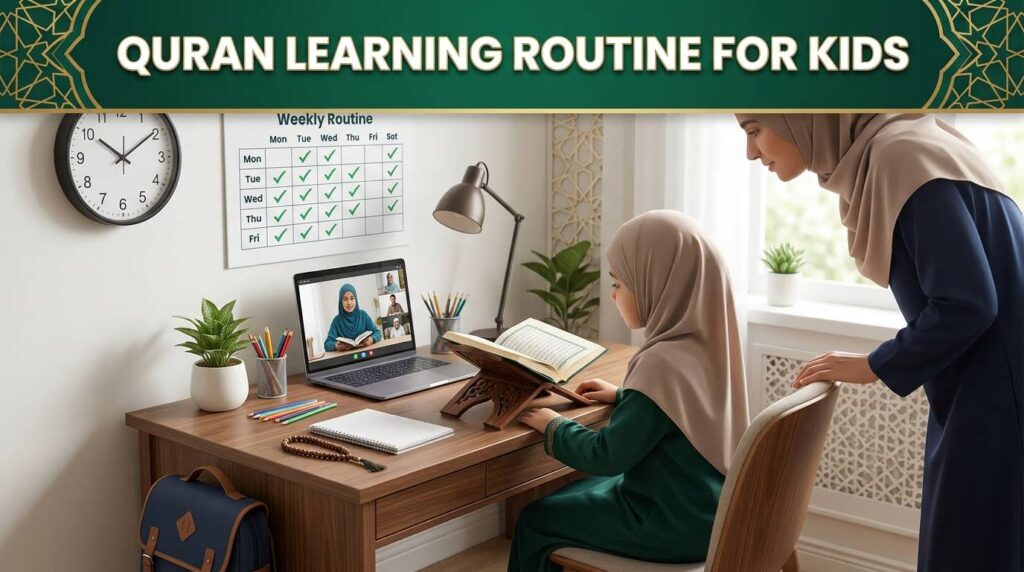
Family Quran classes online are Quran lessons designed to help multiple members of a family learn Quran through an online learning program.
Instead of each family member having to travel to a separate Quran academy, parents and children can learn from home with a qualified online Quran teacher.
Depending on the family’s needs, lessons may include:
- Quran reading
- Noorani Qaida
- Tajweed
- Quran memorization
- Quran translation
- Basic Islamic studies
- Recitation improvement
Some families may prefer individual lessons for each person, while others may choose a shared lesson when family members have similar learning levels.
The goal is to make Quran learning a regular part of family life rather than something that only one member of the household studies.
- Why Choose Family Quran Classes Online?
- Can the Whole Family Learn Quran Together?
- What Are the Benefits of Learning Quran as a Family?
- Can Parents and Children Learn Quran Together?
- Is One Family Quran Class Better Than Individual Classes?
- Can Siblings Learn Quran Together?
- Can Parents Join Their Children's Quran Classes?
- What Can Families Learn Together?
- Can Beginners Join Family Quran Classes?
- Can Family Quran Classes Include Tajweed?
- Can Families Learn Quran Memorization Together?
- Why Is Hifz Revision Important for Families?
- Can Family Quran Classes Work for Busy Parents?
- How Can Families Create a Quran Routine?
- Should Families Read Quran Together Outside Class?
- Can Family Quran Classes Help Children Stay Motivated?
- Can Family Quran Classes Be Online for Different Age Groups?
- Can Families Have Female Quran Teachers?
- Can a Family Learn Quran From Home?
- What Technology Does a Family Need?
- Can Families Learn Quran Using a Smartphone?
- How Can Parents Track Family Quran Progress?
- What Should a Family Look for in an Online Quran Teacher?
- How Can Families Avoid Making Quran Learning Stressful?
- Can Family Quran Classes Work for Families Living in Different Countries?
- Can Family Quran Classes Be Scheduled in the Evening?
- Can Family Quran Classes Be Scheduled on Weekends?
- How Can Parents Practice Quran With Children?
- What If Family Members Have Different Learning Goals?
- Can Family Quran Classes Include Islamic Studies?
- Can Family Quran Learning Strengthen the Home Environment?
- What If a Family Member Is a Complete Beginner?
- Can Adults Learn Quran With Their Children?
- How Long Should Family Quran Classes Be?
- How Many Days a Week Should Families Learn Quran?
- What If Someone Misses a Family Quran Class?
- How Can Families Make Quran Learning a Long-Term Habit?
- Start With a Family Quran Trial Class
- Final Thoughts
- Frequently Asked Questions
Why Choose Family Quran Classes Online?
Learning Quran as a family can make it easier to establish a consistent routine.
When parents and children have Quran learning built into their weekly schedule, it becomes easier to encourage one another and maintain regular practice.
Online classes also remove the need for the entire family to travel to a physical academy.
This can be particularly helpful for families with:
- Multiple children
- Busy parents
- Different work schedules
- School-going children
- Long commutes
- Limited access to local Quran teachers
A family can learn from the comfort of home while receiving guidance from an online teacher.
Can the Whole Family Learn Quran Together?
Yes, but everyone does not necessarily need to study the same material.
A family may include:
- A child learning Arabic letters
- Another child learning Quran reading
- A teenager studying Tajweed
- A parent improving recitation
- Another parent working on memorization
Trying to teach everyone the same lesson in this situation may not be effective.
A better approach is to assess each learner’s level and create an appropriate learning plan.
Family Quran learning does not always mean everyone sits in the same class.
It can also mean that the entire family follows a coordinated Quran-learning routine.
What Are the Benefits of Learning Quran as a Family?
It Creates a Shared Routine
When Quran learning becomes part of the household schedule, children are more likely to see it as a normal part of daily life.
Parents Can Lead by Example
Children often learn from what they see.
When parents also make time for Quran learning, children can see that Quran education is not something only children are expected to do.
It Encourages Consistency
Family members can remind one another about lessons and revision.
It Saves Travel Time
Online classes eliminate the need for the whole family to travel to an academy.
It Can Simplify Scheduling
Families can coordinate lessons around school, work, meals, and other responsibilities.
It Can Strengthen Family Learning
Quran learning can become an activity that families discuss and practice together.
Can Parents and Children Learn Quran Together?
Yes.
However, parents and children may have different abilities.
For example, a parent may already read Quran but want to improve Tajweed, while a young child may still be learning Noorani Qaida.
In that situation, the teacher can provide different material according to each learner’s level.
The family can still share the same overall learning goal while following individual lesson plans.
Is One Family Quran Class Better Than Individual Classes?
Not necessarily.
The right format depends on the family.
Shared Family Class
A shared class can work when family members have:
- Similar levels
- Similar goals
- Compatible schedules
- Similar learning needs
Individual Classes
Separate classes may be better when learners have significantly different abilities.
For example:
Child: Noorani Qaida
Teenager: Tajweed
Father: Quran reading improvement
Mother: Hifz revision
Individual lessons allow the teacher to focus on each person’s specific needs.
Can Siblings Learn Quran Together?
Yes, especially when their levels are similar.
Siblings can benefit from learning together because they can encourage each other and practice outside class.
However, parents should not force siblings into the same class simply because they are the same age.
A younger child who is already reading fluently may need a different lesson from an older beginner.
The teacher should assess each child’s ability.
Can Parents Join Their Children’s Quran Classes?
This depends on the class structure and the teacher.
Parents can sometimes participate in shared lessons or observe children’s progress.
Even when parents do not attend the entire lesson, they can support learning by:
- Listening to recitation
- Helping with revision
- Asking what was learned
- Encouraging practice
- Maintaining the schedule
Parents do not need to become the teacher to remain involved.
What Can Families Learn Together?
Family Quran classes can cover different areas.
Quran Reading
Improve accuracy and fluency.
Noorani Qaida
Teach beginners the foundations of Arabic reading.
Tajweed
Improve pronunciation and recitation.
Hifz
Memorize and revise selected portions of the Quran.
Translation
Understand the meaning of Quranic verses.
Islamic Studies
Develop foundational Islamic knowledge alongside Quran learning.
The right curriculum depends on the family’s goals and individual levels.
Can Beginners Join Family Quran Classes?
Absolutely.
A family does not need to already know how to read Quran.
A complete beginner can start with Arabic letters and gradually progress through:
Arabic letters → Harakat → Joined letters → Noorani Qaida → Quran reading → Tajweed
This is particularly useful for families where parents want to begin learning Quran alongside their children.
If you are starting completely from scratch, read our guide on how to learn Quran from zero.
Can Family Quran Classes Include Tajweed?
Yes.
Tajweed can be taught to both children and adults according to their individual levels.
A teacher may work on:
- Makharij
- Sifaat
- Madd
- Qalqalah
- Noon Sakinah
- Tanween
- Meem Sakinah
- Rules of stopping
- Correct pronunciation
For students who already know how to read Quran, Tajweed can become an important part of continued learning.
Families can also read how to improve Tajweed for additional guidance.
Can Families Learn Quran Memorization Together?
Yes.
A family can create a shared Hifz routine even if members memorize at different speeds.
For example:
Parent: Memorizes five verses
Teenager: Memorizes ten verses
Child: Memorizes three verses
The numbers are not the important part.
The goal is consistent memorization and revision according to each person’s ability.
Parents should avoid turning family Hifz into a competition.
Each learner should progress according to their own capacity.
Why Is Hifz Revision Important for Families?
Memorization requires regular revision.
Without revision, previously memorized portions can become weak.
Families can create a simple revision routine:
New lesson → Daily practice → Recent revision → Older revision
If a family member is struggling to retain memorized portions, our article on why people forget their Hifz provides additional guidance.
Can Family Quran Classes Work for Busy Parents?
Yes.
Online classes can be scheduled around work and family responsibilities.
For example:
Children: After school
Parents: Evening
This allows different family members to participate without requiring everyone to be available at exactly the same time.
Another option is to schedule consecutive lessons:
6:00 PM: Child 1
6:30 PM: Child 2
7:00 PM: Parent
The family remains at home while everyone receives structured Quran instruction.
How Can Families Create a Quran Routine?
A simple routine is easier to maintain than an ambitious one.
For example:
Monday: Quran class
Tuesday: Individual practice
Wednesday: Quran class
Thursday: Revision
Friday: Family Quran reading
Saturday: Quran class
Sunday: Review
The schedule can be adjusted according to the family’s lifestyle.
The most important thing is consistency.
Should Families Read Quran Together Outside Class?
Yes.
Online classes provide teacher instruction, but family reading time can reinforce the habit.
A family might spend 10–20 minutes together reading Quran after dinner or at another convenient time.
The purpose is not necessarily to complete a large amount of Quran.
It is to create a regular connection with the Quran.
Can Family Quran Classes Help Children Stay Motivated?
They can.
Children may feel encouraged when they see parents and siblings learning as well.
Instead of saying:
“Go to your Quran class.”
Parents can create a household culture where everyone has their own Quran-learning goal.
For example:
- Child practices Qaida.
- Teenager revises Tajweed.
- Parent works on Quran reading.
- Family reads together.
This makes Quran learning a shared family value.
Parents can also explore how to motivate kids to learn Quran for additional practical ideas.
Can Family Quran Classes Be Online for Different Age Groups?
Yes.
An online Quran program can accommodate learners at different stages.
For example:
Young Children
Noorani Qaida and basic Quran reading.
Older Children
Quran reading and Tajweed.
Teenagers
Tajweed, Hifz, translation, and deeper study.
Adults
Quran reading, Tajweed, memorization, or learning from the beginning.
The important factor is proper level assessment.
Can Families Have Female Quran Teachers?
Yes.
Some families may prefer a female teacher for mothers, daughters, or sisters.
The important consideration is that the teacher should have suitable Quran knowledge, Tajweed skills, and teaching experience.
Families looking for female instruction can learn more about qualified female Quran teachers.
Can a Family Learn Quran From Home?
Yes.
This is one of the main advantages of online Quran education.
The family does not need to arrange transportation for every lesson.
A suitable learning area can be prepared at home with:
- Quran
- Noorani Qaida
- Notebook
- Laptop or tablet
- Stable internet
- Headphones if necessary
The learning environment should be quiet enough for the student to hear the teacher clearly.
What Technology Does a Family Need?
Online Quran classes generally require basic equipment.
You may need:
- Laptop
- Tablet
- Smartphone
- Stable internet
- Headset or headphones
- Quran or learning material
If several family members are attending separate classes, families may use different devices or schedule lessons one after another.
There is usually no need for expensive equipment.
Can Families Learn Quran Using a Smartphone?
Yes.
A smartphone can be useful for Quran reading, listening, revision, and joining online lessons.
For additional Quran reading and listening outside class, Quran.com provides Quran text, translations, recitations, and study tools.
However, the phone should be used primarily as a learning tool during the lesson.
Notifications and unrelated apps can easily become distractions.
How Can Parents Track Family Quran Progress?
Each learner should ideally have an individual progress record.
Parents can track:
- Current Quran level
- Surahs being studied
- Tajweed topics
- Memorized portions
- Revision progress
- Common mistakes
- Teacher feedback
This prevents the family from assuming that everyone is progressing at the same pace.
A simple monthly review can help identify where additional practice is needed.
What Should a Family Look for in an Online Quran Teacher?
Before choosing a teacher, consider:
- Quran reading ability
- Tajweed knowledge
- Teaching experience
- Experience with children
- Experience with adults
- Communication skills
- Patience
- Ability to correct pronunciation
- Availability
- Lesson structure
If multiple family members have different levels, the teacher should be comfortable adapting lessons rather than forcing everyone through the same material.
How Can Families Avoid Making Quran Learning Stressful?
Family learning should not become a source of constant pressure.
Avoid:
- Comparing siblings
- Setting unrealistic memorization targets
- Punishing every mistake
- Turning every family reading session into a test
- Expecting identical progress from everyone
Instead:
- Set realistic goals.
- Praise genuine improvement.
- Correct mistakes calmly.
- Allow appropriate breaks.
- Keep the routine consistent.
The Quran should be approached with respect, patience, and sincerity.
Can Family Quran Classes Work for Families Living in Different Countries?
Yes.
Online classes can be particularly convenient for families living in countries where access to local Quran teachers may be limited.
Families in the:
- United States
- Canada
- United Kingdom
- Australia
- New Zealand
- Europe
can arrange online lessons from home.
The main consideration is scheduling.
The teacher’s local time and the family’s local time may differ, so the exact class time should always be confirmed.
Can Family Quran Classes Be Scheduled in the Evening?
Yes.
Evening lessons can work well for families whose children attend school and parents work during the day.
For example:
6:00 PM: Child’s Quran lesson
6:30 PM: Second child’s lesson
7:00 PM: Parent’s lesson
This can make Quran learning part of the family’s evening routine.
Families should avoid scheduling children’s lessons so late that they are too tired to concentrate.
Can Family Quran Classes Be Scheduled on Weekends?
Yes.
Weekend classes can be useful for families with very busy weekdays.
However, families should consider whether learning only on weekends provides enough practice for their goals.
A combination of weekday practice and weekend teacher sessions can sometimes work better.
How Can Parents Practice Quran With Children?
Parents can support children without taking over the teacher’s role.
Try:
- Listening to their recitation.
- Asking them to repeat difficult words.
- Reviewing recently learned material.
- Helping them follow their practice schedule.
- Reading Quran together.
- Asking what they learned in class.
Even a few minutes of positive support can help maintain consistency.
What If Family Members Have Different Learning Goals?
This is completely normal.
One person may want to improve Quran reading.
Another may want to learn Tajweed.
Another may be interested in Hifz.
Another may simply want to start learning from the beginning.
The solution is not to force everyone into the same curriculum.
Instead, create individual goals under one family Quran-learning routine.
Can Family Quran Classes Include Islamic Studies?
Yes.
Families may choose to combine Quran education with basic Islamic studies.
Lessons can include topics such as:
- Salah
- Islamic manners
- Seerah
- Basic beliefs
- Duas
- Quranic stories
- Islamic values
The exact subjects should be selected according to age and learning objectives.
Can Family Quran Learning Strengthen the Home Environment?
It can become one positive part of a family’s routine.
A household that regularly makes time for Quran can create opportunities for:
- Shared reading
- Discussion
- Reflection
- Memorization
- Recitation
- Encouragement
Quran.com also offers structured learning plans, including resources specifically focused on family relationships and faith-centered home life.
The purpose is not simply to increase the number of lessons.
It is to build a lasting relationship with the Quran.
What If a Family Member Is a Complete Beginner?
There is no reason to delay.
Adults can begin learning Quran even if they never learned Arabic reading as children.
The same applies to children.
A teacher can assess the student’s level and begin with the appropriate foundation.
Beginners should focus on accuracy rather than speed.
Progress becomes easier when the foundation is strong.
Can Adults Learn Quran With Their Children?
Yes.
This can be a particularly positive approach for families where parents want to improve their own Quran reading alongside their children.
A parent does not need to be an advanced reader to begin.
The family can have different learning goals while still supporting one another.
For example:
Parent: Tajweed improvement
Child: Quran reading
Teenager: Hifz
Everyone is learning, but everyone is following an appropriate path.
How Long Should Family Quran Classes Be?
There is no universal duration.
The appropriate lesson length depends on:
- Age
- Learning level
- Subject
- Attention span
- Number of students
- Learning goals
Younger children may need shorter lessons.
Adults may be comfortable with longer sessions.
Quality and concentration are more important than simply making lessons longer.
How Many Days a Week Should Families Learn Quran?
This depends on the family’s goals.
A family interested in basic reading may choose several lessons each week.
A Hifz student may need more frequent instruction and revision.
A busy adult may begin with fewer classes.
The best schedule is one the family can maintain consistently.
What If Someone Misses a Family Quran Class?
Missing an occasional lesson is normal.
The student should:
- Inform the teacher.
- Ask what material was covered.
- Review the missed work.
- Practice before the next lesson.
- Continue with the learning plan.
If a family repeatedly misses classes, it may be worth changing the scheduled time.
How Can Families Make Quran Learning a Long-Term Habit?
Make the routine simple.
Choose a consistent time.
Keep learning materials ready.
Set realistic goals.
Review previous lessons.
Encourage one another.
Avoid making every session feel like an exam.
The aim is to create a sustainable relationship with Quran learning.
Start With a Family Quran Trial Class
Before enrolling the entire family, a trial class can help you determine whether the teacher and learning format are suitable.
During the trial, consider:
- Does the teacher assess each student’s level?
- Can the teacher work with different ages?
- Are pronunciation mistakes corrected?
- Is the lesson interactive?
- Can the schedule work for the family?
- Does each learner receive enough attention?
- Is the teaching style comfortable for children and adults?
Families can book a Quran trial class and experience the learning approach before committing to regular classes.
Final Thoughts
Family Quran classes online can make Quran learning more convenient, structured, and accessible for households with children and adults at different learning levels.
The greatest advantage is not simply being able to learn from home.
It is the opportunity to make Quran learning part of the family’s shared routine.
Children can learn reading.
Teenagers can improve Tajweed.
Parents can strengthen their recitation.
Family members can work on Hifz.
And everyone can encourage one another.
The best family Quran program is not necessarily the one where everyone studies the same material.
It is the one that understands the needs of each learner while helping the household build a consistent connection with the Quran.
Start with realistic goals, choose suitable lesson times, practice between classes, and allow every family member to progress at an appropriate pace.
Frequently Asked Questions
What are family Quran classes online?
They are online Quran lessons designed for multiple members of a family, either through shared lessons or coordinated individual classes.
Can the whole family learn Quran together?
Yes, although family members may need different lessons depending on their age and Quran reading level.
Can parents learn Quran with their children?
Yes. Parents can study alongside their children while following a learning plan appropriate to their own level.
Can siblings learn Quran together?
Yes, particularly when their Quran levels and learning goals are similar.
Are family Quran classes suitable for beginners?
Yes. Complete beginners can start with Arabic letters, Noorani Qaida, and basic Quran reading.
Can families learn Tajweed online?
Yes. A qualified teacher can teach Tajweed and correct recitation mistakes during live online lessons.
Can family members learn Hifz together?
Yes. Family members can follow a shared memorization routine while memorizing different amounts according to their individual abilities.
Should the whole family take one class?
Not necessarily. A shared class works best when learners have similar levels. Individual classes may be better when their abilities differ significantly.
Can parents monitor their children’s Quran progress?
Yes. Parents can track lessons, memorization, reading improvement, Tajweed development, and teacher feedback.
Can families learn Quran from home?
Yes. Online classes allow families to learn from home without traveling to a physical academy.
What equipment is needed for Family Quran Classes Online?
A laptop, tablet, or smartphone, stable internet, Quran or learning material, and a quiet space are generally sufficient.
Can family Quran classes be scheduled in the evening?
Yes. Evening classes can be convenient for school-going children and working parents.
Can families take Quran classes on weekends?
Yes. Weekend lessons can work well for families with busy weekday schedules.
Can a female Quran teacher teach family members?
Yes. Families can choose a qualified female Quran teacher according to their preferences and learning requirements.
How can parents motivate children to learn Quran?
Parents can encourage children through positive feedback, consistent routines, realistic goals, and active involvement in their learning.
What if family members have different Quran levels?
Each learner should receive material appropriate to their own level. The family can still follow a shared overall Quran-learning routine.
Can family Quran classes include Islamic studies?
Yes. Families can combine Quran reading with Tajweed, Islamic studies, Quranic stories, and other age-appropriate subjects.
How often should a family take Quran classes?
There is no universal schedule. The right frequency depends on the family’s goals, availability, and individual learning needs.
Can a complete beginner take a Quran trial class?
Yes. A trial class can help the teacher assess the beginner’s level and recommend an appropriate starting point.