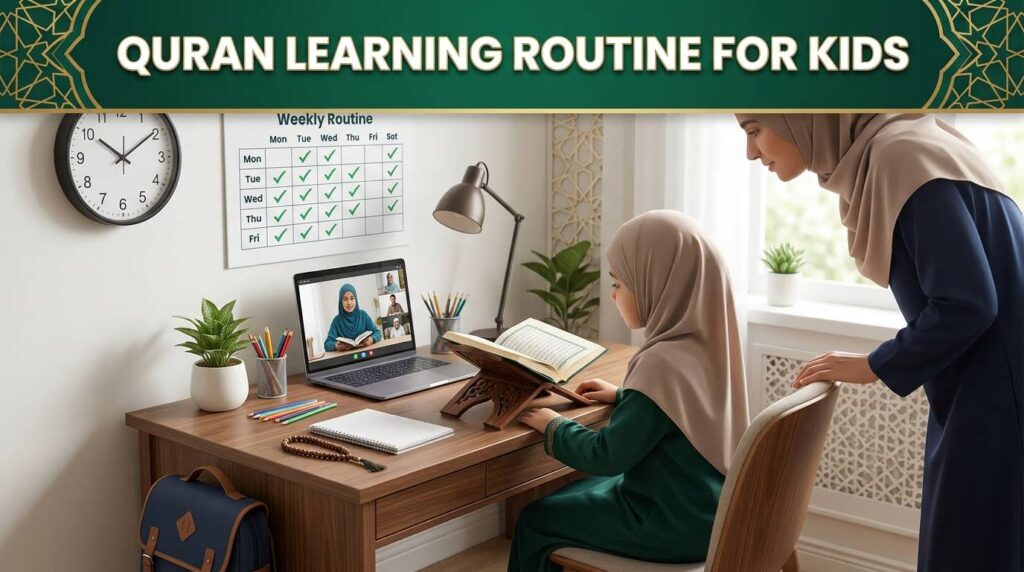
Quran classes for siblings are Quran lessons arranged for brothers and sisters from the same family. Depending on their ages and Quran reading levels, siblings can either learn together in one class or attend individual lessons with the same teacher.
Learning Quran with a brother or sister can make the experience more familiar and encouraging. Siblings can remind each other about practice, celebrate progress, and develop a shared Quran-learning routine.
However, siblings do not always learn at the same speed. A younger child may be learning Noorani Qaida while an older sibling may already be working on Tajweed or Hifz.
For this reason, the best sibling Quran program should combine shared family convenience with individual learning needs.
- Can Siblings Learn Quran Together?
- Should Siblings Have the Same Quran Teacher?
- Is One Quran Class Better Than Separate Classes for Siblings?
- What Are the Benefits of Quran Classes for Siblings?
- Can Younger and Older Siblings Learn Quran Together?
- What If Siblings Have Different Quran Levels?
- Can Siblings Learn Noorani Qaida Together?
- Can Siblings Learn Tajweed Together?
- Can Siblings Do Hifz Together?
- Should Siblings Compete in Hifz?
- Why Is Revision Important for Sibling Hifz?
- Can Siblings Attend Online Quran Classes From Home?
- How Do Online Quran Classes for Siblings Work?
- Can Siblings Take Consecutive Quran Classes?
- Can Siblings Attend Classes at Different Times?
- Can Siblings Learn Quran After School?
- Can Siblings Take Quran Classes on Weekends?
- Can Siblings Take Evening Quran Classes?
- How Can Parents Keep Sibling Quran Learning Organized?
- Can Siblings Practice Quran Together?
- How Can Parents Motivate Siblings to Learn Quran?
- What If One Sibling Learns Faster?
- What If One Sibling Is a Complete Beginner?
- Can Brothers and Sisters Learn With the Same Teacher?
- Can Sisters Learn Quran Together?
- Can Brothers Learn Quran Together?
- What Technology Is Needed for Online Sibling Quran Classes?
- Should Siblings Share One Device?
- How Can Parents Create a Quran-Friendly Home Environment?
- Can Siblings Learn Quran During School Holidays?
- Can Siblings Learn Quran During Ramadan?
- How Can Parents Balance Quran Classes With School?
- What Should Parents Look for in a Quran Academy for Siblings?
- Is a Trial Class Useful for Siblings?
- Start Quran Classes for Your Siblings
- Final Thoughts
- Frequently Asked Questions
Can Siblings Learn Quran Together?
Yes, siblings can learn Quran together if their learning levels are reasonably similar.
For example, two children who are both learning basic Quran reading may benefit from studying together.
But if one sibling is a complete beginner and another has already completed basic Tajweed, putting them through exactly the same lesson may not be effective.
The teacher should consider:
- Age
- Quran reading level
- Tajweed knowledge
- Memorization goals
- Attention span
- Learning speed
Siblings can share a teacher and schedule without necessarily studying identical material.
Should Siblings Have the Same Quran Teacher?
Having the same teacher can be convenient for parents.
The teacher can become familiar with the children’s personalities, strengths, weaknesses, and learning progress.
For example:
Sibling 1: Noorani Qaida
Sibling 2: Quran reading
Sibling 3: Tajweed
The same teacher can manage each student’s learning plan while parents only need to coordinate with one teacher.
However, the teacher must still give each child enough individual attention.
Is One Quran Class Better Than Separate Classes for Siblings?
There is no universal answer.
It depends on how similar the siblings are.
One Shared Class
A shared lesson may work when siblings:
- Have similar Quran levels.
- Are close in age.
- Have similar learning goals.
- Work well together.
- Can concentrate in a shared lesson.
Separate Lessons
Individual classes may be better when:
- Their Quran levels are very different.
- One child needs extra pronunciation practice.
- One sibling is studying Hifz.
- Their attention spans differ.
- One child progresses significantly faster.
The goal should not simply be to reduce the number of classes.
The goal should be effective Quran learning.
What Are the Benefits of Quran Classes for Siblings?
Siblings Can Encourage Each Other
Children often enjoy learning when they have a brother or sister working toward a similar goal.
It Can Create Healthy Motivation
Seeing a sibling progress can encourage another child to practice.
However, parents should avoid turning Quran learning into competition.
Scheduling Can Be Easier
Families may coordinate lessons around school, homework, meals, and other responsibilities.
Parents Can Monitor Progress More Easily
Having siblings with the same teacher can simplify communication.
It Can Build a Shared Routine
Quran learning becomes part of the family’s normal weekly schedule.
Children Can Practice Together
Siblings can listen to one another and revise lessons together outside class.
Can Younger and Older Siblings Learn Quran Together?
They can, but their lessons may need to be structured differently.
For example, a six-year-old may be learning Arabic letters while a twelve-year-old is improving Tajweed.
A single lesson focused on one level would probably not serve both students equally well.
Instead, the teacher can use an individualized approach or schedule separate sessions.
What If Siblings Have Different Quran Levels?
This is one of the most common challenges.
A family might have:
- One beginner
- One intermediate reader
- One advanced reader
- One Hifz student
The solution is not to slow every child down to the beginner’s level.
Each sibling should have an appropriate learning target.
The teacher can coordinate the overall program while adapting the lesson for every child.
Can Siblings Learn Noorani Qaida Together?
Yes.
If siblings are both beginners and are at approximately the same stage, Noorani Qaida can be taught together.
They can practice:
- Arabic letters
- Letter combinations
- Harakat
- Sukoon
- Tanween
- Madd
- Basic pronunciation
Learning together can make practice more enjoyable.
However, if one child is significantly ahead, separate instruction may be more productive.
Can Siblings Learn Tajweed Together?
Yes, provided they have a suitable Quran reading foundation.
A teacher can introduce Tajweed concepts such as:
- Makharij
- Sifaat
- Qalqalah
- Madd
- Noon Sakinah
- Tanween
- Meem Sakinah
- Stopping rules
If one sibling has already mastered a rule while another is still struggling with pronunciation, individual practice may be needed.
Families can also read how to improve Tajweed for additional practice guidance.
Can Siblings Do Hifz Together?
Yes.
Siblings can memorize Quran together while following different memorization targets.
For example:
Older sibling: Ten verses
Younger sibling: Three verses
The important thing is consistency rather than matching the exact number of verses.
Each child should be given a realistic memorization target based on age and ability.
Should Siblings Compete in Hifz?
Generally, Quran memorization should not become a competition.
Healthy encouragement can be positive, but parents should avoid statements such as:
“Your brother has memorized more than you.”
Instead, focus on individual progress.
A child should be encouraged to improve compared with their own previous performance.
This helps keep Quran learning positive and sustainable.
Why Is Revision Important for Sibling Hifz?
Memorization is only one part of Hifz.
Revision is essential for maintaining previously memorized portions.
A sibling learning Hifz may need to review:
- Today’s lesson
- Recent memorization
- Older memorized portions
Families can establish a shared revision period while allowing each child to revise different material.
If a child is struggling to retain previously memorized Quran, parents can read why people forget their Hifz.
Can Siblings Attend Online Quran Classes From Home?
Yes.
Online Quran classes can be particularly convenient for families with several children.
Instead of taking each child to a physical academy, siblings can learn from home using:
- Laptop
- Tablet
- Smartphone
- Stable internet connection
- Headphones
This can save travel time and make scheduling easier.
How Do Online Quran Classes for Siblings Work?
The process can be simple.
Step 1: Assess Each Sibling
The teacher identifies each child’s Quran reading level.
Step 2: Set Individual Goals
Each child receives an appropriate learning target.
Step 3: Create a Schedule
Lessons are arranged according to the family’s availability.
Step 4: Conduct the Lessons
The teacher teaches reading, Tajweed, Hifz, or another selected subject.
Step 5: Assign Practice
Each sibling receives material to review before the next lesson.
Step 6: Monitor Progress
The teacher and parents periodically review each child’s development.
This approach allows siblings to learn under one organized program without forcing them to progress identically.
Can Siblings Take Consecutive Quran Classes?
Yes.
This can be a practical option when siblings need individual lessons.
For example:
5:00 PM: Older sibling
5:30 PM: Younger sibling
6:00 PM: Third sibling
The children remain at home, and parents do not have to arrange separate travel.
Consecutive lessons can also make the family’s weekly schedule easier to manage.
Can Siblings Attend Classes at Different Times?
Yes.
There is no requirement for every sibling to learn at exactly the same time.
For example:
- Child 1 attends after school.
- Child 2 attends in the evening.
- Child 3 attends on weekends.
This can be useful when siblings have different school or extracurricular schedules.
Can Siblings Learn Quran After School?
Yes.
After-school Quran classes can work well for many children.
However, parents should consider whether the child needs a break after school.
A short rest, snack, or physical activity before the Quran lesson may help the child concentrate.
The ideal schedule depends on the individual child.
Can Siblings Take Quran Classes on Weekends?
Yes.
Weekend lessons can be useful for families with busy weekdays.
Parents can schedule one or more sessions during Saturday or Sunday and maintain Quran practice during the week.
However, children who are learning Hifz or working intensively on Tajweed may benefit from more frequent teacher interaction.
Can Siblings Take Evening Quran Classes?
Yes.
Evening lessons can fit well around school and family schedules.
Parents should choose a time when the children are still alert.
Very late classes may not be suitable for younger children because tiredness can reduce concentration.
How Can Parents Keep Sibling Quran Learning Organized?
A simple family schedule can help.
For example:
| Child | Level | Main Goal | Class |
|---|---|---|---|
| Child 1 | Beginner | Noorani Qaida | Monday, Wednesday |
| Child 2 | Intermediate | Quran Reading | Tuesday, Thursday |
| Child 3 | Advanced | Tajweed | Monday, Wednesday |
| Child 4 | Hifz | Memorization | Five days |
The schedule should be adapted to the actual needs of the children.
Can Siblings Practice Quran Together?
Yes.
Siblings can support each other between teacher-led lessons.
They can:
- Listen to each other’s recitation.
- Practice difficult words.
- Revise Surahs together.
- Review memorized portions.
- Remind each other about practice.
Parents should supervise younger children where necessary.
The purpose is to make practice supportive rather than competitive.
How Can Parents Motivate Siblings to Learn Quran?
Children respond differently to motivation.
Parents can:
- Set realistic goals.
- Celebrate progress.
- Keep practice sessions manageable.
- Encourage siblings to support one another.
- Avoid comparisons.
- Make Quran learning consistent.
- Give children appropriate breaks.
For more practical ideas, read how to motivate kids to learn Quran.
What If One Sibling Learns Faster?
This is completely normal.
Children have different learning speeds.
One child may remember a Surah quickly while another needs more repetition.
Parents should avoid treating the faster learner as the standard everyone else must reach.
Instead, teachers should adjust expectations individually.
The slower learner may simply need more repetition or a different teaching approach.
What If One Sibling Is a Complete Beginner?
A beginner can start without feeling embarrassed about being behind the others.
The teacher can begin with the basics:
Arabic letters → Harakat → Joined letters → Noorani Qaida → Quran reading → Tajweed
Parents should avoid comparing the beginner with siblings who have already studied Quran for years.
If your child is starting completely from the beginning, our guide on how to learn Quran from zero can also help.
Can Brothers and Sisters Learn With the Same Teacher?
Yes.
A qualified teacher can teach both boys and girls depending on the academy’s structure and the family’s preferences.
The key considerations are:
- Teacher qualifications
- Tajweed knowledge
- Teaching experience
- Experience with children
- Patience
- Communication
- Ability to adapt lessons
For families who specifically prefer female instruction, learning about qualified female Quran teachers can help when selecting a teacher.
Can Sisters Learn Quran Together?
Yes.
Sisters with similar ages and learning levels can often benefit from shared lessons.
They can practice together and encourage each other.
However, individual lessons may still be more effective when their abilities are significantly different.
Can Brothers Learn Quran Together?
Yes.
Brothers can also learn together when their learning levels are compatible.
The same principle applies:
Similar level = shared learning may work well.
Very different levels = individualized lessons may be better.
What Technology Is Needed for Online Sibling Quran Classes?
The technology requirements are usually simple.
Families generally need:
- Reliable internet
- Laptop, tablet, or smartphone
- Microphone
- Camera
- Quran or Noorani Qaida
- Quiet learning space
If siblings attend separate classes, multiple devices can be useful, but consecutive lessons can also allow the family to use a single device.
Should Siblings Share One Device?
They can if their classes are scheduled one after another.
For example:
4:30 PM: Sibling 1
5:00 PM: Sibling 2
5:30 PM: Sibling 3
If two siblings have simultaneous lessons, separate devices may be more practical.
The best arrangement depends on the family’s schedule and available equipment.
How Can Parents Create a Quran-Friendly Home Environment?
Parents can also explore educational resources from the Yaqeen Institute when looking for additional material related to Islamic learning and family life.
A dedicated learning area can help children understand that Quran time is important.
It does not need to be elaborate.
A simple space with:
- Quran
- Rehal
- Desk
- Comfortable chair
- Learning materials
- Good lighting
can be enough.
Keep distractions such as television, games, and unnecessary phone notifications away during lessons.
Can Siblings Learn Quran During School Holidays?
Yes.
Older siblings who want to explore Quranic Arabic alongside their regular lessons can also use the Quranic Arabic Corpus as a supplementary learning resource.
School holidays can provide additional opportunities for:
- Quran reading
- Tajweed practice
- Hifz
- Revision
- Islamic studies
However, parents should still maintain a balanced routine.
Children need time for rest, family activities, outdoor play, and other interests.
Can Siblings Learn Quran During Ramadan?
Yes.
Ramadan can provide an excellent opportunity to increase Quran reading and revision.
Families may adjust lesson schedules and create additional reading time.
However, children should not be overloaded.
The routine should remain age-appropriate and manageable.
How Can Parents Balance Quran Classes With School?
The key is realistic scheduling.
Children already have:
- School
- Homework
- Exams
- Activities
- Family responsibilities
- Rest requirements
Quran classes should fit into the overall routine rather than creating constant pressure.
Short, consistent practice can often be more sustainable than occasional intensive sessions.
What Should Parents Look for in a Quran Academy for Siblings?
Before choosing an academy, ask:
- Are teachers qualified?
- Are classes live?
- Can siblings have different learning levels?
- Are individual classes available?
- Are shared classes available?
- Is Tajweed taught?
- Is Hifz available?
- How is progress monitored?
- Are teachers experienced with children?
- Are flexible schedules available?
- Is there a trial class?
Parents should choose a program that can accommodate the whole family without sacrificing individual attention.
Is a Trial Class Useful for Siblings?
Yes.
A trial class can help parents determine whether:
- The teacher communicates well with children.
- Siblings can learn comfortably together.
- Each child’s level is properly assessed.
- The teaching method suits the children.
- The class schedule is practical.
- Pronunciation mistakes are corrected properly.
A trial is especially useful when siblings have different ages or Quran levels.
Start Quran Classes for Your Siblings
Choosing Quran classes for siblings does not mean every child must follow exactly the same curriculum.
The better approach is to create a family-friendly learning system where every child receives instruction appropriate to their age, ability, and goals.
Before enrolling, consider whether shared or individual lessons would work better.
A trial class can help you make that decision.
Families can book a Quran trial class to experience the teaching approach and determine whether it is suitable for their children.
Final Thoughts
Quran classes for siblings can make Quran education easier to organize while giving brothers and sisters an opportunity to support each other’s learning.
The biggest mistake is assuming that siblings must learn at the same pace simply because they live in the same household.
Every child is different.
One may excel at reading.
Another may need additional Tajweed practice.
Another may enjoy Hifz.
Another may just be beginning with Noorani Qaida.
A good Quran program recognizes these differences.
Whether siblings study together or attend separate lessons with the same teacher, the goal should remain the same: consistent, accurate, and meaningful Quran learning.
With a suitable schedule, qualified teacher, supportive parents, and regular practice, Quran learning can become a positive part of every sibling’s routine.
Frequently Asked Questions
What are Quran classes for siblings?
They are Quran lessons arranged for brothers and sisters, either through shared classes or individual lessons with the same teacher.
Can siblings learn Quran together?
Yes, when their ages, learning levels, and goals are reasonably similar.
Should siblings have the same Quran teacher?
They can. Having one teacher can simplify scheduling and communication while allowing each child to follow an individual learning plan.
Is it better for siblings to have separate Quran classes?
Not always. Shared classes can work well for children at similar levels, while separate lessons may be better when their abilities differ significantly.
Can younger and older siblings learn Quran together?
Yes, but they may need different material or individualized instruction.
Can siblings learn Noorani Qaida together?
Yes, if they are at similar beginner levels.
Can siblings learn Tajweed together?
Yes, provided their Quran reading abilities are reasonably similar.
Can siblings memorize Quran together?
Yes. They can follow a shared Hifz routine while memorizing different amounts according to their abilities.
Should siblings compete in Hifz?
Parents should encourage healthy motivation without turning Quran memorization into competition.
Can siblings take online Quran classes?
Yes. Online classes allow siblings to learn from home without traveling to a physical academy.
Can siblings take classes one after another?
Yes. Consecutive lessons can be an effective way to use one device and simplify family scheduling.
Can siblings take Quran classes at different times?
Yes. Each child can have a lesson at a time that fits their individual school and family schedule.
Can siblings take Quran classes on weekends?
Yes. Weekend lessons can work well for families with busy weekdays.
Can siblings take evening Quran classes?
Yes, provided the children are alert enough to concentrate.
Can a beginner join sibling Quran classes?
Yes. A complete beginner can start with Arabic letters and Noorani Qaida.
Can brothers and sisters have the same Quran teacher?
Yes, depending on the academy’s teaching structure and family preferences.
Can sisters learn Quran together?
Yes. Sisters with similar learning levels can benefit from shared lessons.
Can brothers learn Quran together?
Yes. Brothers can study together when their learning levels and goals are compatible.
What technology is needed?
A stable internet connection, suitable device, microphone, camera, Quran or learning material, and a quiet study area are generally sufficient.
Can siblings share one device?
Yes, if their classes are scheduled separately. Simultaneous lessons may require separate devices.
How can parents motivate siblings to learn Quran?
Parents can establish realistic goals, praise progress, encourage cooperation, and avoid comparing one sibling with another.
How can parents monitor sibling Quran progress?
Each child should have an individual progress record covering reading, Tajweed, memorization, and areas needing improvement.
Can siblings learn Quran during school holidays?
Yes. Holidays can provide additional time for reading, Tajweed, Hifz, and revision.
Can siblings learn Quran during Ramadan?
Yes. Families can increase Quran reading and revision during Ramadan while keeping the workload appropriate for children.
Is a Quran trial class useful for siblings?
Yes. A trial can help parents evaluate the teacher, teaching method, class format, and suitability for each child.