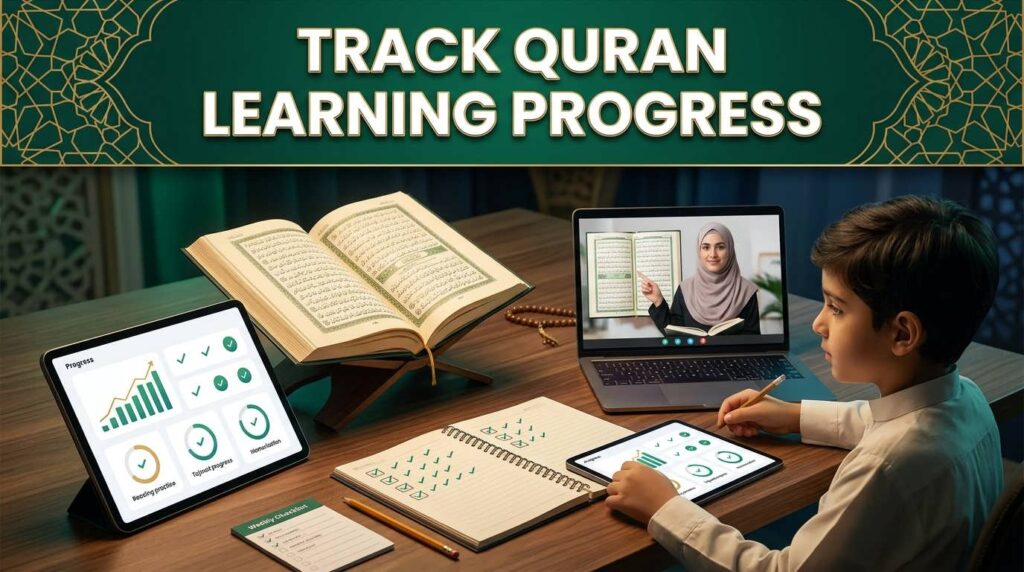
Knowing how to track Quran learning progress can help students, parents, and teachers understand what is improving and what still needs attention.
Quran learning is not measured only by how many pages a student completes. A child may finish several lessons while still struggling with pronunciation, while another student may progress more slowly but develop a stronger foundation.
A useful progress system looks at several areas together:
- Quran reading accuracy
- Arabic letter recognition
- Pronunciation
- Tajweed
- Fluency
- Memorization
- Revision
- Consistency
- Confidence
- Understanding
Tracking these areas gives a much clearer picture of a student’s development.
- Why Is Tracking Quran Learning Progress Important?
- What Should You Track in Quran Learning?
- Create a Quran Learning Progress Baseline
- Track Quran Reading Accuracy
- Track Quran Reading Fluency
- Track Tajweed Progress
- Track Quran Memorization Progress
- Track Quran Learning Consistency
- Track Progress With a Weekly Quran Checklist
- Use Monthly Progress Reviews
- Set Small Quran Learning Goals
- Use Skill-Based Goals Instead of Page-Based Goals
- Track Pronunciation Mistakes
- Record Teacher Feedback
- Use Audio Recordings to Compare Progress
- How Parents Can Track a Child's Quran Progress
- Don't Compare Your Child With Other Children
- How to Track Quran Progress for Adult Learners
- Track Understanding Separately From Recitation
- Use a Simple Monthly Progress Scorecard
- What Should a Quran Teacher Report to Parents?
- How Often Should Quran Progress Be Reviewed?
- Signs That Your Child Is Making Good Quran Progress
- Signs That the Learning Plan May Need Adjustment
- How Technology Can Help Track Quran Learning
- How to Keep Children Motivated While Tracking Progress
- A Simple Quran Learning Progress Template
- What If Progress Seems Slow?
- How Long Does It Take to See Quran Learning Progress?
- Start With a Clear Learning Baseline
- Try a Quran Trial Class
- Final Thoughts
- Frequently Asked Questions
Why Is Tracking Quran Learning Progress Important?
Without tracking, it can be difficult to know whether a student is genuinely improving.
Progress tracking helps parents and teachers identify:
- Skills that are improving
- Areas requiring additional practice
- Repeated pronunciation mistakes
- Lessons that need revision
- Memorization that needs strengthening
- Changes in reading fluency
- Whether the learning pace is appropriate
It can also encourage students.
When children can see that they have moved from recognizing individual letters to reading words and then complete verses, their progress becomes visible.
What Should You Track in Quran Learning?
A good Quran progress system should track more than one measurement.
Reading Ability
Track whether the student can:
- Recognize Arabic letters
- Read joined letters
- Read words
- Read verses
- Read unfamiliar passages
- Read without constant prompting
Pronunciation
Monitor recurring problems with Arabic letters and sounds.
Tajweed
Record which Tajweed rules have been introduced and whether the student can apply them correctly during recitation.
Memorization
For Hifz students, track:
- New portions memorized
- Previous portions revised
- Accuracy
- Recitation without prompts
- Frequently forgotten passages
Consistency
Record whether the student attends classes and completes practice regularly.
Confidence
A student who becomes more comfortable reading aloud is also showing meaningful progress.
Create a Quran Learning Progress Baseline
Before measuring improvement, establish a starting point.
The teacher can assess the student’s current ability.
For a beginner, this may include:
- Arabic letter recognition
- Harakat recognition
- Basic pronunciation
- Joining letters
- Simple reading exercises
For an intermediate student, the assessment may include:
- Quran reading
- Tajweed application
- Fluency
- Common pronunciation mistakes
For a Hifz student, the teacher can assess memorized portions and revision strength.
This initial assessment becomes the baseline against which future progress can be compared.
Track Quran Reading Accuracy
Accuracy is one of the most useful progress indicators.
Instead of asking only:
“How many pages did you read?”
ask:
“How accurately did you read them?”
A student who reads fewer verses with correct pronunciation may be making better progress than a student who reads several pages quickly but makes frequent mistakes.
Create simple categories such as:
- Needs significant help
- Improving
- Mostly independent
- Confident and accurate
The teacher can update the level periodically.
Track Quran Reading Fluency
Fluency is different from simply reading quickly.
A fluent reader can recognize words and continue reciting without excessive hesitation.
When tracking fluency, look for:
- Fewer long pauses
- Fewer repeated attempts
- Better word recognition
- Smoother transitions
- Less dependence on teacher prompting
Do not encourage children to rush.
The objective is accurate and comfortable recitation, not maximum speed.
Track Tajweed Progress
Tajweed should be tracked as a collection of skills rather than a single score.
A teacher may create categories such as:
| Tajweed Area | Status |
|---|---|
| Makharij | Learning |
| Madd | Practicing |
| Ghunnah | Improving |
| Qalqalah | Learning |
| Noon Sakinah | Practicing |
| Meem Sakinah | Learning |
| Stopping Rules | Not Yet Introduced |
The exact categories can be adjusted according to the student’s level.
This gives parents a clearer understanding of what the student is actually learning.
Track Quran Memorization Progress
For students learning Hifz, counting newly memorized pages is only one part of progress.
A better system tracks three areas:
New Memorization + Revision + Retention
For example:
| Week | New Portion | Revision | Accuracy |
|---|---|---|---|
| Week 1 | Surah section | Previous section | Good |
| Week 2 | New section | Week 1 | Improving |
| Week 3 | New section | Weeks 1–2 | Strong |
This prevents a common problem where students memorize new material but gradually forget older portions.
Parents can also learn more about why people forget their Hifz and use that information to strengthen their child’s revision routine.
Track Quran Learning Consistency
Consistency is often more important than occasional long study sessions.
Track:
- Classes attended
- Practice sessions completed
- Revision sessions
- Missed lessons
- Homework completion
A simple weekly record can reveal patterns.
For example, if a child performs well during weeks with regular practice but struggles after several missed sessions, the problem may be consistency rather than ability.
Track Progress With a Weekly Quran Checklist
A simple checklist can make tracking easier.
Weekly Quran Progress Checklist
Reading
- Completed assigned reading
- Read with fewer mistakes
- Improved fluency
Tajweed
- Practiced current rule
- Applied rule during recitation
- Corrected repeated mistakes
Memorization
- Learned new portion
- Revised previous portion
- Recited without prompts
Consistency
- Attended all scheduled classes
- Practiced at home
- Completed assigned revision
Confidence
- Read aloud comfortably
- Needed fewer prompts
- Asked questions when unsure
Parents do not need a complicated tracking system.
A simple checklist used consistently can be extremely useful.
Use Monthly Progress Reviews
Weekly tracking shows small changes.
Monthly reviews show bigger patterns.
At the end of each month, compare:
- Reading accuracy
- Reading fluency
- Tajweed application
- Memorization
- Revision
- Attendance
- Confidence
Ask:
What improved?
What stayed the same?
What needs more attention?
What should be the next learning goal?
This turns tracking into an actual learning strategy.
Set Small Quran Learning Goals
Large goals can sometimes feel overwhelming.
Instead of:
“Become fluent in Quran reading.”
set smaller targets such as:
- Recognize all Arabic letters confidently.
- Reduce pronunciation mistakes in specific letters.
- Read a selected page without teacher prompting.
- Apply a specific Tajweed rule correctly.
- Revise a memorized Surah three times this week.
Small goals make progress easier to see.
Use Skill-Based Goals Instead of Page-Based Goals
Page numbers can be useful, but they should not be the only measurement.
Compare:
Page-based goal:
“Complete 10 pages.”
With:
Skill-based goal:
“Read the assigned pages while correctly applying the Tajweed rules learned this month.”
The second goal measures actual learning rather than simple completion.
Track Pronunciation Mistakes
Pronunciation deserves its own record.
If a child repeatedly struggles with particular Arabic letters, write them down.
For example:
| Skill | Current Issue | Action |
|---|---|---|
| Letter pronunciation | Needs correction | Daily practice |
| Madd | Sometimes shortened | Teacher review |
| Qalqalah | Inconsistent | Recitation exercises |
Over time, the teacher can mark whether the issue is:
Frequent → Occasional → Rare → Correct
This makes improvement visible.
Record Teacher Feedback
Teacher feedback can provide valuable information that numbers cannot.
After a lesson, record one or two observations.
For example:
- “Recognizes letters faster.”
- “Needs more practice with Madd.”
- “Reads familiar passages confidently.”
- “Still needs help with unfamiliar words.”
- “Improved pronunciation of difficult letters.”
Do not write a long report after every class.
A short note is enough.
Use Audio Recordings to Compare Progress
Audio recordings can provide one of the clearest ways to hear improvement.
With appropriate parental supervision, parents can occasionally record a short Quran reading sample.
For example:
Month 1: Frequent pauses and teacher prompting.
Month 2: Fewer pauses and improved pronunciation.
Month 3: More independent and smoother reading.
Listening to recordings side by side can reveal improvements that may be difficult to notice during everyday lessons.
For children’s privacy, parents should keep recordings secure and avoid sharing them publicly without appropriate consent.
How Parents Can Track a Child’s Quran Progress
Parents do not need to become Quran teachers to monitor progress.
They can ask the teacher for a simple monthly update covering:
- Current reading level
- Pronunciation
- Tajweed
- Memorization
- Practice habits
- Strengths
- Areas needing attention
- Recommended next goal
Parents can then support the teacher’s recommendations at home.
Don’t Compare Your Child With Other Children
Every child develops differently.
One child may learn letters quickly but need more time with pronunciation.
Another may memorize quickly but struggle with revision.
Another may need more repetition before becoming confident.
The important comparison is:
Where was my child before, and where are they now?
Tracking should encourage progress rather than create competition.
How to Track Quran Progress for Adult Learners
Adults can use the same basic system.
However, adult learners may have different goals.
For example:
- Learning Quran reading from scratch
- Improving pronunciation
- Learning Tajweed
- Completing regular Quran reading
- Memorizing selected Surahs
- Understanding Quranic vocabulary
An adult can record weekly achievements and review them at the end of each month.
A busy professional might set a realistic goal such as:
“Practice Quran reading for 15 minutes on five days this week.”
This is more practical than creating an unrealistic schedule.
Track Understanding Separately From Recitation
Reading the Quran and understanding its meaning are related but different skills.
A student may read fluently while still having limited understanding of the Arabic language.
If understanding is one of the learning goals, track it separately.
For example:
- Learned vocabulary
- Understood selected verses
- Studied translation
- Learned basic context
- Reviewed Tafsir
This creates a more complete picture of Quran learning.
For students interested in exploring Quranic Arabic, the Quranic Arabic Corpus provides linguistic analysis and grammatical information about the Quran.
Use a Simple Monthly Progress Scorecard
Parents can create a simple scorecard:
| Area | Beginning | Improving | Strong |
|---|---|---|---|
| Letter Recognition | ✓ | ||
| Reading | ✓ | ||
| Pronunciation | ✓ | ||
| Tajweed | ✓ | ||
| Fluency | ✓ | ||
| Memorization | ✓ | ||
| Revision | ✓ | ||
| Confidence | ✓ |
The purpose is not to create a school-style grade.
It is simply a visual snapshot of the student’s current development.
What Should a Quran Teacher Report to Parents?
A useful progress report should answer five questions:
1. What Can the Student Do Now?
Describe current abilities.
2. What Has Improved?
Mention specific progress.
3. What Still Needs Work?
Identify one or two priorities.
4. What Should the Student Practice?
Give practical instructions.
5. What Is the Next Goal?
Set a realistic target for the coming weeks.
This keeps communication focused and useful.
How Often Should Quran Progress Be Reviewed?
A practical approach is:
Daily:
Short practice tracking.
Weekly:
Review attendance, practice, and immediate learning goals.
Monthly:
Evaluate broader skill development.
Every few months:
Perform a more complete assessment.
The exact schedule can vary depending on the student’s age, goals, and learning level.
Signs That Your Child Is Making Good Quran Progress
Progress may not always mean completing more pages.
Positive signs include:
- Fewer pronunciation mistakes
- Faster letter recognition
- Better Tajweed application
- Greater reading confidence
- Fewer pauses
- More independent reading
- Better memorization retention
- More consistent practice
- Greater willingness to read aloud
- Better understanding of corrections
These changes often matter more than simply counting pages.
Signs That the Learning Plan May Need Adjustment
Tracking can also reveal when something is not working.
Consider reviewing the learning approach if:
- The same mistakes continue for months.
- The child is losing confidence.
- Lessons are consistently too difficult.
- The student is progressing too quickly without accuracy.
- Practice is repeatedly being skipped.
- The student cannot explain what they are currently learning.
- The teacher and parent rarely communicate.
The answer may not be to study for longer.
Sometimes the solution is to change the pace, teaching method, lesson frequency, or practice routine.
How Technology Can Help Track Quran Learning
Technology can make progress tracking easier.
Parents can use:
- Digital calendars
- Notes apps
- Spreadsheets
- Audio recordings
- Online lesson records
- Digital checklists
However, technology should support the learning process rather than become another distraction.
A simple system that parents actually use is better than a sophisticated system that gets abandoned after one week.
How to Keep Children Motivated While Tracking Progress
Progress tracking should feel encouraging.
Avoid telling a child:
“You are still behind.”
Instead say:
“Last month you needed help with this, but now you can read it independently.”
Celebrate improvement.
You can also use small milestones such as:
- First complete page
- First independently read Surah
- First successful Tajweed application
- First memorized Surah
- First month of consistent practice
The goal is to help children recognize their own development.
Parents can also read practical advice on how to motivate kids to learn Quran without turning learning into unnecessary pressure.
A Simple Quran Learning Progress Template
Parents can use this basic format:
Student: __________
Month: __________
Reading Level: __________
Pronunciation: __________
Tajweed: __________
Memorization: __________
Revision: __________
Practice Consistency: __________
Strengths: __________
Areas to Improve: __________
Next Month’s Goal: __________
This takes only a few minutes to update but can provide a useful long-term record.
What If Progress Seems Slow?
Slow progress does not automatically mean that a student is failing.
Learning Quran involves skills that develop at different speeds.
A child may spend several weeks working on pronunciation before showing a noticeable improvement.
The important thing is whether the student is gradually moving forward.
Look for small changes.
A student who makes one fewer mistake than last month is still progressing.
A student who reads independently for the first time is progressing.
A student who remembers yesterday’s lesson without help is progressing.
Small improvements accumulate.
How Long Does It Take to See Quran Learning Progress?
There is no universal timeline.
Progress depends on:
- Starting level
- Age
- Lesson frequency
- Practice consistency
- Teaching method
- Learning goals
- Individual ability
Some students may show noticeable reading improvements within weeks.
Others may require longer.
Instead of asking when progress “should” happen, track specific skills and compare them over time.
Start With a Clear Learning Baseline
The best progress tracking system starts with an honest assessment.
Identify what the student can do today.
Then set realistic goals.
After several weeks, measure again.
This creates a simple cycle:
Assess → Learn → Practice → Review → Measure → Adjust
The cycle can continue throughout the student’s Quran learning journey.
Try a Quran Trial Class
If you are considering online Quran lessons for yourself or your child, a trial class can help establish a starting point.
A teacher can observe the student’s current reading ability, pronunciation, and learning needs before recommending an appropriate learning path.
You can book a Quran trial class to understand your current level and discuss suitable learning goals with a teacher.
Final Thoughts
Learning Quran is a journey, and meaningful progress is not always visible through the number of pages completed.
The most useful way to track Quran learning progress is to look at the whole picture.
Track:
- Accuracy
- Pronunciation
- Tajweed
- Fluency
- Memorization
- Revision
- Consistency
- Confidence
- Understanding
Set small goals, review progress regularly, and adjust the learning plan when necessary.
For children especially, progress tracking should encourage rather than pressure.
When students can see how far they have come, even small improvements can become a powerful source of motivation.
Frequently Asked Questions
How do I track Quran learning progress?
Track reading accuracy, pronunciation, Tajweed, fluency, memorization, revision, consistency, and confidence. Review these areas regularly rather than relying only on pages completed.
What is the best way to measure Quran reading improvement?
Compare reading accuracy and fluency over time. Look for fewer pronunciation mistakes, fewer pauses, better word recognition, and greater independence.
Should parents track their child’s Quran progress?
Yes. Parents can use simple weekly and monthly records and ask the teacher for regular feedback.
How often should Quran progress be assessed?
Weekly reviews can track immediate goals, while monthly assessments can show broader development. A more detailed assessment can be performed every few months.
Should Quran learning progress be measured by pages?
Pages can be one measurement, but they should not be the only one. Accuracy, pronunciation, Tajweed, retention, and confidence are also important.
How can I track Hifz progress?
Track new memorization, revision, accuracy, and retention. A student should maintain older portions while learning new material.
How can parents know whether their child is improving?
Look for specific changes such as fewer mistakes, better pronunciation, improved fluency, greater confidence, and more independent reading.
Can audio recordings help track Quran progress?
Yes. Occasional recordings can make changes in pronunciation and fluency easier to hear, provided they are stored securely and handled appropriately.
How can adults track Quran learning progress?
Adults can set weekly goals for reading, Tajweed, memorization, or understanding and review their achievements at the end of each month.
What should a Quran teacher include in a progress report?
A useful report should explain the student’s current ability, improvements, remaining challenges, practice recommendations, and next learning goal.
What if my child is progressing slowly?
Slow progress does not necessarily indicate a problem. Review the child’s specific skills, practice consistency, learning pace, and teaching method before making changes.
Can an online Quran teacher track student progress?
Yes. A teacher can maintain lesson notes, identify recurring mistakes, monitor reading development, and provide parents with periodic feedback.
Is a Quran trial class useful for measuring progress?
A trial class can establish a useful starting point by allowing the teacher to observe the student’s current level and identify appropriate learning goals.