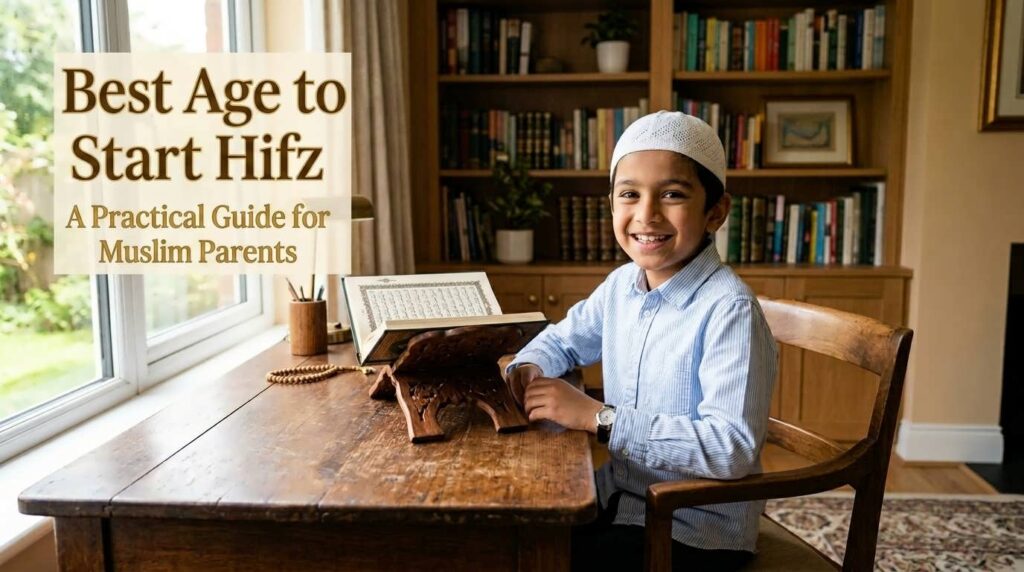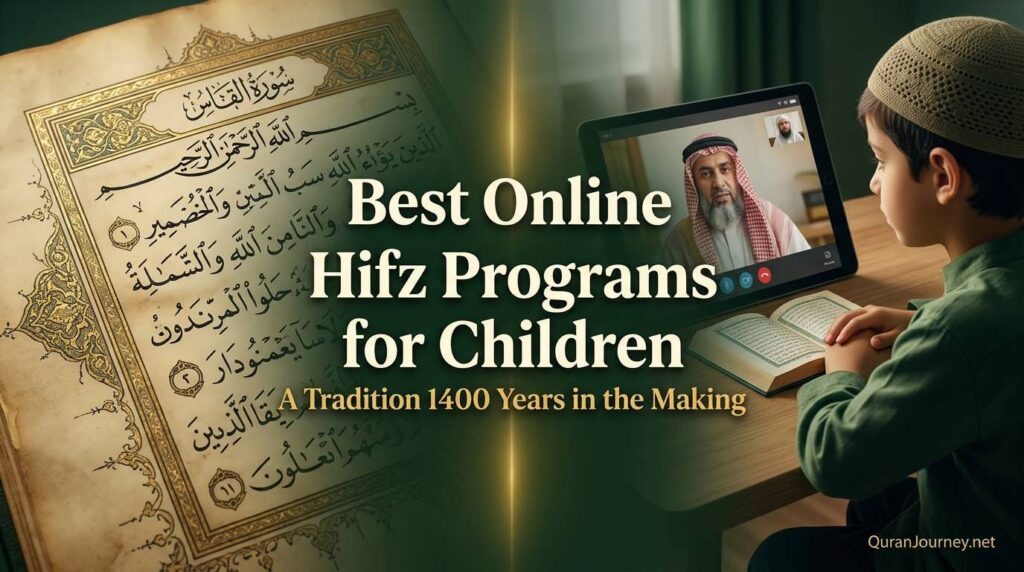
Every Muslim parent who has ever watched their child recite even a short Surah from memory knows the feeling. There is pride in it, yes, but there is also something much deeper, a quiet sense that your child is now carrying something sacred inside them that no one can ever take away.
That feeling is what drives so many families toward Hifz, the complete memorization of the Quran. And the question most parents arrive at, sooner or later, is this: how do I actually make this happen for my child, especially when we are living in the West, far from traditional Islamic schools and full-time Quran institutes?
The answer, for a growing number of families across the USA, UK, Canada, Germany, Australia, and New Zealand, is the best online Quran Hifz programs for children. One on one daily sessions with a qualified teacher, from home, built around your child’s actual school schedule and your family’s real life.
This guide covers everything, from the roots of Hifz in the earliest days of Islam, to how online Hifz e Quran classes work today, to practical tips for making it easier at home.
- The Sahabah and the Origins of Hifz
- What Is Hifz al Quran and Why It Matters for Children Specifically
- How Hifz al Quran Online Works Today
- Quran Hifz for Kids: What to Expect at Different Ages
- Can Quran Hifz Be Done in 6 Months
- How to Hifz Quran at Home Easily: Practical Tips for Parents
- What to Look for in the Best Online Quran Hifz Programs for Children
- Hifz al Quran Online Across the USA, UK, Canada, Germany, and New Zealand
- Start Your Child's Hifz Journey with QuranJourney
- Frequently Asked Questions
The Sahabah and the Origins of Hifz
Before we talk about how your child can memorize the Quran today, it helps to understand where this tradition comes from, because it is one of the oldest and most consistent practices in the history of Islam.
The Prophet Muhammad, peace be upon him, was himself the first person to memorize the Quran. As the verses were revealed to him over a period of 23 years, he would recite them to his companions, who would in turn commit them to memory. Scholars of Islamic history have referred to the Prophet as “Sayyid al-Huffaz” or the leader of those who memorize the Quran, and as “Awwal al-Jamma,” the first to gather the entire Quran in his heart.
The companions, known as the Sahabah, followed closely in his footsteps. Among the most prominent Sahabah who memorized the entire Quran were Abu Bakr as-Siddiq, Umar ibn al-Khattab, Uthman ibn Affan, Ali ibn Abi Talib, Abdullah ibn Masud, and Ubayy ibn Kab, who is described in classical scholarship as the most prominent of the Quran reciters among the companions. Among the women, Aisha, Hafsa, and Umm Salamah, may Allah be pleased with them all, also memorized the Quran completely.
According to historical records, seventy companions who had memorized the entire Quran were killed on a single day at the Battle of al-Yamamah during the caliphate of Abu Bakr, which was precisely what prompted the first organized effort to compile the Quran into written form. The sheer number of Huffaz among the early community speaks to how central this practice was from the very beginning of Islam.
How did the Sahabah memorize? Gradually and consistently. It is narrated that the companions would learn five verses in the morning and five in the evening from their teachers, not moving forward until they had understood and retained what they already had. Al-Imam Ibn Jazari documented that the companions would recite in groups of three, five, or ten verses at a time, never exceeding this amount when memorizing new material. This slow, consistent, revision-heavy approach is the same method that experienced Hifz teachers use with children today.
This living tradition, unbroken from the time of the Prophet through every generation until now, is what your child is stepping into when they begin Hifz. That is not a small thing.
What Is Hifz al Quran and Why It Matters for Children Specifically
Hifz al Quran simply means memorizing the entire Quran by heart, all 114 chapters, 30 sections, and over 6,000 verses. A male who completes this is called a Hafiz, a female a Hafiza. It is considered one of the highest honors a Muslim can achieve and carries profound reward in Islamic belief.
For children specifically, the case for starting early is strong. Research published in the Journal of Neurobehavioral Sciences found that individuals who undertook Quran memorization training showed strengthened performance across multiple cognitive areas including verbal memory, attention, and processing speed. A separate study on younger children found measurable improvements in cognitive intelligence following a structured Quran memorization program.
These findings align with what Quran teachers and parents have observed for centuries. Young children have a remarkable natural capacity for memorization. Their minds absorb repeated input quickly and retain it deeply, especially when the learning environment is consistent and low-pressure. Starting Hifz during the childhood years takes advantage of this natural window in a way that is genuinely difficult to replicate once a child is older.
Beyond the cognitive angle, there is the identity dimension. For children growing up as Muslims in Western countries like the USA, UK, Canada, Germany, and New Zealand, where Islamic culture is not the default environment, carrying the Quran in memory creates a deeply personal anchor to their faith and identity. It is something that belongs entirely to them.
How Hifz al Quran Online Works Today
The traditional Hifz model, attending a full-time residential madrasa often far from home, is not realistic for most Western Muslim families. Online Hifz programs have fundamentally changed what is possible without requiring families to uproot their lives.
Here is what a typical day in a structured online Hifz program looks like for a child.
The session starts with the child reciting the portion they memorized since the last lesson. This is called the sabaq, the new lesson. The teacher listens carefully through the video call, following along with the Quran, and stops the child gently when a word is mispronounced or a verse is missed. Corrections are made immediately in real time, the same way an in-person teacher would do it.
After the new sabaq is reviewed and corrected, the child recites older memorized portions. This revision, called muraja’ah, is what separates programs that produce lasting Hifz from those where children memorize quickly but forget equally fast. A good Hifz teacher will not skip revision just to push through more new pages. The balance between new memorization and revision is the art of the Hifz method.
At the end of the session, the teacher assigns the next portion, usually a specific number of lines or verses, for the child to memorize before the following day. This is the home practice that happens between sessions, and we will cover how to make this work well later in this guide.
Sessions for younger children typically run around 30 to 45 minutes. Older children, especially teenagers working at a faster pace, often do 45 to 60 minute sessions. For families pursuing Hifz al Quran online in the USA, UK, Canada, Germany, and New Zealand, flexible scheduling means sessions can happen early morning before school, after school, or on evenings and weekends, whatever fits the family’s actual routine.
Quran Hifz for Kids: What to Expect at Different Ages
Not every age looks the same in a Hifz program, and understanding this helps parents set realistic expectations from the start.
Ages 5 to 7
At this age, formal Hifz is absolutely possible but the approach needs to be gentle and play-based. Sessions are shorter, usually 20 to 30 minutes, and the teacher focuses heavily on making the experience enjoyable. Progress is measured in verses and short Surahs rather than pages. Children in this age group are often memorizing Juz Amma, the 30th section of the Quran, which contains the short chapters most Muslims already know from prayer. This builds a strong early foundation without overwhelming a young child.
Ages 7 to 10
This is the sweet spot that most experienced Hifz teachers point to. Children at this age can sit through a structured session, take direction from a teacher, feel genuine pride in their achievements, and retain new material with impressive speed. A child starting Hifz e Quran classes at age 7 or 8 with daily sessions and proper home revision can realistically complete the entire Quran in 4 to 5 years, finishing before their early teens.
Ages 10 to 14
Older children bring personal motivation to the table, which matters enormously. A ten or twelve year old who wants to become a Hafiz because they genuinely want it, not just because their parents signed them up, can make remarkably fast progress. The pace might require a bit more structure and self-discipline than younger kids, but the results are just as meaningful. Many families across the USA, UK, and Canada start their children in online Hifz programs at this age and go on to complete it successfully.
Teenagers and Adults
There is no age cutoff for Hifz. Teenagers who commit to daily sessions regularly complete Hifz in 3 to 4 years. Adults take longer on average but many have completed the full memorization later in life. The key difference is that motivation must be internal rather than parent-driven. A teenager who wants this for themselves will consistently outperform a younger child who is doing it primarily because their parents want them to.
Can Quran Hifz Be Done in 6 Months
The question of doing Quran Hifz in 6 months comes up regularly, and it is worth answering honestly rather than just telling people what they want to hear.
Completing the full 30 Juz of the Quran in 6 months is theoretically possible, but it requires an intensive schedule that is extremely demanding. It would typically mean memorizing around 4 to 5 pages of new material every single day with consistent revision alongside it. This pace is generally only sustainable for highly motivated older teenagers or adults who have temporarily freed up most of their time, for example students on a summer break or individuals who have taken time away from work specifically for this purpose.
For most children, and for most families managing school and normal life, this pace is not realistic and attempting it often leads to burnout or shallow memorization that does not hold over time.
A much more sustainable goal is one Juz every 4 to 6 weeks, which puts full completion at around 2.5 to 3 years for a dedicated student. This timeline produces strong, lasting memorization rather than pages that are technically learned but fade quickly without enough revision.
If someone is asking how to Hifz Quran at home easily and quickly, the honest answer is that Hifz is not a quick process, but it can be a manageable one when it is structured well and made part of a daily routine rather than a special effort that competes with everything else.
That said, there are specific shorter goals that are very achievable in 6 months. Memorizing the entire Juz Amma (the 30th section) with strong Tajweed is very realistic in this timeframe for most children. Memorizing the most commonly used Surahs in prayer is achievable in even less time. These shorter goals are genuinely valuable and give children a sense of real progress while building toward something bigger.
How to Hifz Quran at Home Easily: Practical Tips for Parents
A good teacher does the heavy lifting during the session itself. But what happens at home between sessions is what makes Hifz stick or fade. Here is what actually works.
Play Quran recitation every day as background audio. Before a child even begins formal memorization, weeks or months of hearing the Quran at home, during breakfast, in the car, before bed, quietly builds familiarity with the sounds and rhythms of the text. When formal lessons begin, the words already feel partially familiar, which speeds up memorization significantly.
Assign a specific time for home practice and protect it. The child’s practice slot, 15 to 20 minutes of reciting their current sabaq repeatedly, should happen at the same time every day. Right after Fajr prayer is a time that many families find works well since the mind is fresh. Consistency in timing builds a habit that no longer requires willpower to maintain.
Listen to your child recite daily even if you do not know Arabic. You do not need to be able to correct pronunciation to be useful here. Simply sitting with your child while they recite, giving them your full attention, tells them that this matters to you. Children whose parents are engaged in their Hifz journey almost universally do better than those whose parents sign them up and leave it entirely to the teacher.
Keep a simple progress chart. A visual record of Surahs memorized, pages completed, and Juz finished gives children something concrete to feel proud of. Seeing their own progress builds momentum through the inevitable stretches where new material feels difficult.
Reduce pressure during hard patches. Every child in Hifz goes through periods where memorization feels slow, old pages feel shaky, and motivation dips. The worst response is to apply more pressure. The best response is to speak with the teacher, temporarily reduce new material, and focus on solidifying what is already there. The goal is a lifelong Hafiz, not a fast one.
What to Look for in the Best Online Quran Hifz Programs for Children
Not all Hifz programs are built the same way. Here is what separates the good ones from the rest.
A structured daily revision system built into the program from day one. If a program only pushes new memorization without systematic revision, the earlier pages will fade as the child moves through later ones. Proper Hifz requires both, every session.
Qualified teachers with specific Hifz experience. A teacher who holds a Tajweed certification and has personally completed Hifz under a qualified teacher understands the process from the inside. This is very different from someone who simply recites well without having gone through formal Hifz themselves.
Flexible scheduling. For families in the USA, UK, Canada, Germany, and New Zealand, the program must offer genuine time zone flexibility, not just nominal availability. Morning, evening, and weekend slots should all be genuinely accessible.
Female teachers for female students. This should be standard, not an added request.
Regular parent updates. Parents should always know what Surah their child is on, what is being revised, and how retention is holding up. This communication should come from the academy proactively.
A free trial before any commitment. A program confident in its quality offers this without hesitation.
Hifz al Quran Online Across the USA, UK, Canada, Germany, and New Zealand
One of the biggest advantages of online Hifz programs is that geography is no longer a barrier at all. A child in rural Michigan, a suburb of Manchester, a neighborhood in Toronto, a city in Germany, or anywhere across New Zealand can access the same quality of teaching as a child in a city with a large Islamic school nearby.
Time zones are handled by scheduling across morning and evening windows that work for each country. Most reputable online Hifz programs explicitly cover all major time zones, and QuranJourney is no exception.
For families specifically in the USA, the combination of flexible scheduling and one on one teaching has made it possible for children attending American public schools full time to maintain a daily Hifz session alongside their regular education. The session happens before school, after school, or in the evening, and the two do not compete with each other.
Start Your Child’s Hifz Journey with QuranJourney
At QuranJourney, our Hifz ul Quran program is built around the same daily structure that has produced Huffaz for generations, new memorization every session, structured revision to make it last, and a qualified teacher who genuinely knows how to work with children.
Whether your child is 5 years old just starting with Juz Amma, a 10 year old ready to begin the full program, or a teenager with strong personal motivation, we have the right teacher and the right pace for them. If your child has not yet learned to read the Quran properly, our Nazra program is the right place to begin before moving into Hifz.
We also offer Dars e Hadith classes for students who want to deepen their understanding of the Prophet’s teachings alongside their memorization journey.
Detailed fee information for each program is available on the individual course pages so you can plan ahead with no surprises.
Your child’s first class is completely free. No payment details, no commitment. Just book a time and meet your teacher. Book a free trial here.
If you have questions about which program is the right starting point for your child, our team is happy to help. Reach us through our contact page and we will get back to you promptly.
QuranJourney, helping children across the USA, UK, Canada, Germany, Australia, and New Zealand carry the Quran in their hearts.
Frequently Asked Questions
Who was the first Sahabi to memorize the Quran? The Prophet Muhammad, peace be upon him, was the first person to memorize the Quran in its entirety, and is referred to in classical scholarship as Sayyid al-Huffaz, the leader of those who memorize the Quran. Among the Sahabah after the Prophet, many companions memorized the entire Quran during his lifetime, including Abu Bakr, Umar, Uthman, Ali, Abdullah ibn Masud, and Ubayy ibn Kab, who was described by scholars as the most prominent Quran reciter among the companions. The number of Huffaz among the Sahabah was so great that seventy of them were martyred in a single battle.
At what age should my child start Hifz? Most experienced teachers consider the window between ages 5 and 10 to be the most productive time to begin. However, children who start later, at 11, 12, or even as teenagers, can absolutely complete Hifz successfully. The right age is when your specific child is ready to sit consistently with a teacher and commit to daily practice.
How long does Hifz take for a child? For a child starting at age 7 or 8 with daily sessions and proper home revision, completing the full Quran typically takes 4 to 5 years. Children who start slightly older, around 10, can complete it in a similar timeframe with consistent effort. The pace depends more on consistency than on age.
Is Quran Hifz in 6 months realistic? Completing the full 30 Juz in 6 months is possible in theory but extremely intensive and is generally not suitable for children who are also in school. It requires memorizing 4 to 5 pages of new material every single day with no breaks. A more realistic and sustainable goal for most children is one Juz every 4 to 6 weeks. However, memorizing Juz Amma, the last section of the Quran, is very achievable within a 6 month period and is a meaningful milestone in itself.
What is the difference between Hifz e Quran classes and regular Quran classes? Regular Quran classes typically focus on learning to read the Quran correctly with proper Tajweed. Hifz e Quran classes are specifically structured around memorization, with daily new portions being committed to memory and regular revision sessions to ensure older memorized material is retained. The two can overlap but the daily rhythm and the specific skills needed to guide memorization make Hifz a distinct discipline.
How do I keep my child motivated through a long Hifz program? Every child in Hifz goes through motivation dips, and this is entirely normal. What consistently works is keeping the environment positive rather than pressured, celebrating progress milestones, allowing short breaks when needed rather than forcing through burnout, and making sure your child understands what they are doing and why it matters. Children whose parents are genuinely engaged with their Hifz journey, even without knowing Arabic themselves, stay motivated far better than those left entirely on their own.
Do online Hifz programs really produce lasting memorization? Yes, when the program includes systematic daily revision alongside new memorization. The key is not whether the lesson is online or in person but whether the structure includes proper muraja’ah. Programs that only focus on pushing through new pages without building in regular revision produce fragile memorization. The best online Quran Hifz programs for children build revision into every session as a non-negotiable part of the curriculum.
Can a child do Hifz while attending regular school full time? Absolutely, and thousands of children across the USA, UK, Canada, Germany, and New Zealand are doing exactly this through online programs. The Hifz session happens outside school hours, usually in the morning before school or in the evening after. The daily home practice, around 15 to 20 minutes of reciting the current portion, is short enough to fit into any school day without creating conflict.