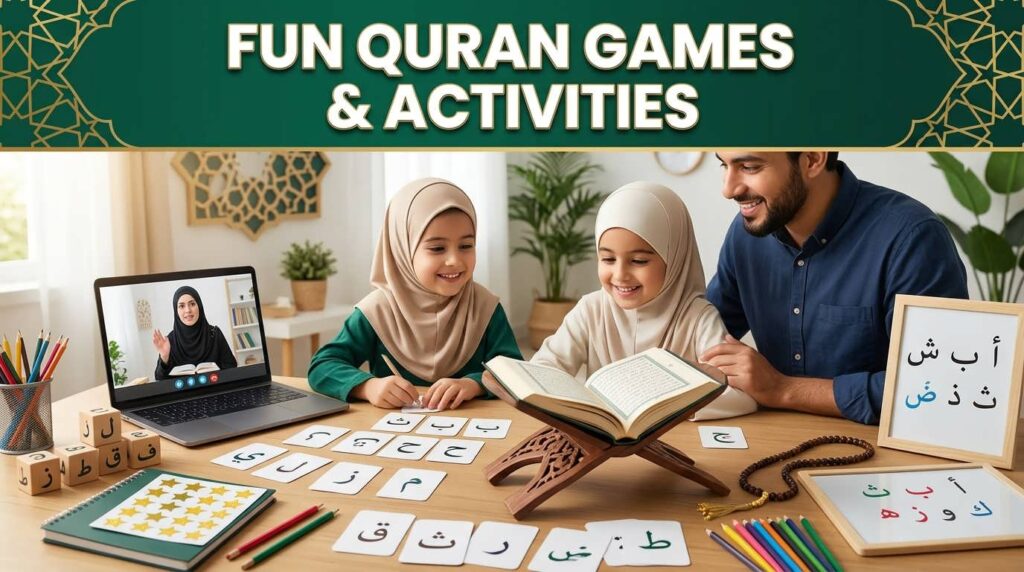
Games and activities that reinforce Quran learning help children improve memorization, recitation, Tajweed, and revision through interactive experiences. Educational games, family activities, and reward-based learning can make Quran study enjoyable while encouraging consistency and long-term retention.
Helping children learn the Quran is one of the greatest responsibilities and blessings for Muslim parents.
However, maintaining a child’s attention can sometimes be challenging. Young learners naturally enjoy exploring, playing, and discovering new things through interactive experiences rather than long periods of passive learning.
This doesn’t mean Quran learning should become entertainment. Instead, carefully chosen games and educational activities can reinforce lessons, increase motivation, and help children remember what they’ve learned more effectively.
When used appropriately, these activities complement regular Quran classes by making revision enjoyable and encouraging children to practice more often.
In this guide, we’ll explore practical games and activities that reinforce Quran learning while helping children develop a lasting love for the Quran.
- Why Interactive Learning Helps Children Remember Better
- Game 1: Quran Word Matching
- Game 2: Arabic Letter Treasure Hunt
- Game 3: Surah Memory Challenge
- Game 4: Tajweed Listening Challenge
- Game 5: Daily Quran Reward Chart
- Family Quran Quiz Night
- Screen-Free Quran Learning Activities
- Common Mistakes When Using Games
- How QuranJourney Keeps Children Engaged
- Conclusion
- Frequently Asked Questions
Why Interactive Learning Helps Children Remember Better
Children learn best when they actively participate in the learning process.
Reading, listening, speaking, and playing educational games together engage different learning skills, making it easier to understand and remember new information.
Interactive activities can help children:
- Improve concentration.
- Strengthen memory.
- Increase confidence.
- Practice Quran lessons more frequently.
- Develop positive learning habits.
- Associate Quran learning with enjoyable experiences.
The goal is not to replace structured Quran lessons but to reinforce what children already learn with their teacher.
Parents looking for additional ways to support their children can also read our guide Parents’ Role During Online Quran Lessons, which explains how encouragement at home contributes to long-term success.
Game 1: Quran Word Matching
This simple activity helps children recognize familiar Quranic words while improving observation and memory.
How to Play
Prepare two sets of cards.
One set contains:
- Simple Arabic Quranic words.
The second set contains:
- Matching words or corresponding meanings suitable for the child’s level.
Spread the cards face down.
Children take turns turning over two cards at a time to find matching pairs.
Learning Benefits
This activity helps children:
- Recognize familiar words more quickly.
- Improve visual memory.
- Reinforce previous lessons.
- Build confidence through repetition.
You can gradually increase the difficulty as your child’s reading ability improves.
Game 2: Arabic Letter Treasure Hunt
This activity is especially useful for beginners learning the Arabic alphabet or Noorani Qaida.
How to Play
Hide Arabic letter cards around the room.
Give your child a target letter.
For example:
- Find the letter ب
- Find the letter م
- Find the letter ن
Each time the child finds a card, encourage them to pronounce the letter correctly before searching for the next one.
Learning Benefits
Children develop:
- Faster letter recognition.
- Better pronunciation.
- Stronger recall.
- Greater enthusiasm for revision.
Physical movement also helps many young learners stay engaged for longer periods.
Game 3: Surah Memory Challenge
Memorization becomes more enjoyable when children see it as a personal achievement rather than a competition.
Choose one short Surah your child is currently learning.
Throughout the week, encourage them to recite it:
- After Salah.
- Before bedtime.
- During family revision time.
Instead of comparing siblings, celebrate each child’s personal progress.
Simple rewards such as extra story time or choosing the family’s weekend activity can motivate younger learners without making rewards the primary reason for learning.
Educational resources from Learning Roots encourage hands-on Islamic learning experiences that combine repetition, creativity, and positive reinforcement, helping children retain knowledge while developing a genuine love for learning.
Game 4: Tajweed Listening Challenge
Children often enjoy identifying sounds and patterns.
This activity strengthens listening skills while reinforcing Tajweed rules.
How to Play
Play a short Quran recitation from a qualified Qari.
Ask your child to listen carefully for a Tajweed rule they have recently learned.
For example:
- Ghunnah.
- Madd.
- Qalqalah.
Older children can explain why they noticed that particular rule, while younger learners can simply identify when they hear it.
This activity improves listening skills without making revision feel repetitive.
Game 5: Daily Quran Reward Chart
A reward chart can encourage consistency, especially for younger children who are developing new habits.
The purpose is not to reward the Quran itself but to recognize positive learning behaviors such as attending lessons, practicing regularly, and showing good effort.
You can create a simple weekly chart that includes goals like:
- Attend today’s Quran lesson.
- Complete daily revision.
- Practice correct pronunciation.
- Memorize a new verse.
- Read with focus.
- Show good manners during class.
At the end of the week, celebrate consistency with simple, meaningful rewards such as:
- Choosing a family activity.
- Extra reading time.
- A favorite healthy treat.
- A new Islamic storybook.
- Verbal praise and encouragement.
Over time, children begin to value the routine itself rather than the reward.
Family Quran Quiz Night
Learning becomes even more enjoyable when the whole family participates.
Choose one evening each week for a short Quran quiz.
Questions can include:
- Which Surah did we learn this week?
- Can you identify this Arabic letter?
- Which Tajweed rule did we practice?
- Who can continue this verse?
- What lesson did we learn from today’s translation?
Keep the atmosphere relaxed and encouraging.
The objective is to reinforce learning while creating positive family memories around the Quran.
Screen-Free Quran Learning Activities
Although online Quran classes use technology effectively, not every learning activity needs a screen.
Offline activities help children review lessons in different ways while reducing screen time.
Ideas include:
- Arabic alphabet flashcards.
- Quran vocabulary matching cards.
- Writing Arabic letters on a whiteboard.
- Coloring Arabic letters for younger learners.
- Building simple Quran-themed puzzles.
- Practicing recitation with parents or siblings.
- Storytelling based on the meaning of short Surahs.
A combination of online lessons and offline activities provides variety and keeps learning fresh.
Resources from Muslim Kids TV also encourage balancing digital learning with hands-on Islamic activities that promote creativity, participation, and family involvement.
Common Mistakes When Using Games
Educational games are most effective when they support learning rather than distract from it.
Parents should avoid:
- Making every lesson feel like a game.
- Offering expensive rewards for every achievement.
- Comparing children with siblings.
- Prioritizing speed over correct recitation.
- Turning games into competitions that create stress.
- Replacing regular Quran lessons with activities.
Games should reinforce the teacher’s lessons, not replace them.
When used in moderation, they help children remain motivated while strengthening what they have already learned.
How QuranJourney Keeps Children Engaged
At QuranJourney, we understand that children learn best when lessons are interactive, encouraging, and appropriate for their age.
Our qualified Quran teachers use engaging teaching methods that help students remain focused while making steady progress.
Our approach includes:
- Live one-on-one online Quran classes.
- Patient and experienced male and female teachers.
- Age-appropriate teaching strategies.
- Interactive revision activities.
- Positive encouragement.
- Personalized learning plans.
- Regular progress updates for parents.
Rather than relying on entertainment, our teachers create enjoyable learning experiences through meaningful interaction, encouragement, and structured guidance.
If you’d like your child to experience our teaching approach, you can book a Free Trial class before enrolling.
Conclusion
Children naturally learn through curiosity, repetition, and meaningful interaction.
By incorporating educational games and activities into their Quran learning routine, parents can reinforce lessons, encourage consistent practice, and make revision more enjoyable without losing sight of the true purpose of learning the Quran.
The most effective activities are those that support the teacher’s guidance, strengthen understanding, and help children build a lifelong love for the Quran.
With patience, encouragement, and the right balance between structured learning and engaging activities, Quran learning can become one of the most rewarding parts of a child’s daily routine.
Frequently Asked Questions
Do games really help children learn the Quran?
Yes. Educational games can improve memory, concentration, and motivation when they reinforce lessons already taught by a qualified Quran teacher.
At what age can children start Quran learning games?
Simple activities such as Arabic letter matching and flashcards can be introduced once children begin recognizing the Arabic alphabet. The activities should always match the child’s age and learning level.
Should games replace regular Quran lessons?
No. Games are designed to reinforce learning, not replace structured Quran lessons or guidance from a qualified teacher.
How often should we use Quran learning activities?
Many families find that including one or two interactive activities each week keeps children engaged while maintaining a balanced learning routine.
Are reward charts a good idea?
Yes, when used appropriately. Rewarding consistency, effort, and good learning habits can motivate children without shifting the focus away from sincere Quran learning.
Can siblings play Quran learning games together?
Absolutely. Cooperative games encourage teamwork, revision, and positive family interaction while avoiding unnecessary competition.
What if my child loses interest in the activities?
Introduce variety by rotating different games, keeping sessions short, and selecting activities that match your child’s age and current learning stage.
Can online Quran classes include interactive activities?
Yes. Many experienced online Quran teachers use age-appropriate interactive methods, questions, and revision exercises to keep children engaged throughout their lessons.