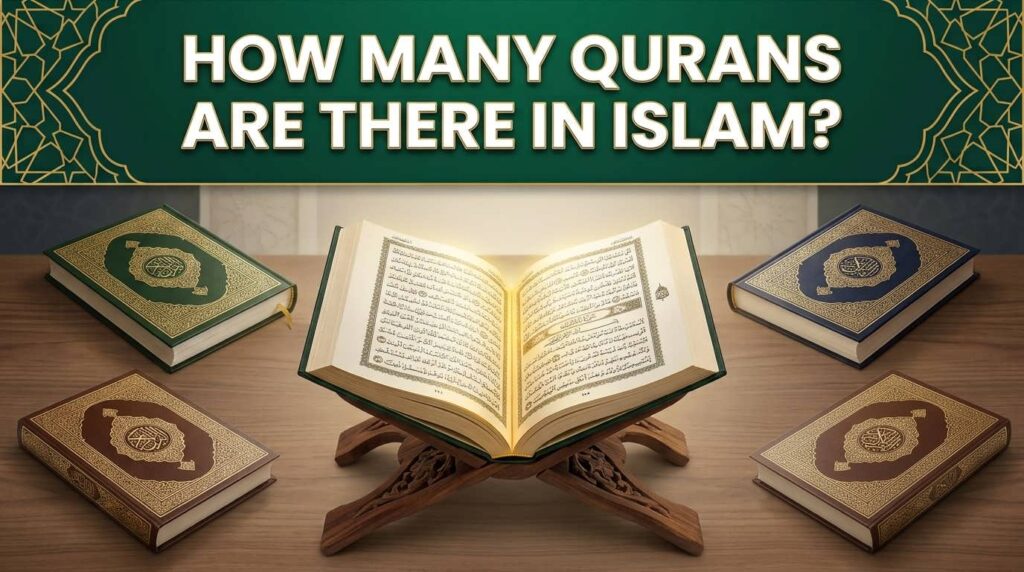
If you search how many Qurans are there in Islam, you may find confusing answers about different editions, translations, recitations, manuscripts, and Quran prints.
The short answer is simple: Muslims believe there is one Quran revealed by Allah to Prophet Muhammad ﷺ.
However, that does not mean every physical copy looks identical. Muslims around the world use different printed editions, translations, calligraphy styles, page layouts, and recognized methods of Quranic recitation.
Understanding this distinction is important.
There is a difference between the Quran itself, different Qira’at, translations of its meanings, and physical copies printed in different countries.
This article explains these differences clearly and answers one of the most common questions people have when studying Islam.
- How Many Qurans Are There?
- Why Do Some People Think There Are Multiple Qurans?
- 7 Powerful Facts About the Quran
- What Is the Original Language of the Quran?
- Are Different Quran Fonts Different Qurans?
- What Is the Madinah Quran?
- What Is an Indo-Pak Quran?
- What Are the Qira'at?
- What Is the Difference Between Hafs and Warsh?
- Why Do Some Quran Recitations Sound Different?
- What Is a Mushaf?
- Are There Different Versions of the Quran?
- Are Quran Translations Different From Each Other?
- Why Does the Quran Look Different in Different Countries?
- Does Every Quran Have the Same Number of Pages?
- Why Do Some Qurans Have Colored Letters?
- What Are Quran Manuscripts?
- Was the Quran Written Down During Prophet Muhammad's Lifetime?
- What Happened to the Quran After Prophet Muhammad ﷺ?
- Does the Quran Say It Will Be Preserved?
- Why Do Millions of Muslims Memorize the Quran?
- Does One Quran Exist in Every Muslim Country?
- What About the Quran in Different Languages?
- Is There One Quran or Many Qurans?
- Why Is Quran Preservation Important to Muslims?
- How Can You Start Learning the Quran?
- Why Is It Important to Learn Quran Correctly?
- Conclusion
- Frequently Asked Questions
How Many Qurans Are There?
There is one Quran in Islam.
Muslims believe that the Quran is the final revelation from Allah given to Prophet Muhammad ﷺ.
It consists of 114 Surahs, or chapters, and the Arabic Quran recited by Muslims around the world is understood to be the same revealed scripture.
A Quran printed in Pakistan, Egypt, Saudi Arabia, the United Kingdom, the United States, or another country is not considered a different Quran simply because its typography, page arrangement, or cover looks different.
The physical book can differ.
The Quranic revelation does not become a different Quran because of those differences.
Why Do Some People Think There Are Multiple Qurans?
The confusion usually comes from several different things being grouped together.
Someone may see:
- Different Quran translations
- Different Arabic fonts
- Different page layouts
- Different recitation styles
- Different Qira’at
- Different printed editions
- Old Quran manuscripts
- Different Quran covers
and conclude that these must be different Qurans.
They are not necessarily different Qurans.
A useful comparison is to distinguish between the original Arabic Quranic text, the way it is recited, and translations or physical editions used by readers.
7 Powerful Facts About the Quran
1. Muslims Believe There Is One Quran
Islam teaches that Allah revealed the Quran to Prophet Muhammad ﷺ.
The revelation took place over approximately 23 years.
The Quran describes itself as revelation and guidance.
For example, Surah Al-Baqarah describes the Book as guidance for those conscious of Allah. (Quran.com)
Muslims therefore do not believe that different countries have fundamentally different Qurans.
A Muslim who travels from one country to another can open a Quran and recognize the same Surahs and verses.
2. The Quran Has 114 Surahs
The Quran consists of 114 Surahs.
Some are very short, while others are considerably longer.
The first Surah is Al-Fatihah, and the final Surah is An-Nas.
The names and order of the 114 Surahs are shared across the Muslim world.
There may be differences in printed page numbering, typography, or layout, but these do not create different Qurans.
3. Quran Translations Are Not Considered Separate Qurans
One of the biggest sources of confusion is translation.
The Quran was revealed in Arabic.
Muslims around the world may read translations into languages such as:
- English
- Urdu
- Bengali
- Turkish
- French
- German
- Indonesian
- Malay
- Spanish
These translations help readers understand the meaning of the Quran.
However, Muslims generally distinguish between the Quran itself in Arabic and a translation of its meanings.
A translation is therefore not considered a second Quran.
This distinction is particularly important because translation always involves interpretation.
Different translators may choose different English or Urdu words to communicate the meaning of an Arabic expression.
The underlying Arabic Quran remains the reference text.
What Is the Original Language of the Quran?
The Quran was revealed in Arabic.
The Quran itself describes the revelation as an Arabic Quran in several places.
For example, Surah Yusuf refers to it as an Arabic Quran so that people may understand. (Quran.com)
Arabic is therefore central to Quranic recitation.
Muslims who do not speak Arabic may use translations to understand the message, but the Arabic text remains central to Islamic worship and Quranic recitation.
Are Different Quran Fonts Different Qurans?
No.
Arabic can be written in different calligraphic styles.
You may see Qurans printed using:
- Uthmani-style script
- Indo-Pak script
- Different Arabic fonts
- Different calligraphic styles
- Different sizes
- Different page layouts
These visual differences do not automatically mean that the underlying Quran is different.
For example, a Quran printed in an Indo-Pak style may look quite different from a Quran printed in a Madinah-style script.
Yet Muslims recognize both as copies of the same Quranic revelation.
What Is the Madinah Quran?
The term Madinah Mushaf or Madinah Quran is commonly associated with Quran editions produced in Saudi Arabia, particularly editions published by the King Fahd Quran Printing Complex.
These editions are widely distributed around the world.
The term does not mean that Muslims believe there is a separate “Madinah Quran.”
It refers to a particular printed edition and script tradition.
The King Fahd Quran Printing Complex provides extensive information and Quran resources.
What Is an Indo-Pak Quran?
Many Muslims in South Asia are familiar with the Indo-Pak style of Quran printing.
It uses a distinctive calligraphic style that can look different from the script commonly seen in many Middle Eastern Quran editions.
The page layout may also differ.
For example, a learner in Pakistan may be accustomed to one page arrangement while a learner in Saudi Arabia may use another.
This does not mean they are studying different Qurans.
They are using different physical presentations of the same Quranic revelation.
What Are the Qira’at?
The word Qira’at refers to recognized methods of Quranic recitation and transmission.
This is one of the most important concepts to understand when discussing variations in Quranic recitation.
There are traditionally recognized canonical Qira’at, transmitted through chains of scholarship.
Among the best-known are:
- Hafs ‘an Asim
- Warsh ‘an Nafi’
- Qalun ‘an Nafi’
- Al-Duri
- Shu’bah ‘an Asim
These recitations can contain differences in pronunciation, vowelization, or certain readings.
However, these recognized Qira’at are not generally understood by Muslims as different competing Qurans.
They are transmitted readings of the Quran.
What Is the Difference Between Hafs and Warsh?
Hafs and Warsh are two well-known Quranic transmission traditions.
Hafs ‘an Asim is particularly common in many parts of the Muslim world, including much of the Middle East and South Asia.
Warsh ‘an Nafi’ is particularly common in parts of North and West Africa.
Someone familiar with one recitation may notice differences when listening to another.
These differences can involve pronunciation, vowels, or specific accepted readings.
The existence of these recognized Qira’at does not mean Muslims have separate religious scriptures.
It is more accurate to understand them as transmitted Quranic readings within the Islamic tradition.
Why Do Some Quran Recitations Sound Different?
There are several reasons.
The most important include:
Qira’at
Different recognized recitation traditions can produce differences in pronunciation and certain readings.
Tajweed
Different reciters may apply pronunciation rules with different levels of vocal emphasis or melodic style while maintaining the underlying text.
Regional Accent
A reciter’s natural Arabic pronunciation can reflect their linguistic background.
Recitation Style
Two reciters using the same Qira’ah can still sound different because of their voice, pace, tone, and recitation technique.
Therefore, hearing two different Quran recitations does not automatically mean that two different Qurans are being recited.
What Is a Mushaf?
Mushaf is a commonly used Arabic term for a written or compiled copy of the Quran.
When someone holds a physical Quran, they are holding a Mushaf.
This distinction can be useful when discussing the difference between the revealed Quran and its physical written form.
A Mushaf can have:
- Different cover designs
- Different paper quality
- Different page numbers
- Different font styles
- Different sizes
- Different translations alongside the Arabic
These physical differences do not make each copy a separate Quran.
Are There Different Versions of the Quran?
It depends on what is meant by “versions.”
If by versions you mean completely different scriptures with different core contents, Muslims do not consider there to be multiple versions of the Quran.
If you mean different printed editions, translations, scripts, or recognized Qira’at, then yes, Muslims encounter different forms of presentation and recitation.
These categories should not be confused.
For example:
Different translation = translation of Quranic meanings
Different font = different visual presentation
Different printed edition = different physical publication
Different Qira’ah = recognized method of recitation
None of these automatically means “a different Quran.”
Are Quran Translations Different From Each Other?
Yes, translations can differ.
But that does not mean the Quran itself has multiple conflicting Arabic versions.
Arabic words can have a range of meanings.
A translator must choose how to communicate that meaning in another language.
For example, one translator may choose “mercy,” while another may choose a phrase that provides additional context.
This is why serious Quran study often benefits from consulting the Arabic text, more than one translation, and reliable Tafsir.
For English readers, Quran.com provides access to the Quran along with translations and study resources.
Why Does the Quran Look Different in Different Countries?
Physical Quran editions are influenced by local printing and reading traditions.
Differences may include:
- Font
- Calligraphy
- Page dimensions
- Number of lines per page
- Verse markers
- Tajweed color coding
- Translation placement
- Cover design
- Paper quality
For example, one Mushaf may use 15 lines per page while another may use a different layout.
These differences are similar to different editions of a printed book.
They do not automatically represent different underlying scriptures.
Does Every Quran Have the Same Number of Pages?
No.
A Quran does not have to contain exactly the same number of physical pages.
Page count can change because of:
- Font size
- Page dimensions
- Line spacing
- Number of lines per page
- Translation placement
- Calligraphy style
- Margins
One Mushaf may contain 600 or more pages while another may contain fewer.
The number of pages does not determine whether it is a different Quran.
The number of Surahs and the Quranic text are much more relevant.
Why Do Some Qurans Have Colored Letters?
Many modern Qurans use colors to help students apply Tajweed rules.
For example, different colors may identify certain pronunciation rules.
These colors are instructional tools.
They do not represent different words or different Qurans.
They are particularly helpful for students who are learning Quran recitation.
What Are Quran Manuscripts?
Before modern printing, Quranic text was transmitted through manuscripts.
Historical Quran manuscripts exist in libraries, museums, universities, and private collections around the world.
These manuscripts are important for studying the history of Quranic writing and transmission.
However, an ancient manuscript and a modern printed Mushaf should not automatically be treated as completely different texts simply because their handwriting, spelling conventions, or page appearance differ.
Early Arabic writing developed with different conventions from modern printed Arabic.
Was the Quran Written Down During Prophet Muhammad’s Lifetime?
Islamic sources describe Quranic revelation being both memorized and written during the lifetime of Prophet Muhammad ﷺ.
Companions memorized passages and scribes wrote down revelation.
After the Prophet’s death, the early Muslim community undertook efforts to collect and standardize the written Quranic text.
This transmission history is an important part of how Muslims understand Quranic preservation.
What Happened to the Quran After Prophet Muhammad ﷺ?
According to Islamic historical tradition, Quranic passages had already been memorized and written during the Prophet’s lifetime.
After his death, the early Muslim community collected the written material.
During the caliphate of Abu Bakr, a collection was prepared.
Later, during the caliphate of Uthman ibn Affan, standardized copies were produced and distributed to different regions.
This process is commonly discussed in the classical Islamic sources concerning the compilation of the Quran.
For Muslims, this history is closely connected with their belief that the Quran has been preserved.
Does the Quran Say It Will Be Preserved?
The Quran itself states:
“Indeed, it is We who sent down the Reminder, and indeed, We will be its guardian.”
This is found in Surah Al-Hijr 15:9. (Quran.com)
Muslim scholars understand this verse as part of the Quran’s promise of divine preservation.
Quran memorization has also played an important role in this tradition.
Why Do Millions of Muslims Memorize the Quran?
Quran memorization is known as Hifz.
Muslims memorize portions of the Quran for several reasons.
Some memorize Surahs for Salah.
Others want to preserve the Quran in their memory.
Some undertake the long-term goal of memorizing the entire Quran.
The tradition of Hifz also means that Quranic recitation is not dependent solely on physical books.
A person who has memorized the Quran can recite it without holding a Mushaf.
This living memorization tradition is one of the distinctive features of Islamic religious practice.
Does One Quran Exist in Every Muslim Country?
Yes, in the sense that Muslims around the world use the same Quranic scripture.
However, the physical copies may look different.
A Muslim in Pakistan may commonly use an Indo-Pak Mushaf.
A Muslim in Saudi Arabia may commonly use a Madinah Mushaf.
A Muslim in Morocco may commonly encounter a Warsh-based Mushaf.
These differences relate to script, recitation tradition, and printing conventions rather than different competing revelations.
What About the Quran in Different Languages?
The Quran’s revelation is in Arabic.
Muslims have translated its meanings into hundreds of languages.
These translations are important for people who do not understand Arabic.
However, a translation is not normally treated as the Quran itself in Islamic theology.
This distinction matters especially in Salah, where Quranic recitation is traditionally performed in Arabic.
Translations are primarily used to understand the message.
Is There One Quran or Many Qurans?
The clearest answer is:
There is one Quranic revelation, while there are many physical copies, translations, editions, scripts, and recognized recitation traditions.
This distinction resolves most of the confusion surrounding the question.
Think of the categories separately:
| What You See | Is It a Different Quran? |
|---|---|
| Different cover | No |
| Different font | No |
| Different page layout | No |
| Different number of pages | No |
| English translation | No |
| Urdu translation | No |
| Different Tajweed colors | No |
| Different printed edition | No |
| Recognized Qira’ah | No, it is a recitation tradition |
| A completely different scripture | Not considered a separate Quran within Islam |
Why Is Quran Preservation Important to Muslims?
Preservation matters because Muslims believe the Quran is Allah’s final revelation.
If the scripture is a source of divine guidance, maintaining its transmission is extremely important.
This is why Muslims have historically emphasized:
- Memorization
- Recitation
- Written copies
- Teaching
- Verification
- Transmission through teachers
- Quranic scholarship
Today, these practices continue around the world.
Children and adults learn Quran reading, Tajweed, and memorization through mosques, Islamic schools, and online Quran academies.
How Can You Start Learning the Quran?
If you are asking questions about the Quran because you want to begin learning, you do not need to wait until you know everything about Arabic.
A beginner can start step by step.
You can learn:
- Arabic letters
- Letter pronunciation
- Harakat
- Joining letters
- Basic Quran reading
- Tajweed
- Memorization
- Translation and meaning
A qualified teacher can correct pronunciation and help prevent mistakes from becoming habits.
For students who prefer learning from home, online Quran classes can provide structured lessons with a teacher.
Why Is It Important to Learn Quran Correctly?
Correct Quran reading matters because Arabic pronunciation can affect meaning.
Students may struggle with:
- Similar Arabic letters
- Correct articulation
- Long and short vowels
- Stopping and starting
- Tajweed rules
- Fluency
Regular teacher feedback can help identify these problems early.
For children especially, a patient and structured learning routine can make Quran education easier to maintain. Our guide on Quran learning routine for kids provides practical ideas for building consistent Quran study habits.
Conclusion
So, how many Qurans are there in Islam?
The Islamic answer is that there is one Quran, understood by Muslims as the final revelation from Allah to Prophet Muhammad ﷺ.
However, there are many physical copies and presentations of the Quran.
You may find different fonts, calligraphy styles, page layouts, translations, printed editions, and recognized Qira’at.
These differences can sometimes make Qurans look or sound different, but they should not automatically be understood as evidence of multiple competing Qurans.
The key distinction is between the Quranic revelation, its physical Mushaf copies, its translations, and its recognized recitation traditions.
Once these categories are understood, the question becomes much clearer.
For Muslims, the Quran remains a central source of faith, worship, guidance, and spiritual development.
Frequently Asked Questions
How many Qurans are there in Islam?
Muslims believe there is one Quranic revelation. There are many physical copies, editions, translations, and recognized recitation traditions.
Are there different versions of the Quran?
There are different printed editions, scripts, translations, and Qira’at. Muslims do not generally consider these to be separate competing Qurans.
Why do Qurans look different?
Qurans can use different fonts, calligraphy, page layouts, sizes, Tajweed color systems, and printing styles.
Is the Quran the same in every country?
The physical presentation can differ between countries, but Muslims recognize the same 114 Surahs of the Quran.
Are Quran translations different Qurans?
No. A translation communicates the meaning of the Quran in another language. Muslims distinguish translations from the original Arabic Quran.
What are Qira’at?
Qira’at are recognized methods of Quranic recitation transmitted through established chains of scholarship.
Is Hafs different from Warsh?
Hafs and Warsh are two recognized Quranic transmission traditions. They contain certain differences in recitation and readings but are not generally understood by Muslims as separate Qurans.
Why does an Indo-Pak Quran look different from a Madinah Quran?
They may use different calligraphic and page-layout traditions. The visual difference does not mean that they are separate scriptures.
Does every Quran have the same number of pages?
No. Page count can vary according to font, page size, line count, margins, and layout.
What is a Mushaf?
Mushaf commonly refers to a written or compiled physical copy of the Quran.
Was the Quran written during Prophet Muhammad’s lifetime?
Islamic historical sources describe Quranic revelation being memorized and written during the Prophet’s lifetime, followed by collection and standardization in the early Muslim community.
Does the Quran claim to be preserved?
Yes. Surah Al-Hijr 15:9 states that Allah sent down the Reminder and would guard it. (Quran.com)
Can I learn the Quran online?
Yes. Students can learn Quran reading, Tajweed, memorization, and related skills through structured online lessons with qualified teachers.