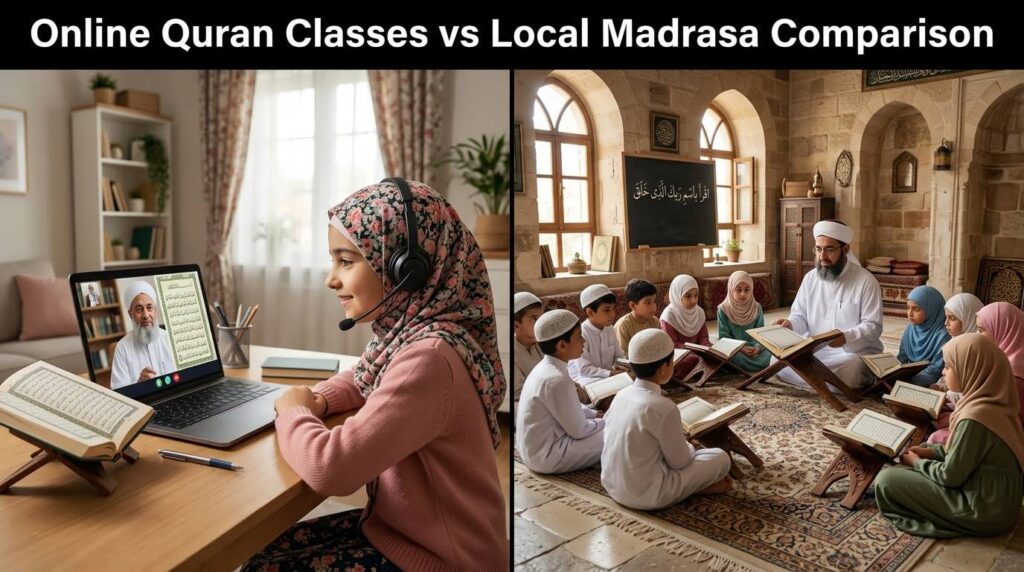
When comparing online Quran classes vs local madrasa education, neither option is universally better. Online Quran classes offer flexibility, personalized learning, and access to qualified teachers worldwide, while local madrasas provide in-person interaction, community engagement, and a traditional learning environment. The best choice depends on your child’s needs, schedule, learning style, and educational goals.
Many Muslim parents eventually face the same question: should they enroll their child in online Quran classes or send them to a local madrasa?
Both options can provide valuable Islamic education, Quran recitation training, and religious guidance. However, the learning experience differs significantly. Understanding these differences can help parents make a decision that supports their child’s long-term Quran learning journey.
- Online Quran Classes vs Local Madrasa: Quick Comparison
- Understanding Online Quran Classes
- Understanding Local Madrasa Education
- Flexibility: A Major Advantage of Online Quran Classes
- Access to Qualified Teachers
- Personalized Learning vs Group Learning
- Travel and Convenience
- Community and Social Development
- Learning Outcomes: Which Option Produces Better Results?
- Which Option Is Better for Quran Memorization?
- Which Option Is Better for Tajweed?
- When Online Quran Classes May Be the Better Choice
- When a Local Madrasa May Be the Better Choice
- A Balanced Approach for Modern Muslim Families
- How to Make the Right Decision for Your Child
- Conclusion
- Frequently Asked Questions
Online Quran Classes vs Local Madrasa: Quick Comparison
| Feature | Online Quran Classes | Local Madrasa |
|---|---|---|
| Learning Location | Home | Physical Classroom |
| Schedule Flexibility | High | Limited |
| Travel Required | No | Yes |
| One-on-One Learning | Common | Less Common |
| Teacher Availability | Global Access | Local Teachers Only |
| Parent Involvement | Easier | Moderate |
| Class Size | Usually Small | Often Larger |
| Personalized Learning | High | Varies |
| Community Interaction | Limited | Strong |
| Weather Impact | Minimal | Possible |
For many families in the USA, UK, Canada, Germany, New Zealand, and Europe, online Quran education has become increasingly popular because it solves many logistical challenges associated with traditional learning.
Understanding Online Quran Classes
Online Quran classes connect students with qualified Quran teachers through live video sessions.
Students can learn:
- Noorani Qaida
- Quran Reading (Nazara)
- Tajweed
- Hifz
- Tafsir
- Islamic Studies
- Hadith
Lessons take place from home using a laptop, tablet, or smartphone.
If you’re new to virtual Quran education, our guide on How Online Quran Classes Work can help you understand the learning process from enrollment to daily lessons.
Understanding Local Madrasa Education
A local madrasa is a traditional Islamic educational institution where students attend classes in person.
Depending on the madrasa, students may learn:
- Quran Recitation
- Tajweed
- Islamic Studies
- Arabic
- Hadith
- Seerah
Many families appreciate the traditional environment and face-to-face interaction that madrasas provide.
However, the quality of instruction and available resources can vary significantly depending on location.
Flexibility: A Major Advantage of Online Quran Classes
One of the biggest reasons families choose online learning is flexibility.
Modern families often juggle:
- School schedules
- Sports activities
- Homework
- Work commitments
- Family responsibilities
Online classes allow students to schedule lessons around these obligations.
For example, a family in London or Toronto may schedule Quran lessons before school, after school, or during weekends without commuting across town.
Local madrasas typically operate on fixed schedules, which may not work for every family.
Access to Qualified Teachers
Teacher quality is one of the most important factors in Quran education.
Online Quran Classes
Parents can choose from a wide range of teachers specializing in:
- Tajweed
- Hifz
- Quran Recitation
- Islamic Studies
- Female Quran Instruction
- Children’s Quran Education
Families looking for female instructors may also find our article on Female Quran Teacher Online helpful when evaluating teaching options.
Local Madrasa
Local madrasas are limited to the teachers available within the community.
Some communities have excellent instructors, while others may have fewer qualified teaching options.
For families living in areas with limited Islamic educational resources, online learning often provides greater choice.
Personalized Learning vs Group Learning
Every child learns differently.
Some students need additional support, while others progress quickly.
Online Quran Classes
Online programs frequently offer:
- One-on-one lessons
- Customized lesson plans
- Individual progress tracking
- Immediate feedback
This personalized approach can help students advance more efficiently.
Local Madrasa
Many madrasas teach larger groups of students.
Group learning can encourage social interaction, but teachers may have less time to focus on individual learning challenges.
Travel and Convenience
Travel may seem like a small issue, but it can significantly affect consistency.
Online Learning
Students simply log in from home.
Benefits include:
- No commuting
- Time savings
- Greater attendance consistency
- Reduced parental transportation responsibilities
Local Madrasa
Parents may need to:
- Drive children to class
- Coordinate transportation
- Adjust schedules around class times
In regions with long winters or busy traffic, travel can become a barrier to consistent attendance.
Community and Social Development
This is one area where local madrasas often have an advantage.
Benefits of Local Madrasa Community
Students can:
- Meet Muslim peers
- Participate in group activities
- Build friendships
- Experience community events
- Develop a sense of belonging
These social experiences can be valuable, especially for children growing up in non-Muslim majority countries.
Online Learning Limitations
While online classes provide excellent academic instruction, they generally offer fewer opportunities for in-person social interaction.
Learning Outcomes: Which Option Produces Better Results?
The answer depends less on the format and more on the quality of instruction and student consistency.
Research across education generally shows that personalized learning often improves outcomes when students remain engaged.
Online Quran classes frequently provide:
- Individual attention
- Customized pacing
- Consistent feedback
- Regular assessments
These factors can contribute to strong learning outcomes.
Students seeking structured Quran education can benefit from programs such as the Nazara Quran Course and the Hifz Ul Quran Course.
Which Option Is Better for Quran Memorization?
Memorization requires:
- Consistency
- Revision
- Accountability
- Teacher supervision
Online Hifz programs often provide daily monitoring and individualized revision schedules.
Students pursuing Quran memorization may benefit from the structured approach used in the Hifz Ul Quran Course.
However, some traditional madrasas also offer highly effective memorization programs.
The quality of the teacher remains more important than the delivery method.
Which Option Is Better for Tajweed?
Tajweed requires careful listening and correction.
Qualified teachers can effectively teach Tajweed both online and in person.
The Quran encourages believers to recite properly and thoughtfully, as emphasized through resources such as Quran.com.
Because many online classes are one-on-one, students often receive more direct pronunciation correction than they would in larger group settings.
When Online Quran Classes May Be the Better Choice
Online learning may be ideal if:
- You have a busy family schedule
- Qualified local teachers are unavailable
- Your child benefits from one-on-one instruction
- You want flexible class timings
- You prefer learning from home
- You need access to female Quran teachers
Parents interested in the broader advantages of virtual learning may also find value in our article on Benefits of Online Quran Classes.
When a Local Madrasa May Be the Better Choice
A local madrasa may be preferable if:
- Community interaction is a top priority
- You have access to excellent local teachers
- Your child learns best in group settings
- You value traditional classroom environments
- Transportation is not a concern
For some families, a hybrid approach works best by combining madrasa activities with supplemental online Quran instruction.
A Balanced Approach for Modern Muslim Families
The decision is not always either-or.
Many families combine:
- Local mosque programs
- Weekend madrasa classes
- Online Quran lessons
- Home-based revision
This approach allows students to benefit from both community engagement and personalized instruction.
Students seeking deeper Quranic understanding can also supplement recitation studies through a Dars-e-Quran Course, while those interested in Prophetic teachings may explore a Dars-e-Hadith Course alongside authentic resources from Sunnah.com.
How to Make the Right Decision for Your Child
Before choosing a learning method, consider:
- Your child’s learning style
- Teacher quality available to you
- Family schedule
- Educational goals
- Budget considerations
- Transportation requirements
- Desired level of parental involvement
Most importantly, choose an option that encourages consistency and long-term engagement with the Quran.
Families who want to evaluate an online learning environment can begin with a free Trial Class before committing to regular lessons.
Conclusion
The debate between online Quran classes vs local madrasa education does not have a one-size-fits-all answer. Online Quran classes excel in flexibility, personalized instruction, and access to qualified teachers, while local madrasas provide valuable community engagement and traditional classroom experiences.
The best choice depends on your child’s needs, your family’s circumstances, and the quality of instruction available. Regardless of the format you choose, consistency, qualified teachers, and a structured learning path remain the keys to successful Quran education.
Frequently Asked Questions
Are online Quran classes better than a local madrasa?
Online Quran classes are not automatically better. They offer flexibility and personalized instruction, while local madrasas provide community interaction and traditional classroom experiences. The best option depends on individual needs and educational goals.
Do students learn Quran recitation effectively online?
Yes. Qualified teachers can provide real-time correction, Tajweed instruction, and recitation guidance through live online sessions, often with significant individual attention.
Is a local madrasa better for social development?
In many cases, yes. Madrasas provide opportunities for students to interact with peers, participate in group activities, and build community relationships.
Can children memorize the Quran through online classes?
Absolutely. Many online Hifz programs offer structured memorization plans, regular revision schedules, and teacher accountability that support successful memorization.
Are online Quran classes suitable for young children?
Yes. Many academies offer age-appropriate lessons designed specifically for young learners, using engaging teaching methods and individualized attention.
How can parents monitor online Quran classes?
Parents can easily observe lessons, communicate with teachers, review progress reports, and support learning at home.
Which option is more flexible?
Online Quran classes are generally more flexible because students can schedule lessons around school, work, and family commitments without requiring travel.
Can families combine online Quran classes and madrasa education?
Yes. Many families successfully combine local community involvement with online Quran instruction to benefit from both approaches.