A Quran recitation academy can help students improve their Quran reading, pronunciation, fluency, and Tajweed through structured lessons with a qualified teacher.
Many Muslims can read some Quran but are not confident about whether they are pronouncing every letter correctly. Others may have learned Quran as children but want to improve their recitation as adults. Some students are preparing for Hifz, while others simply want to recite the Quran more accurately during Salah.
A Quran recitation academy provides structured instruction to help students identify and correct these problems.
Today, students do not necessarily need to travel to a mosque or Islamic school for this type of learning. Online Quran recitation classes allow children and adults to study with teachers from home, often with flexible schedules and one-on-one instruction.
- What Is a Quran Recitation Academy?
- Why Is Quran Recitation Important?
- What Is Tajweed?
- What Does a Quran Recitation Academy Teach?
- Who Should Join a Quran Recitation Academy?
- Can Adults Learn Quran Recitation?
- Can Children Learn Quran Recitation Online?
- What Is an Online Quran Recitation Academy?
- What Are the Benefits of Online Quran Recitation Classes?
- What Should You Look for in a Quran Recitation Academy?
- What Qualifications Should a Quran Recitation Teacher Have?
- What Is the Difference Between Quran Reading and Quran Recitation?
- What Are Makharij?
- What Is the Difference Between Tajweed and Qira'at?
- Can You Learn Quran Recitation Without Knowing Arabic?
- How Long Does It Take to Improve Quran Recitation?
- How Often Should You Practice Quran Recitation?
- Can a Quran Recitation Academy Help With Tajweed?
- Is a Recorded Quran Recitation Course Enough?
- How Can You Tell if Your Quran Recitation Is Improving?
- Common Quran Recitation Mistakes
- Should You Choose a Male or Female Quran Teacher?
- How Much Do Quran Recitation Classes Cost?
- What Questions Should You Ask a Quran Recitation Academy?
- What Are the Red Flags of a Quran Recitation Academy?
- How Can Parents Help Children Improve Quran Recitation?
- Is Online Quran Recitation Right for You?
- QuranJourney as an Online Quran Recitation Option
- Quran Recitation Academy vs Learning by Yourself
- A Simple Quran Recitation Learning Plan
- Final Thoughts
- Frequently Asked Questions
What Is a Quran Recitation Academy?
A Quran recitation academy is an educational institution or online learning service that teaches students how to read and recite the Quran correctly.
Depending on the academy, lessons may cover:
- Basic Quran reading
- Arabic letter pronunciation
- Makharij
- Tajweed
- Quran fluency
- Hifz
- Qira’at
- Voice improvement
- Quran translation
- Tafsir
- Islamic Studies
A beginner may start by learning the Arabic letters and Noorani Qaida, while an advanced student may focus on detailed Tajweed, Qira’at, or memorization.
The exact curriculum depends on the academy and the student’s level.
Why Is Quran Recitation Important?
Quran recitation is an important part of Muslim worship.
Muslims recite Quranic verses during Salah and at other times as an act of worship and remembrance.
Correct pronunciation matters because Arabic letters have specific articulation points and characteristics. A mistake in pronunciation can sometimes change the meaning of a word.
This is one reason students are encouraged to learn Quran recitation from someone who understands Tajweed and can listen to their reading carefully.
The goal is not simply to read faster.
The goal is to read accurately, confidently, and respectfully.
What Is Tajweed?
Tajweed refers to the rules and principles used for correct Quranic pronunciation and recitation.
It helps students understand how Arabic letters should be articulated and how different letters and sounds interact during Quranic recitation.
Tajweed can include areas such as:
- Makharij al-Huruf
- Sifaat al-Huruf
- Noon Sakinah
- Tanween
- Meem Sakinah
- Madd
- Qalqalah
- Ghunnah
- Rules of stopping and starting
A student does not need to memorize every Tajweed rule before beginning Quran recitation.
A good teacher can introduce the rules gradually and demonstrate how they are applied while reading.
What Does a Quran Recitation Academy Teach?
The exact curriculum differs between academies, but a structured recitation program may progress through several stages.
Stage One: Quran Reading Foundations
Beginners may learn:
- Arabic letters
- Letter sounds
- Harakat
- Joining letters
- Basic words
- Quranic vocabulary patterns
Students who are completely new to Quran reading may begin with Noorani Qaida or a similar foundational method.
Stage Two: Quran Fluency
Once students understand the basics, they can begin reading Quranic passages more fluently.
The teacher listens to the student and identifies:
- Pronunciation errors
- Hesitation
- Incorrect vowel sounds
- Letter confusion
- Stopping mistakes
Regular correction helps students develop confidence.
Stage Three: Tajweed
After establishing basic reading ability, students can progressively learn Tajweed rules.
Instead of simply memorizing definitions, students should practice applying each rule during actual Quran recitation.
Stage Four: Regular Recitation Practice
The final goal is not merely to finish a Tajweed textbook.
Students need regular reading practice.
A teacher can listen to recitation, identify recurring mistakes, and help the student improve.
Who Should Join a Quran Recitation Academy?
A Quran recitation academy can be useful for many types of learners.
Complete Beginners
If you cannot read Arabic Quranic text, you can start from the basics.
Children
Children can develop correct pronunciation and reading habits early.
Adults
Adults who missed Quran education during childhood can begin at any age.
Intermediate Readers
Someone who can read Quran but makes frequent pronunciation mistakes may benefit from structured Tajweed training.
Hifz Students
Students memorizing the Quran need accurate recitation because memorizing incorrect pronunciation can create problems later.
Muslims Who Want to Improve Their Salah
Improving Quran recitation can also help students feel more confident when reciting Surahs during prayer.
Can Adults Learn Quran Recitation?
Absolutely.
Many adults believe they are too old to improve their Quran reading.
That is not a good reason to stop learning.
Adults may have different challenges from children, particularly when balancing work, family, and other responsibilities.
Online classes can make learning more convenient because students can schedule lessons around their existing routines.
Someone who already knows how to read Quran can focus on Tajweed rather than starting from the alphabet.
Someone who struggles with basic reading can begin from the foundation.
The learning plan should match the student’s current ability.
Can Children Learn Quran Recitation Online?
Yes.
Online Quran recitation classes can work particularly well for children when the teacher understands how to maintain a young student’s attention.
Parents should look for:
- Patient teachers
- Age-appropriate lessons
- Short and focused sessions
- Individual attention
- Positive correction
- Regular practice
- Progress updates
The child’s relationship with the teacher matters.
A teacher who constantly criticizes mistakes may make a child afraid of reading.
A teacher who corrects mistakes patiently can help build confidence.
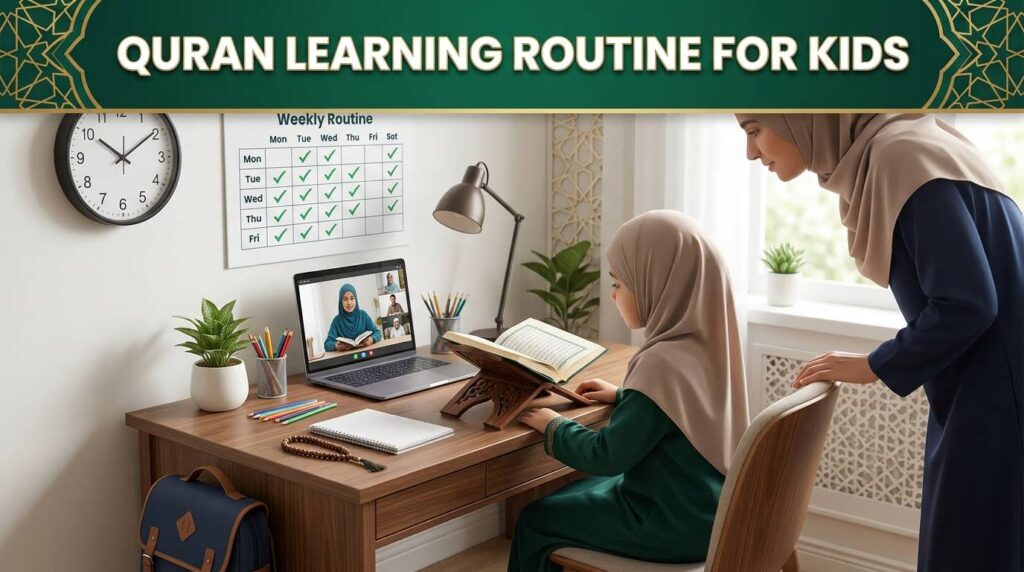
Parents can also establish a consistent Quran learning routine for kids at home.
What Is an Online Quran Recitation Academy?
An online Quran recitation academy provides Quran lessons through the internet instead of requiring students to attend a physical classroom.
Classes may take place through video conferencing platforms or a dedicated learning system.
A typical lesson may involve:
- Teacher checks the student’s previous work.
- Student reads a previously assigned passage.
- Teacher corrects pronunciation.
- Teacher introduces a new Tajweed concept.
- Student practices the concept.
- Teacher assigns practice for the next lesson.
The exact format depends on the academy.
For example, Al-Quran Academy offers live one-on-one Quran courses covering Quran reading, Tajweed, Hifz, Tafseer, Qira’at, and recitation improvement. Its courses are designed for children, teenagers, and adults.
What Are the Benefits of Online Quran Recitation Classes?
Learn From Home
Students can learn without traveling to a mosque or Islamic school.
Flexible Scheduling
Online academies can often accommodate students living in different time zones.
One-on-One Attention
Individual lessons allow the teacher to focus entirely on one student’s recitation.
Convenient for Families
Parents do not need to drive children to and from physical classes.
Suitable for International Students
Muslims living in countries where local Quran teachers are difficult to find can access teachers online.
Easier Teacher Matching
Some academies offer male and female teachers, allowing families to select an instructor based on their preferences.
What Should You Look for in a Quran Recitation Academy?
Not every academy offers the same quality of education.
Before enrolling, consider the following factors.
Qualified Quran Teachers
Ask about the teacher’s Quran education, Tajweed training, teaching experience, and relevant certifications.
For advanced Qira’at or Ijazah study, ask about the teacher’s specific qualifications in that field.
Live Classes
For pronunciation training, live instruction can be particularly valuable because the teacher needs to hear the student’s recitation.
Some programs also use recorded lessons as supplementary material.
A recorded course can be useful for independent practice, but it does not provide the same individualized correction as a live teacher.
One-on-One Learning
One-on-one classes allow teachers to identify individual pronunciation problems.
This can be especially useful for beginners, children, and students studying Tajweed.
Trial Class
A trial allows you to evaluate the teacher before committing.
Pay attention to how the teacher assesses the student’s reading level and corrects mistakes.
Flexible Timings
For international students, flexible scheduling can make a major difference.
Clear Curriculum
Ask what the student will learn and how progress will be measured.
A good curriculum should have a logical progression rather than random lessons.
Progress Tracking
Parents and students should have some way to understand whether improvement is taking place.
What Qualifications Should a Quran Recitation Teacher Have?
There is no single qualification that automatically makes someone the perfect teacher for every student.
However, relevant training can include:
- Quran memorization
- Tajweed education
- Ijazah
- Qira’at studies
- Formal Islamic education
- Teaching experience
The appropriate qualification depends on the level of instruction.
For basic Quran reading, an experienced Tajweed teacher may be sufficient.
For advanced Qira’at, a student should seek someone with appropriate training in the specific recitation tradition.
The important thing is to verify qualifications rather than relying solely on marketing claims.
What Is the Difference Between Quran Reading and Quran Recitation?
The terms are sometimes used interchangeably, but there is a useful distinction.
Quran reading can refer broadly to the ability to read the Arabic text.
Quran recitation generally emphasizes the way the Quran is pronounced and delivered.
A student might be able to read every word but still have problems with:
- Makharij
- Madd
- Ghunnah
- Qalqalah
- Stopping
- Letter characteristics
This is why someone who already reads Quran may still benefit from a recitation or Tajweed course.
What Are Makharij?
Makharij al-Huruf refers to the articulation points from which Arabic letters are pronounced.
Learning Makharij helps students understand where and how different Arabic sounds are produced.
For example, some letters may sound similar to a beginner but require different tongue, throat, or mouth positions.
A teacher can demonstrate these differences and listen to the student reproduce them.
This type of correction is difficult to achieve through text alone.
What Is the Difference Between Tajweed and Qira’at?
These terms should not be confused.
Tajweed concerns the rules and proper pronunciation of Quranic recitation.
Qira’at refers to recognized Quranic reading and recitation traditions transmitted through established chains.
A beginner generally does not need to study advanced Qira’at immediately.
It is usually better to establish accurate Quran reading and Tajweed first.
Students interested in advanced recitation should then seek appropriately qualified teachers.
Can You Learn Quran Recitation Without Knowing Arabic?
Yes.
You do not need to speak Arabic fluently to learn Quran recitation.
Many students learn to read and pronounce Quranic Arabic without becoming conversational Arabic speakers.
However, learning the meaning of what you recite can deepen your understanding.
For this reason, some students eventually combine Quran recitation lessons with translation or Quranic Arabic.
How Long Does It Take to Improve Quran Recitation?
There is no single answer.
Progress depends on:
- Current reading level
- Age
- Practice frequency
- Teacher quality
- Pronunciation difficulties
- Lesson length
- Consistency
- Number of Tajweed rules being studied
A complete beginner may need more time than someone who already reads fluently.
The most important factor is consistency.
Twenty or thirty minutes of focused practice several times a week can be more productive than studying intensively once every few weeks.
How Often Should You Practice Quran Recitation?
Ideally, Quran practice should become a regular habit.
A beginner might start with a manageable daily routine.
For example:
10 minutes: Review previous lesson
10 minutes: Practice the current Tajweed rule
10 minutes: Read a short Quran passage
The exact amount can be adjusted according to age and ability.
The objective is to build consistency without making the routine overwhelming.
Can a Quran Recitation Academy Help With Tajweed?
Yes.
Tajweed is one of the most common components of Quran recitation programs.
For example, Quran Recitation Academy currently offers a structured Tajweed and Quran recitation program that includes recorded lessons, practice worksheets, read-along sessions, and weekly live Tajweed classes.
This difference matters when choosing a course.
If you mainly need to understand Tajweed concepts, a self-paced course may be useful.
If you need someone to listen to your recitation and correct pronunciation, live instruction may be more appropriate.
Is a Recorded Quran Recitation Course Enough?
It depends on your needs.
Recorded lessons can be helpful because you can:
- Pause videos
- Repeat explanations
- Practice at your own pace
- Review difficult rules
- Study at convenient times
However, recorded lessons cannot fully replace personalized feedback for students who need pronunciation correction.
A strong learning approach can combine recorded material with live teacher feedback.
For example, Quran Recitation Academy currently offers a recorded Tajweed program along with additional live Tajweed sessions.
How Can You Tell if Your Quran Recitation Is Improving?
Look for measurable changes.
You may notice:
- Fewer pronunciation errors
- Less hesitation
- Better application of Tajweed rules
- Improved fluency
- Better control of Madd
- More accurate articulation
- More confidence during Salah
A teacher should also be able to identify areas where you are improving and where further practice is needed.
Common Quran Recitation Mistakes
Students often struggle with recurring pronunciation problems.
Common issues include:
Confusing Similar Letters
Some Arabic letters can sound similar to beginners.
Incorrect Madd
Students may shorten or lengthen sounds incorrectly.
Ignoring Ghunnah
Some learners do not apply nasal sounds correctly.
Incorrect Qalqalah
Students may exaggerate or weaken Qalqalah.
Incorrect Stopping
Stopping at an inappropriate place can affect meaning or disrupt the intended recitation.
Reading Too Quickly
Speed can cause students to overlook pronunciation errors.
Accuracy should come before speed.
Should You Choose a Male or Female Quran Teacher?
This depends on your personal and family preferences.
Some parents prefer female teachers for their daughters or young children.
Some adults prefer a teacher of the same gender.
Others prioritize teaching experience and availability regardless of gender.
A good academy should make the available options clear rather than making unrealistic promises.
How Much Do Quran Recitation Classes Cost?
The cost varies according to the academy and learning format.
Factors may include:
- Number of lessons per week
- Lesson duration
- Teacher experience
- One-on-one or group classes
- Beginner or advanced course
- Country
- Additional learning materials
Do not choose solely based on price.
The quality of teacher feedback is particularly important for recitation training.
A cheap course that does not correct your pronunciation may not provide good value.
What Questions Should You Ask a Quran Recitation Academy?
Before enrolling, ask:
- Who will teach me?
- What Quran qualifications does the teacher have?
- Does the teacher specialize in Tajweed?
- Are classes live?
- Are classes one-on-one?
- How long is each lesson?
- How many classes are held each week?
- Is there a trial class?
- How is student progress monitored?
- Can I change teachers if necessary?
- Are male and female teachers available?
- What happens if I miss a class?
- Are there additional fees?
- Does the course include practice material?
- Can advanced students study Qira’at or Ijazah?
Getting clear answers before enrolling can prevent problems later.
What Are the Red Flags of a Quran Recitation Academy?
Be cautious when an academy:
- Cannot explain teacher qualifications.
- Makes unrealistic guarantees.
- Has no clear curriculum.
- Avoids explaining how students are assessed.
- Uses pressure to make you pay immediately.
- Does not offer any way to evaluate teaching quality.
- Provides unclear pricing.
- Constantly changes teachers without explanation.
- Does not provide meaningful pronunciation correction.
- Makes advanced claims without explaining teacher credentials.
You can read our detailed guide on online Quran academy red flags before making a decision.
How Can Parents Help Children Improve Quran Recitation?
Parents do not need to become Quran teachers themselves.
They can support the learning process by creating a consistent environment.
Try to:
- Keep a regular class schedule.
- Encourage daily practice.
- Listen occasionally to the child’s assigned lesson.
- Celebrate improvement.
- Avoid comparing siblings.
- Ask the teacher for progress updates.
- Give children enough rest between activities.
- Keep Quran learning positive.
If a child repeatedly refuses Quran classes, the problem may not always be laziness.
The teacher, lesson duration, learning environment, or teaching approach may not match the child’s needs.
Is Online Quran Recitation Right for You?
Online learning can be a good option if you:
- Have a busy schedule.
- Live far from an Islamic school.
- Need flexible timings.
- Prefer one-on-one lessons.
- Want to learn from home.
- Need a teacher who can listen to your recitation regularly.
It may be less suitable if your internet connection is unreliable or if you strongly prefer face-to-face classroom learning.
The important thing is to choose the format that allows you to learn consistently.
QuranJourney as an Online Quran Recitation Option
QuranJourney provides online Quran education through personalized lessons designed for students in different countries and age groups.
Its Quran programs include Quran reading and Hifz, alongside broader Islamic education.
For students specifically interested in improving Quran recitation, the important questions to ask are the same ones you should ask any academy:
- Who will teach you?
- What is the teacher’s Tajweed background?
- How frequently will you receive correction?
- Is the class one-on-one?
- Can the schedule fit your routine?
- Is there a trial lesson?
Rather than choosing an academy solely because of its marketing claims, use these criteria to determine whether the teaching approach fits your needs.
Quran Recitation Academy vs Learning by Yourself
Self-study has become much easier because of online videos, apps, websites, and recorded courses.
These resources can be valuable.
However, Quran recitation has a practical component that benefits from teacher feedback.
You may believe you are pronouncing a letter correctly while an experienced teacher can immediately identify the problem.
A combination can therefore work well:
Teacher: Corrects your recitation.
Course: Explains Tajweed concepts.
Practice: Builds fluency.
Listening: Helps reinforce correct pronunciation.
A Simple Quran Recitation Learning Plan
If you are starting today, keep the process simple.
Week One: Assess Your Level
Read a short Surah to a qualified teacher and ask them to identify your main weaknesses.
Week Two: Correct Pronunciation
Focus on the letters that cause the most problems.
Week Three: Begin Tajweed
Start learning basic Tajweed rules and immediately apply them during recitation.
Week Four: Build Consistency
Create a daily reading routine.
Continue reviewing old mistakes while learning new material.
Do not try to master every Tajweed rule at once.
Final Thoughts
A Quran recitation academy can provide structured support for anyone who wants to improve Quran reading, pronunciation, fluency, or Tajweed.
The most important factor is not the appearance of the website or the number of courses advertised.
It is the quality of the teaching.
A good teacher listens carefully, identifies mistakes, explains the correct pronunciation, and gives the student opportunities to practice.
For beginners, the journey may start with the Arabic alphabet and basic Quran reading.
For intermediate students, it may focus on Tajweed.
For advanced learners, it may eventually lead toward Hifz, Qira’at, or Ijazah study.
Online Quran learning has made these opportunities accessible to students around the world.
Take your time when choosing an academy, ask about teacher qualifications, attend a trial lesson when available, and choose a learning schedule you can maintain consistently.
The objective is not simply to finish a course.
It is to develop a more accurate, confident, and meaningful Quran recitation that can remain part of your life.
Frequently Asked Questions
What is a Quran recitation academy?
A Quran recitation academy teaches students how to read and recite the Quran correctly, often including Tajweed, pronunciation, fluency, and sometimes Hifz or advanced Qira’at.
Can I learn Quran recitation online?
Yes. Many academies provide live online Quran recitation and Tajweed classes for children and adults.
Is Quran recitation the same as Tajweed?
They are closely related but not identical. Quran recitation is the act of reading the Quran, while Tajweed provides rules for correct pronunciation and recitation.
Can beginners join a Quran recitation academy?
Yes. Beginners can start with Arabic letters, Noorani Qaida, pronunciation, and basic Quran reading.
Can adults learn Quran recitation?
Yes. Adults can begin from the basics or focus on Tajweed if they already know how to read Quran.
How long does it take to learn Tajweed?
The time varies according to your starting level, practice routine, teacher, and the complexity of the material.
Do I need to speak Arabic to learn Quran recitation?
No. You can learn Quranic pronunciation without becoming conversationally fluent in Arabic.