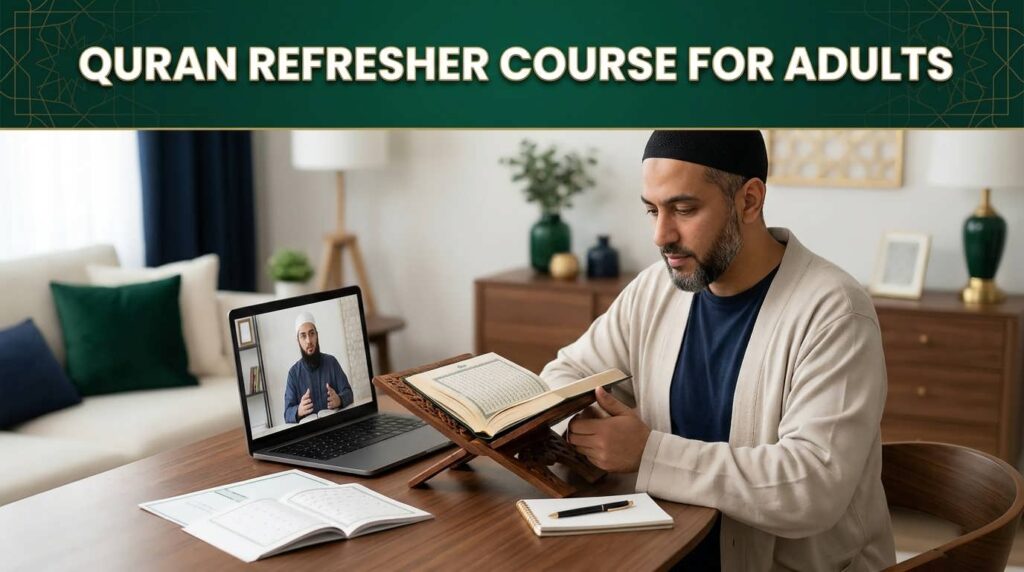
A Quran refresher course for adults is designed for people who learned Quran reading before but have become rusty, forgotten some Arabic reading rules, lost fluency, or need to correct their pronunciation and Tajweed. You do not necessarily need to restart from the Arabic alphabet or complete Noorani Qaida from page one. A good refresher begins with an assessment, identifies exactly what you still remember, and then focuses your lessons on the skills that need rebuilding.
| Your current reading | Likely refresher starting point |
|---|---|
| Forgotten most Arabic letters | Alphabet + beginner Qaida |
| Remember letters but struggle to join them | Noorani Qaida revision |
| Can decode words but read very slowly | Guided Quran reading |
| Read Quran but make frequent mistakes | Nazara + pronunciation |
| Read reasonably well but forgot Tajweed | Tajweed refresher |
| Previously fluent but now rusty | Direct Quran recitation + targeted correction |
The goal is not to repeat everything you learned as a child. It is to recover what has weakened and strengthen what remains.
- Quran Refresher Course for Adults: Who Is It For?
- 1. Begin With an Assessment, Not a Course Page
- 2. Decide Whether You Actually Need Noorani Qaida Again
- 3. Rebuild Reading Accuracy Before Chasing Speed
- 4. Use Your Quran Refresher Course for Adults to Fix Pronunciation
- 5. Refresh Tajweed Through Your Actual Reading
- 6. Practice Between Classes Instead of Depending on Lessons Alone
- 7. Use Spaced Practice to Make the Refresher Stick
- What Should a Quran Refresher Course Include?
- Quran Refresher Course vs Beginner Quran Course
- What If I Learned Quran as a Child but Forgot Most of It?
- Can Adults Take a Quran Refresher After 10 or 20 Years?
- How Long Does a Quran Refresher Course for Adults Take?
- How Often Should Adults Take Refresher Classes?
- Can I Take a Quran Refresher Course Online?
- A 30-Minute Quran Refresher Routine
- Should You Learn Tajweed and Quran Reading at the Same Time?
- What If I Feel Embarrassed Taking a Refresher Course?
- How Do You Know When the Refresher Is Working?
- What Comes After a Quran Refresher Course?
- Refresh What You Forgot Without Relearning What You Already Know
- Frequently Asked Questions
Quran Refresher Course for Adults: Who Is It For?
A refresher course sits between two common types of Quran learning.
It is not necessarily a complete beginner course.
It is also not necessarily an advanced Tajweed course.
It is useful for adults who recognize statements such as:
- “I learned Quran as a child but haven’t read regularly for years.”
- “I can still read, but I’m extremely slow.”
- “I remember the Arabic letters but struggle when they’re joined.”
- “I have forgotten many Tajweed rules.”
- “I can read familiar Surahs but struggle with unfamiliar pages.”
- “My pronunciation isn’t as good as it used to be.”
- “I learned from Qaida years ago but need to revise it.”
- “I want someone to correct my recitation before I continue independently.”
Structured Quranic literacy programs for adults do exist outside commercial online academies. For example, the Muslim Converts’ Association of Singapore describes its Quranic literacy program as covering Quranic phonetics and Tajweed with the goals of improving Quranic literacy, fluency and proper recitation.
That highlights an important point: adult Quran learning can be structured by current skill level, rather than assuming every adult is either a total beginner or already an advanced reader.
1. Begin With an Assessment, Not a Course Page
Before deciding what to relearn, find out what you’ve actually forgotten.
A useful Quran reading assessment might ask you to:
- Identify individual Arabic letters.
- Recognize letters when their shapes change inside words.
- Read letters with Fatha, Kasra and Damma.
- Read Sukoon, Shaddah and Tanween correctly.
- Recognize basic Madd.
- Read several simple Arabic words.
- Read a familiar short Surah.
- Read several lines from an unfamiliar Quran page.
- Demonstrate any Tajweed you still remember.
The unfamiliar passage is particularly useful.
If you test yourself only with Al-Fatihah or Surahs you memorized as a child, you may recite from memory rather than actually read the Arabic in front of you.
An assessment helps separate memory of familiar recitation from current Quran-reading ability.
QuranJourney’s guide to what happens in your first online Quran class explains how a first lesson can be used to identify a student’s current level before regular instruction begins.
2. Decide Whether You Actually Need Noorani Qaida Again
One of the first questions returning adults ask is:
“Do I need to start Qaida again?”
Sometimes yes.
Sometimes no.
Restart Qaida if you struggle with:
- Basic letter recognition
- Joined Arabic letters
- Harakat
- Sukoon
- Shaddah
- Tanween
- Basic Madd
- Sounding out unfamiliar words
If these foundations have disappeared, direct Quran reading can become frustrating because every line exposes several problems at once.
Don’t automatically restart from page one if you can still:
- Recognize Arabic letters
- Understand common reading signs
- Join letters
- Decode unfamiliar words
- Read slowly without relying entirely on memory
You might need only selected Qaida exercises.
For example, a teacher may spend several lessons reviewing difficult patterns and then move you into direct Quran reading.
The decision should be based on what you can read now, not simply on how many years have passed since you last studied.
If your main concern is that your reading has largely disappeared, the guide for adults who forgot how to read Quran provides a step-by-step restart plan.
3. Rebuild Reading Accuracy Before Chasing Speed
Returning adults often become frustrated by slow reading.
They remember being able to read much faster.
That can lead to rushing.
Avoid it.
Suppose you read a line slowly but accurately.
That gives you something stable to practice.
If you read quickly while:
- Guessing words
- Dropping vowels
- Confusing letters
- Missing Shaddah
- Shortening or extending sounds incorrectly
you are practicing errors.
Start with accuracy.
Then let repetition increase speed naturally.
A useful progression
Stage 1: Recognize the word correctly.
Stage 2: Read it accurately without help.
Stage 3: Read it with less hesitation.
Stage 4: Read it naturally inside the complete phrase.
Stage 5: Apply relevant Tajweed while maintaining fluency.
Don’t attempt stage five while stage two is still unreliable.
4. Use Your Quran Refresher Course for Adults to Fix Pronunciation
Reading the correct letters isn’t the entire problem.
Many returning learners can identify a word but pronounce some Arabic letters incorrectly.
Commonly challenging distinctions may include sounds represented by letters such as:
- ح and ه
- س and ص
- ت and ط
- د and ض
- ذ and ظ
- ك and ق
- ع and ا
- خ and ح
The solution isn’t simply listening to the sound repeatedly.
Your teacher needs to hear your version of it.
That allows the teacher to identify whether the problem comes from:
- Tongue position
- Throat articulation
- Lip position
- Incorrectly substituting a familiar sound
- Habit developed over years
- Confusion between two similar letters
This is where live correction becomes especially valuable.
QuranJourney’s Nazara Quran course focuses on Quran reading, pronunciation, Tajweed and fluency through one-to-one lessons.
5. Refresh Tajweed Through Your Actual Reading
If you learned Tajweed years ago, you may remember fragments:
Ikhfa… Idgham… Madd… Qalqalah…
but struggle to apply them while reading.
Don’t panic and try to memorize an entire Tajweed syllabus in one week.
A practical refresher can combine rules with real recitation.
For example:
You read a passage.
Your teacher notices a recurring Tajweed error.
The teacher explains the rule.
You identify several examples.
You repeat them.
Then you apply the rule in the next passage.
This connects theory to what you’re actually doing with your mouth.
Adult refresher courses elsewhere also commonly focus specifically on restoring Tajweed and recitation rather than treating the learner as a complete beginner. For example, adult refresher curricula describe their purpose as refreshing and improving proper Quran recitation with Tajweed.
For independent reference alongside teacher-led practice, Quran.com can also be useful for accessing Quran text, translations and recitation while reviewing assigned passages.
6. Practice Between Classes Instead of Depending on Lessons Alone
Suppose you take three 30-minute refresher classes each week.
That’s only 90 minutes.
If you don’t revisit the material between lessons, part of every new class may be spent recovering what you practiced previously.
Add short independent sessions.
For example:
| Day | Refresher activity | Time |
|---|---|---|
| Monday | Live Quran class | 30 min |
| Tuesday | Repeat corrections | 15 min |
| Wednesday | Live Quran class | 30 min |
| Thursday | Read assigned passage | 15 min |
| Friday | Tajweed/word review | 10–15 min |
| Saturday | Live Quran class | 30 min |
| Sunday | Weekly reading review | 20 min |
You don’t need another teacher-led lesson every day.
Use classes for instruction and correction.
Use independent time for repetition and reinforcement.
This distinction can make a refresher course much easier to fit around adult responsibilities.
7. Use Spaced Practice to Make the Refresher Stick
If lack of regular use caused your reading to weaken, one long weekly lesson may not be the best way to rebuild it.
Repeated contact matters.
A practical approach might be:
Monday: Learn/correct
Tuesday: Review
Wednesday: Learn/correct
Thursday: Review
Saturday: Learn/correct
Sunday: Review
This is also consistent with broader evidence on learning.
The U.S. Department of Education’s Institute of Education Sciences recommends spacing learning over time rather than concentrating the same amount of learning into closely packed sessions. Its practice guide rates the evidence supporting this recommendation as moderate.
That research isn’t specifically a study of Quran recitation, so it shouldn’t be used to promise a particular Quran-learning outcome.
It does support the general learning strategy of revisiting material across separate sessions rather than depending entirely on occasional intensive practice.
What Should a Quran Refresher Course Include?
There isn’t one universal syllabus because the entire purpose of a refresher is to address what an individual learner has forgotten.
A useful program may include some combination of:
Arabic letter review
Only where needed.
If you still recognize every letter immediately, don’t spend weeks reviewing the alphabet.
Noorani Qaida revision
Selected lessons can rebuild:
- Harakat
- Joined letters
- Sukoon
- Shaddah
- Tanween
- Madd
- Word-reading patterns
Quran reading
Direct reading from the Mushaf helps move skills from exercises into actual recitation.
Makharij
Your teacher identifies letters that need articulation correction.
Tajweed revision
Rules can be reviewed progressively as they appear during recitation.
Fluency practice
Repeated reading helps reduce unnecessary hesitation after accuracy improves.
Stopping and starting
Returning readers may also need guidance on appropriate stopping and restarting while reciting.
Personal correction list
This is particularly useful for adults.
Instead of keeping only general notes such as “practice Tajweed,” maintain a short list of your recurring mistakes.
For example:
My current correction list:
- ق pronunciation
- Madd length
- Shaddah
- Confusing س and ص
- Reading too quickly at the end of an Ayah
Your independent practice can then target your actual weaknesses.
Quran Refresher Course vs Beginner Quran Course
These terms shouldn’t automatically mean the same thing.
| Beginner course | Refresher course |
|---|---|
| May assume no previous reading ability | Assumes some previous exposure |
| Often starts with Arabic alphabet | Starts from assessed current level |
| Builds skills for the first time | Recovers weakened skills |
| Full Qaida may be appropriate | Selected Qaida revision may be enough |
| New reading patterns | Previously learned patterns may return faster |
| Basic pronunciation from scratch | Correction of old pronunciation habits |
| Progression is mostly foundational | Progression can be highly individualized |
A returning learner can still turn out to need a beginner-level starting point.
That’s not a contradiction.
The assessment simply shows that enough foundational knowledge has been lost that rebuilding from the beginning is the sensible route.
What If I Learned Quran as a Child but Forgot Most of It?
This is exactly the type of situation where a refresher assessment helps.
Don’t decide your starting point based on embarrassment.
Test your reading.
If you remember:
- Most letters
- Basic vowel marks
- Some joined forms
but cannot comfortably read Quranic words, you may need a focused Qaida refresher.
If you can read Quran slowly but make frequent mistakes, you may be better served by direct guided reading.
If reading itself is fine but Tajweed has disappeared, focus the refresher on recitation.
The important question is not:
“Where should someone my age be?”
It is:
“What can I read accurately today?”
That gives the teacher something concrete to work with.
Can Adults Take a Quran Refresher After 10 or 20 Years?
Yes.
A long gap does not automatically tell you how much you’ve retained.
Two people who stopped reading Quran 15 years ago can have completely different starting points.
One may immediately recognize the Arabic script once they see it again.
The other may remember only a handful of letters.
Previous learning, frequency of past reading, how well the foundation was originally taught and later exposure can all affect what remains.
Rather than trying to estimate your level from the number of years, spend one lesson testing it.
How Long Does a Quran Refresher Course for Adults Take?
There is no responsible fixed timeline.
A refresher might be relatively short for someone who remains able to read but needs fluency and Tajweed correction.
It can take much longer if the learner needs to rebuild Arabic letter recognition and Qaida from near the beginning.
Your timeline depends on:
- Your current reading level
- How much you’ve forgotten
- Whether you need Qaida
- Pronunciation problems
- Tajweed knowledge
- Lesson frequency
- Independent practice
- Learning pace
- Consistency
Avoid any program promising that every adult will become fluent within the same number of days.
Instead, track observable progress.
For example:
Week 1: Frequently confusing joined letters
Later: Recognizing them without teacher prompts
or:
Initially: Stopping after almost every word
Later: Reading short phrases smoothly
Those improvements tell you more than the number of calendar weeks.
How Often Should Adults Take Refresher Classes?
For many adults, two to four teacher-led sessions per week can be a practical starting range.
The exact frequency depends on your schedule and level.
Someone relearning basic reading may benefit from shorter, more frequent contact.
Someone who already reads and wants only Tajweed correction may need fewer teacher-led sessions alongside independent recitation.
If you work full time, don’t create a schedule that requires constant cancellation.
The guide on how to learn Quran with a full-time job explains how working adults can combine teacher-led lessons with short practice periods.
Can I Take a Quran Refresher Course Online?
Yes.
Online refresher lessons can be particularly practical because the teacher does not need to be physically beside you to hear your recitation, provided the audio connection is clear.
For adults, online learning can remove:
- Travel time
- Distance from a suitable teacher
- Fixed local class times
- Some of the discomfort of joining a group below your expected level
One-to-one lessons can also be adjusted quickly.
If the teacher discovers that you remember Qaida better than expected, you can move forward.
If your Quran reading reveals a foundational weakness, you can temporarily return to the relevant exercise.
QuranJourney offers live one-to-one instruction and flexible scheduling, including male and female teacher options on its location-specific class pages.
If you want to determine whether you need a complete restart or only a refresher, book a free Quran trial class and ask for a reading assessment before choosing your study plan.
A 30-Minute Quran Refresher Routine
If you have half an hour for independent practice, divide it intentionally.
First 5 minutes: Previous corrections
Read the words or passages your teacher corrected last time.
Don’t begin new material until you’ve revisited the problem areas.
Next 10 minutes: Foundation review
Use Qaida if you need it.
If your foundation is already stable, use these ten minutes for difficult Quranic words or Tajweed patterns.
Next 10 minutes: Quran reading
Read aloud from your assigned passage.
Prioritize accuracy over page count.
Final 5 minutes: Repeat mistakes
Return to the places where you hesitated.
Read them again slowly.
Write down recurring issues to ask your teacher about.
If you prefer a fuller daily structure, use the 30-minute daily Quran learning plan for beginners and adapt the foundation portion to your refresher level.
Should You Learn Tajweed and Quran Reading at the Same Time?
Often, yes.
You don’t necessarily need to finish every Tajweed rule before reading Quran.
If your basic reading is stable enough, your teacher can introduce or refresh Tajweed while you recite.
For example:
You encounter a rule during reading.
The teacher stops you.
The rule is explained.
You repeat the example.
Then you continue reading and look for the same pattern again.
This can make Tajweed more practical because the rule is connected to a real reading situation.
If your foundational reading is extremely weak, however, it may be more efficient to stabilize letter and word reading before adding too much technical terminology.
What If I Feel Embarrassed Taking a Refresher Course?
Adults often know what they used to be able to do.
That can make restarting uncomfortable.
You may remember reading fluently at age twelve and now hesitate over words.
Or your child may currently read better than you.
That doesn’t change the practical next step.
A teacher needs to identify your current reading, not judge your history.
One-to-one learning can also provide privacy.
You don’t need to sit in a group where everyone progresses through the same material.
The teacher can move quickly through what you remember and slow down only where correction is needed.
That is exactly what a refresher should do.
How Do You Know When the Refresher Is Working?
Don’t judge progress only by how many pages you finish.
Look for changes in your reading behavior.
Early signs of progress
You:
- Recognize letters faster
- Hesitate less on joined forms
- Stop guessing words
- Correct yourself more often
- Remember previously reviewed rules
- Repeat fewer errors
Later signs
You:
- Read longer phrases smoothly
- Need fewer teacher prompts
- Apply Tajweed more consistently
- Recognize your own pronunciation errors
- Approach unfamiliar Quran pages with more confidence
The goal isn’t to remain in a “refresher course” forever.
Eventually, the refresher should lead into regular Quran reading, Tajweed improvement, Hifz, or Quran understanding according to your goals.
What Comes After a Quran Refresher Course?
Once your reading foundation returns, decide what you want to develop next.
You might continue with:
Regular Nazara
Build fluency through continued guided Quran reading.
Tajweed
Develop more accurate recitation and stronger application of rules.
Hifz
Begin or resume memorization once reading and revision habits are stable.
Quran understanding
Add translation, vocabulary and Tafsir.
QuranJourney’s Dars e Quran course can be studied by adults interested in Quran understanding, and the site notes that Nazara and Dars can be studied simultaneously when appropriate.
Your refresher is therefore not the destination.
It is the bridge between what you once learned and what you want to do with the Quran now.
Refresh What You Forgot Without Relearning What You Already Know
A Quran refresher course for adults should not automatically send every returning learner back to page one.
Start with an assessment.
Keep the skills you still have.
Review the parts you’ve forgotten.
Use Noorani Qaida where the foundation needs repair.
Move into direct Quran reading when you’re ready.
Correct Makharij and Tajweed through live recitation, and practice between lessons so the recovered skills don’t disappear again.
If you’re unsure whether you need a complete beginner course, a short Qaida revision or direct Quran reading, book a free QuranJourney trial class. Use the first lesson to identify your current reading level and build a refresher plan around what you actually need.
Frequently Asked Questions
What is a Quran refresher course for adults?
A Quran refresher course for adults helps returning learners rebuild Quran-reading skills they previously learned but have partly forgotten. Depending on the learner, it may include Arabic-letter review, selected Noorani Qaida lessons, Quran reading, Makharij, fluency and Tajweed. A good refresher begins from the learner’s current level rather than automatically starting from zero.
Who should take a Quran refresher course?
It can suit adults who learned Quran as children but stopped reading regularly, adults whose recitation has become slow, people who remember Arabic letters but struggle with words, or readers who need to refresh Tajweed and pronunciation. An assessment can determine whether you need a refresher or a complete beginner program.
Do I need to complete Noorani Qaida again?
Not always. If you still recognize letters, Harakat and joined forms and can decode Quranic words, selected revision or direct Quran reading may be enough. If you’ve forgotten fundamental reading patterns, returning to the relevant Qaida lessons can rebuild the foundation before you progress.
How long does a Quran refresher course for adults take?
There is no fixed duration because adults return with very different levels of retained knowledge. Someone who still reads but needs Tajweed correction may progress differently from someone who has forgotten most Arabic letters. Your current level, lesson frequency, practice and pronunciation needs determine the appropriate duration.
Can I take an online Quran refresher course?
Yes. Live online lessons allow a teacher to listen to your recitation, identify weaknesses and correct pronunciation remotely. One-to-one online instruction can be particularly useful for adults because lesson content and pace can be adjusted according to what the learner remembers rather than following a fixed group syllabus.
Is a Quran refresher course suitable if I can still read slowly?
Yes. If you can decode Quranic Arabic but have become slow, you may not need beginner lessons. Your refresher can focus on guided Nazara reading, repeated practice, pronunciation and fluency. A teacher may still return briefly to Qaida when a specific foundational weakness appears.
Can I refresh Tajweed without restarting Quran reading?
Yes, if your basic reading remains stable. A teacher can listen to your recitation, identify forgotten or incorrectly applied Tajweed rules and refresh them as they appear in Quran passages. If basic decoding is also weak, strengthening reading first may make Tajweed revision easier.
What should I do after completing a Quran refresher?
Continue using the recovered skills regularly. Depending on your goals, you can progress into regular Nazara, more detailed Tajweed, Hifz, translation or Tafsir. Maintaining a recurring Quran-reading routine is important because another long period without practice can allow fluency to weaken again.