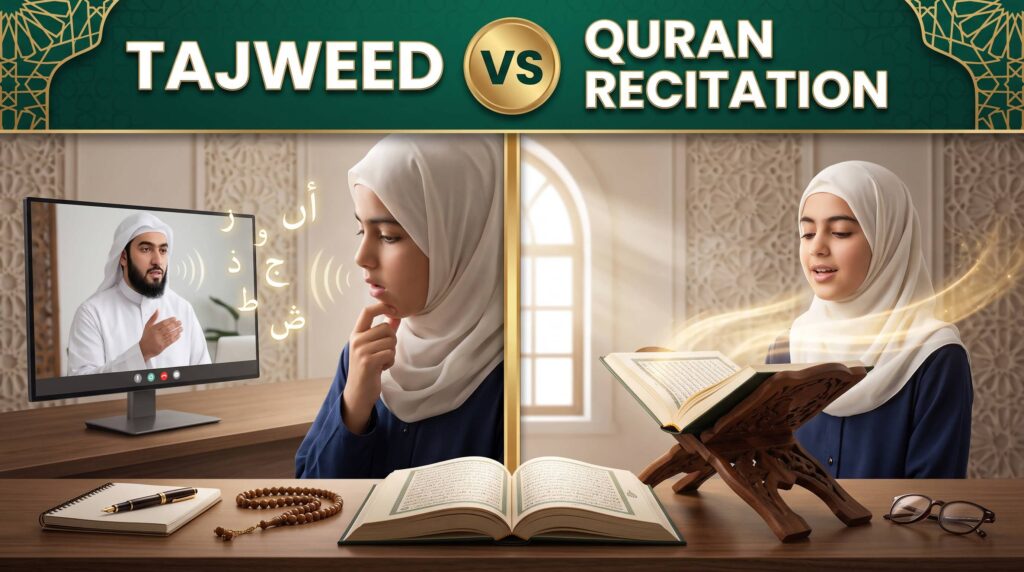
Quran recitation is the act of reading or reciting the Quran, while Tajweed is the set of rules that ensures the Quran is recited correctly. In simple terms, recitation is what you do, and Tajweed is how you do it correctly. Learning both helps Muslims recite the Quran accurately, clearly, and respectfully.
Many beginners hear the terms Tajweed and Quran recitation used together and assume they mean the same thing.
Although they are closely connected, they are not identical. Understanding the difference can help you choose the right learning path, avoid common mistakes, and improve your Quran reading more effectively.
In this guide, we’ll explain the difference between Tajweed and Quran recitation, when to learn each one, and how both work together to help you become a confident Quran reader.
- What Is Quran Recitation?
- What Is Tajweed?
- Tajweed vs Quran Recitation: Key Differences
- Do You Need Tajweed to Recite the Quran?
- Which Should Beginners Learn First?
- Common Misconceptions About Tajweed and Quran Recitation
- How Online Quran Classes Teach Tajweed and Recitation Together
- How QuranJourney Helps Students Learn Both
- Conclusion
- Frequently Asked Questions
What Is Quran Recitation?
Quran recitation simply means reading or reciting the words of the Quran aloud or silently.
It includes:
- Reading the Arabic text.
- Pronouncing the words.
- Following the verses correctly.
- Reading with concentration and respect.
Every Muslim who reads the Quran is engaged in Quran recitation, whether they are a beginner or an experienced reader.
The quality of recitation, however, depends on how accurately the words are pronounced.
What Is Tajweed?
Tajweed refers to the rules that govern the correct pronunciation of Quranic Arabic.
These rules help preserve the way the Quran was revealed and recited.
Tajweed covers areas such as:
- Correct pronunciation of Arabic letters (Makharij).
- Characteristics of letters (Sifaat).
- Rules of Noon Sakinah and Tanween.
- Rules of Meem Sakinah.
- Qalqalah.
- Madd (elongation).
- Rules for stopping and starting (Waqf and Ibtida).
Rather than changing the words of the Quran, Tajweed ensures they are recited accurately and beautifully.
Tajweed vs Quran Recitation: Key Differences
| Quran Recitation | Tajweed |
|---|---|
| The act of reading the Quran. | The rules for reading the Quran correctly. |
| Focuses on reciting the verses. | Focuses on correct pronunciation and articulation. |
| Can be performed by beginners. | Learned gradually through study and practice. |
| Includes fluency and confidence. | Includes Makharij, Madd, Qalqalah, and other pronunciation rules. |
| Answers the question: “Am I reading?” | Answers the question: “Am I reading correctly?” |
The easiest way to understand the relationship is this:
Recitation is the journey, while Tajweed is the roadmap that helps you travel correctly.
Do You Need Tajweed to Recite the Quran?
A common question among beginners is whether they should wait until they have mastered Tajweed before reading the Quran.
The answer is no.
You should begin reading the Quran while gradually learning Tajweed.
Most qualified Quran teachers introduce Tajweed step by step alongside regular Quran reading.
This approach allows students to:
- Build confidence.
- Improve pronunciation gradually.
- Avoid feeling overwhelmed.
- Apply new rules immediately during recitation.
Learning both together is usually the most practical and effective approach.
Our guide How to Improve Quran Recitation explains how consistent practice and gradual Tajweed learning work together to strengthen fluency and confidence.
Educational resources from About Islam explain that Tajweed is intended to help Muslims preserve the correct pronunciation of the Quran while making recitation more accurate and meaningful, rather than creating unnecessary difficulty for beginners.
Which Should Beginners Learn First?
For complete beginners, the recommended learning order is generally:
Step 1
Learn the Arabic alphabet and basic pronunciation.
Step 2
Study Noorani Qaida or another beginner-friendly reading method.
Step 3
Begin reading the Quran with teacher guidance.
Step 4
Learn basic Tajweed rules gradually.
Step 5
Continue improving recitation through regular practice and revision.
This step-by-step approach helps learners build confidence without becoming overwhelmed by technical rules too early.
Common Misconceptions About Tajweed and Quran Recitation
Many learners delay their Quran studies because they misunderstand the relationship between Tajweed and recitation.
Let’s clear up some of the most common misconceptions.
Misconception 1: Tajweed and Quran Recitation Are the Same Thing
They are closely connected but not identical.
Recitation is the act of reading the Quran, while Tajweed is the system of rules that helps ensure the recitation is accurate.
Misconception 2: You Must Master Tajweed Before Reading the Quran
Many beginners think they need to memorize every Tajweed rule before opening the Quran.
In reality, most students learn Tajweed gradually while practicing Quran recitation under the guidance of a qualified teacher.
Misconception 3: Tajweed Is Only for Advanced Students
Although advanced learners continue refining their Tajweed, beginners also benefit from learning the basics from the very beginning.
Simple concepts such as correct letter pronunciation can prevent mistakes from becoming long-term habits.
Misconception 4: Beautiful Voice Is More Important Than Correct Recitation
A pleasant voice is appreciated, but accurate pronunciation should always come first.
The goal is to recite the Quran correctly before focusing on style or melody.
How Online Quran Classes Teach Tajweed and Recitation Together
One of the biggest advantages of structured online Quran classes is that students don’t have to choose between learning Tajweed and learning to recite.
A qualified teacher typically combines both throughout the learning process.
For example:
- Beginners start with Arabic letters and basic pronunciation.
- Noorani Qaida introduces essential reading skills.
- Quran reading begins with simple Surahs.
- Basic Tajweed rules are introduced naturally during lessons.
- Teachers provide immediate correction and regular revision.
This gradual approach helps students improve without feeling overwhelmed.
If you’re wondering whether online learning is effective for pronunciation, our guide Online Quran Recitation Course explains how structured online lessons help students develop confident and accurate recitation.
How QuranJourney Helps Students Learn Both
At QuranJourney, we believe that Tajweed and Quran recitation should be learned together in a structured and practical way.
Our experienced teachers help students develop confidence while improving their pronunciation step by step.
Our online classes include:
- Live one-on-one Quran lessons.
- Qualified male and female Quran teachers.
- Beginner-friendly learning plans.
- Practical Tajweed instruction.
- Personalized pronunciation correction.
- Flexible scheduling.
- Regular progress assessments.
Whether you’re reading the Quran for the first time or refining your recitation, our teachers guide you at a pace that matches your experience and learning goals.
If you’d like to experience our teaching approach before enrolling, you can book a Free Trial class.
Conclusion
Understanding the difference between Tajweed and Quran recitation helps remove confusion and gives learners a clearer path forward.
Quran recitation is the act of reading Allah’s words, while Tajweed is the set of rules that helps you read them correctly.
Rather than viewing them as separate subjects, think of them as two parts of the same journey. As your recitation improves, your Tajweed naturally develops through consistent practice and qualified guidance.
No matter your age or current skill level, beginning today with steady practice is the best way to build confidence and strengthen your relationship with the Quran.
Frequently Asked Questions
What is the difference between Tajweed and Quran recitation?
Quran recitation is the act of reading the Quran, while Tajweed is the set of pronunciation rules that ensures the Quran is recited correctly.
Can I recite the Quran without learning Tajweed?
Yes, beginners can start reading the Quran while gradually learning Tajweed. Most teachers introduce Tajweed step by step during regular Quran lessons.
Should beginners learn Tajweed first?
Beginners should first learn the Arabic alphabet and basic reading skills. Tajweed is usually introduced gradually as they begin reciting the Quran.
Is Tajweed compulsory?
Learning Tajweed helps preserve the correct pronunciation of the Quran. The level of Tajweed required depends on a learner’s ability and level of study, but every Muslim should strive to recite the Quran as accurately as possible.
Does Tajweed improve Quran recitation?
Yes. Tajweed improves pronunciation, fluency, clarity, and confidence while reducing common recitation mistakes.
Can adults learn Tajweed online?
Yes. Many adults successfully learn Tajweed through live online Quran classes with qualified teachers who provide personalized feedback.
How long does it take to learn Tajweed?
The timeline varies depending on your experience, practice routine, and learning goals. Most learners improve gradually through consistent practice and teacher guidance.
Can children learn Tajweed and Quran recitation together?
Yes. Many structured Quran courses introduce basic Tajweed while children develop their reading skills, making the learning process more natural.