There is something special about hearing a child recite the Quran from memory. It is one of those moments that stays with a parent forever. And for a lot of Muslim families today, the question is no longer whether their child should memorize the Quran, but how to actually make it happen without uprooting the whole family routine.
That is where online Quran memorization programs come in. Your child can work with a real, qualified teacher every day, from your living room, without you needing to drive anywhere or find a local school with the right program.
In this guide, we will go through everything you need to know about Quran memorization for kids online. How it works, what age to start, how progress is tracked, and how to keep your child motivated when things get hard, because they will at some point, and that is completely normal.
This is written for families in the USA, UK, Canada, Australia, Germany, and New Zealand, where finding a good local Hifz program is not always easy.
- What Does Quran Memorization Actually Mean
- Why Parents Choose Online Programs for This
- How Online Quran Memorization Sessions Work
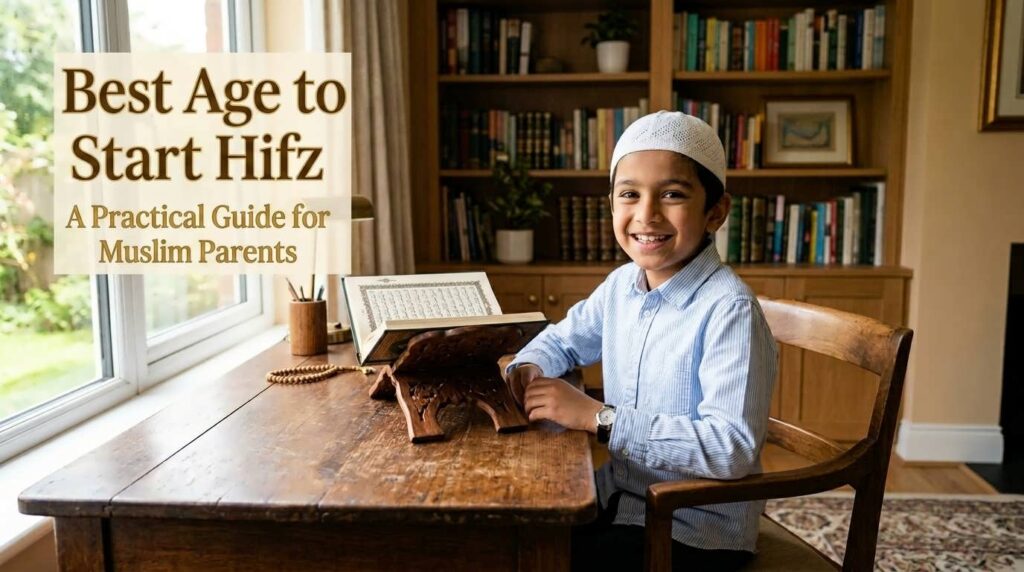
- What Age Should Kids Start Quran Memorization
- What Actually Determines Success More Than Anything Else
- How Long Does It Take
- What a Good Online Hifz Teacher Looks Like
- How to Support Your Child at Home
- What If My Child Loses Motivation
- Getting Started with QuranJourney
What Does Quran Memorization Actually Mean
Quran memorization, often called Hifz, means a person learns to recite the entire Quran from memory, all 114 chapters and over six thousand verses, without needing to read from a book. A person who completes this is called a Hafiz if male, or Hafiza if female.
It does not have to mean memorizing the whole Quran right away, though. Many children start by memorizing a handful of short chapters used in daily prayer, and from there, families decide whether to continue toward the full memorization or keep it at a more manageable level. Both are valuable, and there is no pressure to do the full thing unless your family wants to.
The Prophet Muhammad, peace be upon him, spoke about the high status given to those who carry the Quran in their hearts. For a child, this becomes part of who they are, not just something they did once. It shapes how they relate to their faith for the rest of their life.
Why Parents Choose Online Programs for This
A few years ago, most families assumed Hifz meant sending a child to a residential Islamic school, often far from home, sometimes even abroad. That option still exists for families who want it, but it is simply not realistic for most households in the West.
Online Hifz programs solve a real problem. Your child gets a dedicated teacher, one on one, every single day, without leaving home. No driving, no rearranging the whole family schedule around a physical class, no compromise on quality just because there is no Hifz school nearby.
There is also something to be said for keeping your child in their normal school and home life while they work on memorization. They stay close to family, keep their friendships, continue their regular education, and simply add a daily Quran session into their routine, the same way they might have a daily reading habit or a music lesson.
For families who have tried both, many say the personal attention in a one on one online session is actually better than what their child got in a crowded classroom setting, where the teacher’s time was shared between many students.
How Online Quran Memorization Sessions Work
If you are picturing something complicated, it is actually pretty simple once you see it in action.
Your child sits with a laptop or tablet, ideally with headphones, and joins a video call at a scheduled time, usually using something like Zoom. The teacher, often based somewhere with strong traditions in Quran teaching, joins from their side.
Each session usually follows the same basic structure. First, your child recites the portion they memorized since the last lesson. This is called the new lesson or sabaq. The teacher listens carefully and corrects any mistakes in pronunciation or wording right there in the moment.
Then, your child recites portions they memorized previously, to keep them fresh in their memory. This revision part is honestly just as important as learning new material, maybe even more so, because memorized pages can fade quickly if they are not reviewed regularly.
Finally, the teacher assigns the next portion to memorize before the following session, along with any specific things to focus on, like a tricky pronunciation point or a verse that needs more repetition.
A typical session for younger kids runs around 30 to 45 minutes. Older children or those further along often do 45 minutes to an hour, sometimes split into a memorization session and a separate revision session.
What Age Should Kids Start Quran Memorization
There really is no single right answer here, but there are some general patterns that most experienced teachers see.
Many families start somewhere between ages 5 and 7. At this age, kids have an incredible natural ability to absorb and retain things they hear repeatedly, which is exactly what memorization relies on. The sessions at this age are usually shorter and more playful, focusing on the shorter chapters first.
Kids who start around age 7 or 8, once they can read reasonably well and sit through a structured lesson, often make very steady progress. This age tends to be a sweet spot because the child has enough focus to work consistently, but is still young enough that new material sticks easily.
If your child is older, say 10, 12, or even a teenager, starting later is absolutely fine too. Older kids bring something younger ones do not always have, which is genuine personal motivation. A child who wants to do this for themselves, not just because a parent suggested it, often progresses faster despite starting later.
The honest truth is that the right age is whenever your child is ready to commit to a daily habit and sit with a teacher for a focused session. That could be 5, that could be 11. What matters more is what comes next.
What Actually Determines Success More Than Anything Else
Here is something most parents do not realize until they are a few months in. The age your child starts matters far less than how consistent the daily routine is.
A child who does 20 minutes every single day, with proper revision built in, will almost always outperform a child who does longer sessions but only two or three times a week, regardless of which one started younger.
Daily repetition is what makes memorization stick. Skipping days, even with good intentions to make it up later, breaks the rhythm that the brain relies on for this kind of learning. This is why online programs work so well, because there is no excuse of distance or weather getting in the way of a daily session.
The other big factor is revision. New memorization is exciting, but old memorization needs constant care or it fades. A good teacher will not just push forward with new material every day, they will build in regular review of everything memorized so far, even if that means progress on new pages feels slower at times. This is normal and it is actually a sign of a program doing things properly.
How Long Does It Take
This is one of the most common questions, and the honest answer is that it depends a lot on the child and the consistency of the program.
For a child who starts around age 6 or 7 and does daily sessions with proper revision, completing the entire Quran often takes somewhere between 4 and 6 years. That puts most kids finishing somewhere in their early teens.
For a child starting a bit later, say 9 or 10, with the same daily consistency, the timeline is often similar, around 4 to 5 years, finishing before age 15.
Teenagers who start at 12 or 13 with strong personal motivation often complete it in 3 to 4 years, sometimes faster if they add extra sessions.
It is worth saying clearly that none of this is a race. A child who takes 7 years and retains everything solidly is in a much better position than a child who rushed through in 3 years but cannot recall large portions afterward. Quality of retention matters more than speed.
If your family decides that memorizing the entire Quran is not the goal right now, and instead you want your child to memorize a set of important chapters for daily prayer, that usually takes a matter of months rather than years, and is a completely valid goal on its own.
What a Good Online Hifz Teacher Looks Like
The teacher really is the most important part of this whole picture, so it is worth knowing what to look for.
A good Hifz teacher for kids is patient above everything else. Children forget things, mix up verses, and need the same correction repeated many times. A teacher who gets frustrated by this is not the right fit, no matter how qualified they are on paper.
Proper qualification still matters though. Look for teachers who hold a Tajweed certification, ideally an Ijazah, which means they themselves learned correctly under a qualified teacher and have been formally authorized to teach others.
For girls, check whether female teachers are available. This is something that should be offered without you having to specifically push for it.
A good teacher also keeps parents informed. You should have a general sense of what your child memorized this week, what is being revised, and whether there are any specific struggles. If you feel completely in the dark about what is happening in lessons, that is worth raising with the academy.
How to Support Your Child at Home
Even with a great teacher, what happens at home between lessons makes a real difference.
Play Quran recitation in the background during everyday moments, breakfast, car rides, before bed. Hearing the words repeatedly, even passively, helps familiarize your child with sounds and rhythms before they even sit down to memorize them formally.
Set a consistent daily time for the lesson and protect it the same way you would protect a school commitment. Consistency really is the single biggest factor in how well this works.
Spend five or ten minutes a day listening to your child recite what they have memorized so far. You do not need to know Arabic to do this, you are simply listening and giving them a chance to recite out loud to someone, which builds confidence.
Celebrate the small wins. Finishing a chapter, completing a section, hitting a few months of consistency without missing a day, these are all worth acknowledging. Kids stay motivated when their effort is noticed.
And when your child has a rough week, and they will, stay calm about it. Talk to the teacher, see if the pace needs adjusting, and remember that this is a long term journey, not something that needs to be perfect every single day.
What If My Child Loses Motivation
This happens to almost every child at some point, and it does not mean anything has gone wrong.
Sometimes it is simply tiredness. School gets busier, other activities pile up, and Quran memorization starts to feel like one more obligation. If this happens, talk to the teacher about temporarily reducing the new material while keeping revision steady, just to ease the pressure for a bit.
Sometimes it is about how the material feels. Longer chapters can feel less rewarding because progress feels slower compared to the short chapters at the start. A good teacher can mix things up, maybe revisiting favorite shorter chapters alongside newer, longer ones, to keep a sense of achievement alive.
And sometimes kids just need a short break. A week off, with no guilt attached, followed by easing back into the normal routine, often resets things better than pushing through when a child is clearly burned out.
The goal is to keep this a positive part of your child’s life for years, not to grind through it as fast as possible and risk them associating the Quran with stress or pressure.
Getting Started with QuranJourney
At QuranJourney, our online Hifz program is built specifically with kids in mind. Daily one on one sessions with qualified, patient teachers, proper revision built into every program, and regular updates so you always know how your child is progressing.
We offer both male and female teachers, flexible scheduling that works across all major time zones for families in the USA, UK, Canada, Australia, Germany, and New Zealand, and programs designed for kids as young as 5 all the way through to teenagers and adults.
If your child is just starting out with reading the Quran, our Nazra program is the right place to begin before moving into full memorization.
For families ready to start the memorization journey, our Hifz ul Quran course is structured around daily new lessons and consistent revision, with a clear path from the first chapter all the way through to completion.
We also offer Dars e Hadith for older students who want to deepen their understanding alongside their memorization journey.
You can find detailed information about our teaching approach and team on our about page, and fee details for each program are listed on their individual course pages.
Your child’s first class is completely free, with no payment details required. It is simply a chance to meet a teacher and see how the sessions feel before committing to anything. Book a free trial here.
If you have any questions before getting started, feel free to reach out to our team, we are happy to help you figure out the right starting point for your child.
QuranJourney, helping families raise children who carry the Quran in their hearts, one page at a time.