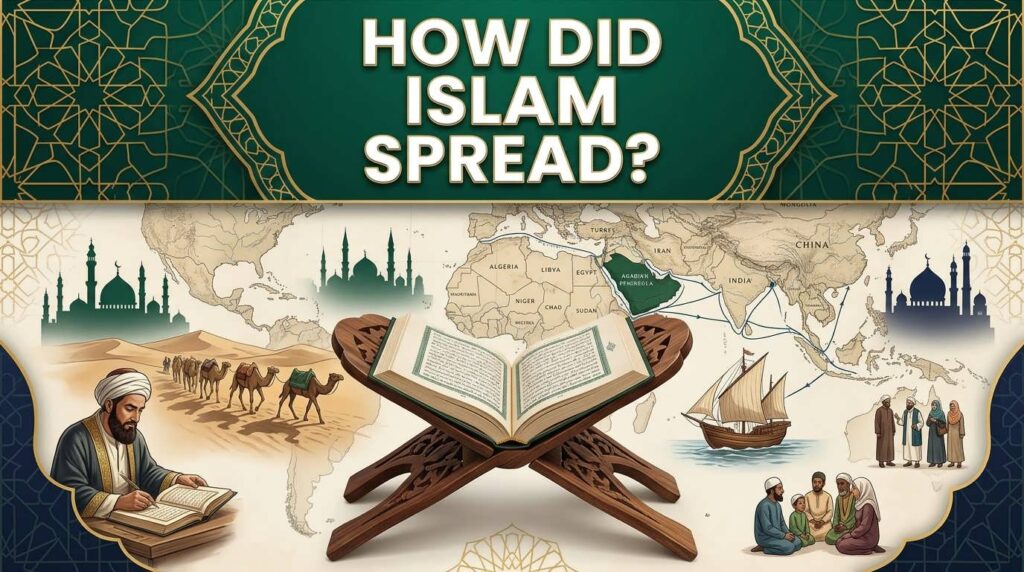
Islam spread from the Arabian Peninsula across much of the world through a combination of preaching, migration, trade, political expansion, scholarship, and the growth of Muslim communities. During the lifetime of Prophet Muhammad (peace and blessings be upon him), Islam became established in Arabia. After his death, Muslim-ruled territories expanded rapidly, while merchants, travelers, scholars, and teachers helped Islam reach regions including Africa, Central Asia, South Asia, and Southeast Asia. The process differed significantly from one region to another and took place over many centuries.
Islam is one of the world’s major religions, with Muslim communities now found across virtually every region of the globe.
But how did Islam spread from its beginnings in the Arabian Peninsula to become a global faith?
The answer is more complex than a single event or method.
Islam spread over many centuries through a combination of religious teaching, migration, trade, political expansion, scholarship, and the establishment of Muslim communities.
Different regions experienced this process in different ways.
In some places, merchants and travelers played an important role. In others, scholars, teachers, and spiritual traditions helped establish Islam. Political expansion also played a significant role in the early history of Muslim states, but the expansion of Muslim political control should not automatically be treated as identical to the conversion of local populations.
Understanding this distinction gives us a more accurate picture of how Islam became established across different parts of the world.
- Where Did Islam Begin?
- The Hijrah and the Growth of the Muslim Community
- How Did Islam Spread During the Prophet Muhammad's Lifetime?
- The Role of the Quran in the Early Spread of Islam
- How Did Islam Spread Beyond Arabia?
- Did Conquest Spread Islam?
- The Role of Trade in the Spread of Islam
- How Did Islam Spread Through Scholarship and Education?
- How Did Islam Spread in Africa?
- How Did Islam Spread in South Asia?
- The Role of Sufi Traditions
- How Did Islam Spread in Southeast Asia?
- How Did Islam Spread in Central Asia?
- How Did Islam Reach Europe?
- Why Did People Embrace Islam?
- Did People Have to Convert to Islam Under Muslim Rule?
- How Did Islam Become a Global Religion?
- What Role Did Mosques and Quran Schools Play?
- The Spread of Islam Was a Long Historical Process
- What Can We Learn From the History of Islam's Spread?
- Islam Today
- Conclusion
- Frequently Asked Questions
Where Did Islam Begin?
Islam began in the Arabian Peninsula in the 7th century CE.
According to Islamic belief, Prophet Muhammad (peace and blessings be upon him) received the first revelation from Allah in Makkah when he was approximately 40 years old.
The revelations continued over approximately 23 years and form the Quran, the central scripture of Islam.
The early message emphasized the worship of one God, accountability, righteous conduct, compassion, justice, and devotion to Allah.
For a broader historical overview of Islam’s origins, Encyclopaedia Britannica’s overview of Islam provides useful background on the religion’s origins, beliefs, and historical development.
The Early Muslim Community in Makkah
The first Muslims faced significant opposition in Makkah.
The message challenged established religious practices and social structures, and early Muslims experienced pressure and persecution.
Despite these difficulties, the Muslim community continued to grow.
People learned the Quran, practiced their faith, and shared the message of Islam with others.
The Quran itself describes the Prophet’s role as conveying the message rather than forcing people to believe.
This principle is important when discussing the historical spread of Islam because religious conversion and political expansion should not be treated as exactly the same process.
The Hijrah and the Growth of the Muslim Community
A major turning point in early Islamic history was the Hijrah, the migration of Prophet Muhammad (peace and blessings be upon him) and his followers from Makkah to Madinah.
This migration took place in 622 CE and became the starting point of the Islamic calendar.
In Madinah, Muslims established a growing community in which religious, social, and political life developed together.
The Hijrah was therefore much more than a change of location.
It provided the early Muslim community with an environment where Islam could develop as a complete way of life.
The community grew, relationships were established with surrounding groups, and Islam became increasingly established in Arabia.
How Did Islam Spread During the Prophet Muhammad’s Lifetime?
During the Prophet Muhammad’s lifetime, Islam spread primarily through his preaching, the Quranic revelation, personal relationships, correspondence, alliances, and the growing Muslim community.
The Prophet taught people about the oneness of Allah and invited them to Islam.
People from different tribes encountered the message through direct contact with Muslims and through the changing political and social circumstances of Arabia.
The Quran encouraged Muslims to communicate the message with wisdom and good instruction.
This emphasis on conveying the message is an important part of understanding early Islamic outreach.
As the Muslim community became stronger, more tribes and individuals entered into relationships with the Muslims.
By the time of the Prophet Muhammad’s death in 632 CE, Islam had become established across much of the Arabian Peninsula.
The Role of the Quran in the Early Spread of Islam
The Quran was central to the early Muslim community.
Muslims memorized and recited its verses, taught them to others, and used them as guidance in matters of worship, ethics, family life, justice, and community affairs.
The message of the Quran therefore traveled wherever Muslims traveled.
For readers interested in exploring the original Quranic text and translations, Quran.com provides access to the Quran in Arabic, translations, and recitations.
Quran learning also became an important part of Muslim education.
Children and adults learned to read and memorize passages, while scholars studied the Quran’s language, meanings, and interpretation.
This educational tradition would later contribute significantly to the development of Islamic scholarship in many regions.
How Did Islam Spread Beyond Arabia?
After the death of Prophet Muhammad (peace and blessings be upon him), Muslim-ruled territories expanded considerably.
During the period of the early caliphates, Muslim armies and governments established control over territories beyond Arabia, including areas of the Byzantine and Sasanian empires.
The Rashidun Caliphate expanded into regions including Syria, Iraq, Egypt, and parts of Persia.
Later Muslim dynasties expanded or consolidated territories across North Africa, Central Asia, the Iberian Peninsula, and other regions.
However, territorial expansion did not mean that every person living in those territories immediately became Muslim.
Conversion was often a gradual process that unfolded over generations.
In many areas, substantial non-Muslim populations continued to live under Muslim rule for centuries.
This distinction is essential when answering the question “How did Islam spread?”
Political expansion explains where Muslim governments gained territory, but it does not by itself explain why or how individuals and communities became Muslim.
Did Conquest Spread Islam?
Military expansion was certainly part of early Islamic history, particularly during the rapid territorial expansion of Muslim states in the centuries following the Prophet Muhammad’s death.
However, saying that Islam spread only through conquest presents an incomplete picture.
The historical process varied considerably by region.
In some areas, political conquest was followed by gradual conversion over generations.
In other places, Islam spread primarily through merchants, migration, scholars, teachers, and local communities.
For example, parts of South and Southeast Asia experienced significant Islamic influence through commercial networks and Muslim merchants, while various regions of Africa developed Muslim communities through trade, scholarship, migration, and political relationships.
Therefore, the spread of Islam needs to be studied region by region rather than explained through a single universal mechanism.
The Role of Trade in the Spread of Islam
Trade became one of the most important ways Islam traveled beyond the areas of early Muslim political expansion.
Muslim merchants traveled across established commercial networks connecting Arabia with Africa, Central Asia, South Asia, and Southeast Asia.
Trade routes did more than move goods.
They also connected people, languages, cultures, ideas, and religious traditions.
Muslim merchants often established communities in trading centers and port cities.
Over time, these communities became places where Islamic practices, education, and social institutions developed.
In some regions, local rulers and influential families eventually embraced Islam, further contributing to the growth of Muslim communities.
The process was gradual and differed from one society to another.
How Did Islam Spread Through Scholarship and Education?
Another important factor was the development of Islamic scholarship.
As Muslim communities expanded geographically, scholars traveled between cities and regions seeking knowledge and teaching others.
Mosques became important centers of learning.
Students studied the Quran, Hadith, Arabic, Islamic law, theology, history, and other subjects.
This created networks of learning that connected Muslim communities across vast distances.
The development of Islamic intellectual traditions also helped preserve and transmit religious knowledge from one generation to another.
Major centers of scholarship emerged in cities such as Makkah, Madinah, Damascus, Baghdad, Cairo, and later many other parts of the Muslim world.
The importance of scholarship is also reflected in the long-standing Islamic emphasis on seeking knowledge.
How Did Islam Spread in Africa?
Africa has some of the world’s oldest Muslim communities outside the Arabian Peninsula.
Islam reached parts of Africa very early in its history.
One of the earliest examples is the migration of some of the Prophet Muhammad’s followers to Abyssinia, generally associated with present-day Ethiopia and Eritrea. These Muslims sought protection from persecution in Makkah and were received by the Christian ruler known in Islamic sources as the Negus.
This early migration demonstrates that Islam had reached the African continent during the lifetime of Prophet Muhammad (peace and blessings be upon him).
Later, Islam became firmly established across North Africa following the expansion of Muslim-ruled territories.
From North Africa, Muslim communities and Islamic culture developed further west and south.
Trade played a particularly important role in the spread of Islam across West Africa.
Islam and the Trans-Saharan Trade
For centuries, trans-Saharan trade connected North Africa with communities south of the Sahara.
Muslim merchants traveled along these routes carrying goods such as gold, salt, textiles, and other products.
They also carried religious ideas and cultural practices.
Muslim trading communities developed in important commercial centers, and some local rulers and elites eventually embraced Islam.
Over time, Islamic learning expanded through mosques, Quran schools, scholars, and traveling teachers.
The Metropolitan Museum of Art’s overview of Islamic art and history provides useful historical context for understanding the development of Islamic civilization across different regions.
The spread of Islam in West Africa was therefore closely connected with trade, political relationships, scholarship, and local communities.
How Did Islam Spread in South Asia?
South Asia became one of the world’s largest centers of Muslim population.
Islam reached the region through several different channels and over a long period.
Muslim merchants had commercial connections with coastal areas of the Indian subcontinent from the early centuries of Islam.
Arab Muslim traders established communities in parts of coastal India, where commercial relationships created opportunities for cultural and religious exchange.
Later, Muslim political dynasties established rule over parts of the subcontinent.
However, political rule and religious conversion did not happen simultaneously.
Islam continued to develop through multiple channels, including trade, migration, scholarship, local Muslim communities, and religious teachers.
Over centuries, Muslim communities became established across areas that are now India, Pakistan, Bangladesh, and other parts of South Asia.
The region also became home to major centers of Islamic scholarship, architecture, literature, and culture.
The Role of Sufi Traditions
In several parts of Asia and Africa, Sufi scholars and spiritual teachers played an important role in the development of Muslim communities.
Sufism refers to diverse Islamic spiritual traditions emphasizing aspects such as remembrance of Allah, spiritual discipline, ethical conduct, and purification of the heart.
Sufi teachers often established relationships with local communities and developed educational and religious institutions.
Their influence varied considerably from region to region.
In South Asia, for example, Sufi figures became associated with centers of learning and spiritual life that attracted people from different backgrounds.
It is important not to reduce the entire spread of Islam to Sufism, but Sufi traditions were certainly one of several factors involved in the development of Muslim communities in particular regions.
How Did Islam Spread in Southeast Asia?
Southeast Asia provides another important example of Islam spreading through commercial and social networks.
Today, countries such as Indonesia, Malaysia, and Brunei have significant Muslim populations, with Indonesia having the world’s largest Muslim population.
Islam reached Southeast Asia gradually rather than through a single conquest.
Muslim merchants traveling through the Indian Ocean established commercial relationships with coastal communities.
Over time, Muslim trading settlements grew, local rulers adopted Islam in some areas, and Muslim communities expanded.
Marriage, migration, scholarship, and connections between commercial centers also contributed to this process.
Islamic traditions became integrated into local societies in different ways.
This history demonstrates why the question “How did Islam spread?” cannot be answered only by looking at military expansion.
In Southeast Asia especially, maritime trade and social networks played a major role.
How Did Islam Spread in Central Asia?
Islam also expanded into Central Asia during the early centuries of Muslim political expansion.
The region became an important part of the wider Muslim world and eventually produced major Islamic scholars and intellectual figures.
Cities such as Bukhara and Samarkand became famous centers of scholarship and culture.
Some of the most influential Hadith scholars in Islamic history came from this broader region.
The development of scholarship helped connect Central Asian Muslim communities with other parts of the Islamic world.
Over time, Islam became deeply established in societies across Central Asia, although the process differed between regions and historical periods.
How Did Islam Reach Europe?
Islam reached Europe through several different historical routes.
One of the earliest and most significant examples was the establishment of Muslim rule in parts of the Iberian Peninsula beginning in the early 8th century.
Muslim-ruled Al-Andalus became an important center of intellectual, scientific, artistic, and cultural development.
Muslim presence in Europe also developed through other historical interactions involving the Mediterranean, the Balkans, trade, migration, and later the Ottoman Empire.
The history of Muslims in Europe is therefore much broader than a single period or political dynasty.
Today, European Muslim communities have diverse backgrounds and include both longstanding communities and more recent immigrant populations.
Why Did People Embrace Islam?
There was no single reason why every individual or community became Muslim.
People make religious decisions for different personal, social, intellectual, and spiritual reasons.
Historical factors that sometimes contributed to the growth of Muslim communities included:
- Personal belief in Islamic teachings
- Contact with Muslim merchants and travelers
- Marriage and family relationships
- Influence of local rulers
- Islamic scholarship and education
- Relationships with Muslim communities
- Spiritual traditions
- Social and cultural connections
- Migration
The importance of each factor depended on the region and historical period.
It is therefore misleading to assume that every conversion happened for the same reason.
Did People Have to Convert to Islam Under Muslim Rule?
This question requires historical nuance.
Muslim states governed populations that included Muslims as well as Christians, Jews, Zoroastrians, Hindus, and followers of other traditions.
The legal and political status of non-Muslim communities varied according to the period, dynasty, location, and historical circumstances.
Some non-Muslim communities continued to exist for centuries under Muslim governments.
At the same time, there were also periods and places where religious minorities experienced restrictions, discrimination, or persecution.
Therefore, the history cannot accurately be summarized as either “everyone was forced to convert” or “there was never any pressure.”
Historical experiences varied significantly.
The Quran contains the well-known principle that “There is no compulsion in religion” in Quran 2:256. Readers can explore the verse and its surrounding context through Quran 2:256 on Quran.com.
How Did Islam Become a Global Religion?
By the medieval period, Muslim communities existed across a vast geographic area.
From the Atlantic coast of Africa to Central Asia and from southern Europe to the Indian Ocean, Islam had become part of many different societies.
But its global development did not stop there.
Muslim migration, trade, scholarship, and travel continued to carry Islam to new communities.
Later, Muslim populations also developed in regions far beyond the traditional centers of Islamic civilization.
Today, Muslims live across Asia, Africa, Europe, North America, South America, and Oceania.
This global presence reflects centuries of movement, community building, education, commerce, migration, and religious development.
What Role Did Mosques and Quran Schools Play?
As Muslim communities became established in new regions, mosques often became important centers of worship and community life.
They provided places where Muslims could pray together, learn the Quran, teach children, meet other members of the community, and preserve religious traditions.
Quran education was particularly important.
Children learned to read and memorize the Quran, while more advanced students studied Arabic, Hadith, Islamic law, and other Islamic sciences.
This helped Muslim communities maintain their religious identity across generations.
The tradition of Quran education continues today through both local institutions and online learning.
For families interested in building a consistent Quran learning routine, Daily Quran Learning Plan for Beginners offers practical guidance for developing regular study habits.
The Spread of Islam Was a Long Historical Process
One of the most important things to understand is that Islam did not become a global religion overnight.
Its spread took place over more than fourteen centuries.
Different regions followed different paths.
In some places, Muslim armies and governments arrived first.
In others, merchants established communities before political authorities had any significant Muslim presence.
In some societies, rulers converted before large sections of the population.
In others, ordinary people gradually became Muslim and communities developed over generations.
Scholars, teachers, travelers, families, merchants, and spiritual leaders all contributed in different ways.
This makes the history of Islam’s spread both complex and diverse.
What Can We Learn From the History of Islam’s Spread?
The history of Islam’s expansion demonstrates the importance of human relationships, education, travel, and community.
Ideas can travel with people.
Merchants crossed deserts and oceans.
Students traveled thousands of miles to study with scholars.
Teachers established learning centers.
Families passed religious knowledge to their children.
Communities built mosques and schools.
Through these interconnected networks, Islamic beliefs and practices became established in societies far beyond their original setting.
The history also shows that Islamic civilization was never limited to one ethnicity, language, or geographic region.
Arabs, Persians, Africans, Turks, South Asians, Southeast Asians, Europeans, and people from many other backgrounds became part of the wider Muslim community.
Islam Today
Today, Islam is a global religion with Muslim communities in almost every part of the world.
Muslims speak hundreds of languages and belong to diverse cultures and societies.
Arabic remains central to Islamic worship and Quran recitation, but Muslims also learn and practice Islam in their own languages and cultural environments.
The Quran continues to connect Muslims across these different backgrounds.
Whether a Muslim lives in Makkah, London, Toronto, Jakarta, Cairo, Johannesburg, or Sydney, Quran recitation remains an important part of Islamic life.
This continuity helps explain why Quran education has remained central to Muslim communities throughout history.
Conclusion
So, how did Islam spread?
Islam spread over many centuries through a combination of religious teaching, migration, trade, political expansion, scholarship, education, travel, family relationships, and the development of Muslim communities.
The process was different in every region.
In Arabia, the message of Prophet Muhammad (peace and blessings be upon him) established the foundation of the Muslim community.
After his lifetime, Muslim political territories expanded into neighboring regions.
Merchants carried Islam along trade routes across Africa and Asia.
Scholars and teachers established centers of Islamic learning.
Sufi traditions influenced some communities.
Local rulers and ordinary people embraced Islam at different times and for different reasons.
Understanding this history requires looking beyond a single explanation.
Islam’s global presence developed through a long and complex interaction between faith, people, communities, political powers, commerce, education, and culture.
For Muslims today, learning about this history can also encourage a deeper appreciation of the Quran, Islamic scholarship, and the diverse communities that have preserved Islamic knowledge across generations.
Frequently Asked Questions
How did Islam spread so quickly?
Islam expanded rapidly in its early centuries partly because Muslim-ruled territories grew significantly after the death of Prophet Muhammad (peace and blessings be upon him). Trade, migration, scholarship, and the development of Muslim communities also helped Islam spread beyond areas of political expansion.
Did Islam spread only through conquest?
No. Military and political expansion were important parts of early Islamic history, but Islam also spread through trade, migration, scholarship, education, family relationships, and local communities. The importance of each factor varied by region.
How did Islam spread to Africa?
Islam reached Africa very early, including through the migration of early Muslims to Abyssinia. Later, Muslim rule expanded across North Africa, while trade, scholarship, migration, and local communities helped Islam develop across other parts of the continent.
How did Islam spread to South Asia?
Islam reached South Asia through several channels, including maritime trade, Muslim merchant communities, migration, political expansion, scholarship, and religious teachers. The process occurred over many centuries.
How did Islam spread to Southeast Asia?
Trade was particularly important in Southeast Asia. Muslim merchants established relationships with coastal communities, while migration, marriage, scholarship, and the conversion of some local rulers contributed to the gradual development of Muslim societies.
How did Islam reach Europe?
Islam reached Europe through several historical routes, including Muslim rule in parts of the Iberian Peninsula, Mediterranean interactions, migration, trade, and the expansion of the Ottoman Empire into southeastern Europe.
What role did trade play in spreading Islam?
Trade connected Muslim merchants with communities across Africa, Asia, and the Indian Ocean. Commercial relationships created opportunities for cultural exchange and helped Muslim communities develop in important trading centers.
What role did Quran education play in the spread of Islam?
Quran education helped Muslim communities preserve and transmit their religious knowledge across generations. Mosques, schools, scholars, and teachers taught Quran reading, memorization, recitation, and interpretation in communities across the Muslim world.
Is Islam still spreading today?
Islam continues to be practiced by communities across every major region of the world. Contemporary Muslim population growth and the development of Muslim communities occur through many different demographic, social, migratory, and religious processes.