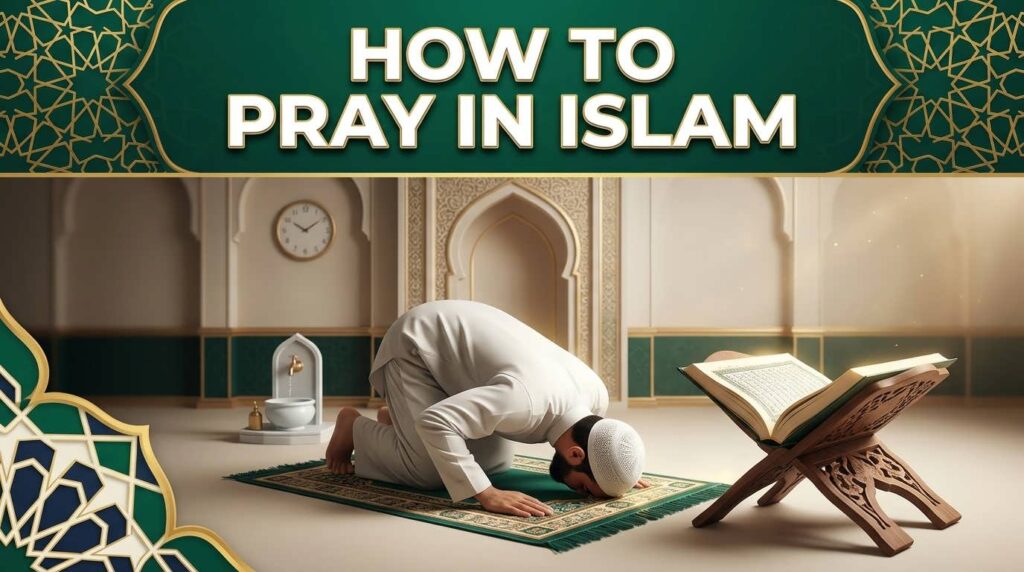
To pray in Islam, a Muslim first prepares by performing Wudu, ensuring the prayer time has begun, wearing appropriate clothing, facing the Qiblah, and making the intention for Salah. The prayer begins with Takbir and includes standing, Quran recitation, Ruku, Sujood, sitting, and concluding with Salam. Muslims perform five obligatory prayers each day: Fajr, Dhuhr, Asr, Maghrib, and Isha.
Salah is one of the most important acts of worship in Islam and the second of the Five Pillars of Islam.
For Muslims, the five daily prayers provide regular opportunities to remember Allah, seek His guidance, express gratitude, and strengthen faith.
For someone who has never learned Salah, however, the process can initially seem complicated.
There are prayer times to understand, Wudu to learn, different numbers of Rak’ahs, Arabic words to memorize, and specific movements to perform in the correct order.
The good news is that beginners do not need to learn everything at once.
Salah can be learned gradually, one step at a time.
This guide explains how to pray in Islam in a simple and beginner-friendly way, including what to do before Salah, the basic steps of prayer, what beginners should learn first, and how Quran learning can make prayer easier and more meaningful.
- What Is Salah in Islam?
- Why Is Salah Important?
- What Are the Five Daily Prayers?
- What Should You Do Before Salah?
- How to Pray in Islam Step by Step
- Step 1: Stand Facing the Qiblah
- Step 2: Begin With Takbir
- Step 3: Recite the Opening of the Prayer
- Step 4: Recite Surah Al-Fatihah
- Step 5: Recite Another Portion of the Quran
- Step 6: Perform Ruku
- Step 7: Rise From Ruku
- Step 8: Perform Sujood
- Step 9: Sit Between the Two Prostrations
- Step 10: Stand for the Next Rak'ah
- Completing the Prayer
- How Many Rak'ahs Are in Each Daily Prayer?
- What Should a Beginner Memorize for Salah?
- Why Quran Reading Matters in Salah
- Common Mistakes Beginners Make in Salah
- How Can You Improve Your Salah?
- Can Children Learn How to Pray?
- How QuranJourney Can Help You Learn Quran for Salah
- A Simple Way to Start Learning Salah
- Conclusion
- Frequently Asked Questions
What Is Salah in Islam?
Salah is the formal prayer Muslims perform at prescribed times throughout the day and night.
It is an essential act of worship and a direct way for a Muslim to stand before Allah.
The five obligatory prayers are:
- Fajr – the dawn prayer
- Dhuhr – the midday prayer
- Asr – the afternoon prayer
- Maghrib – the prayer shortly after sunset
- Isha – the night prayer
Each prayer has its own prescribed time and number of obligatory Rak’ahs.
Salah is more than a series of physical movements.
It combines standing before Allah, Quran recitation, remembrance, supplication, bowing, and prostration.
For beginners, understanding this purpose can make learning the physical steps much easier.
Why Is Salah Important?
Salah is one of the Five Pillars of Islam.
It gives Muslims a regular structure for remembering Allah throughout the day instead of allowing worship to become something occasional.
The five daily prayers can help develop:
- Consistency in worship
- Humility
- Patience
- Gratitude
- Self-discipline
- Awareness of Allah
The Quran repeatedly emphasizes the importance of establishing prayer.
For a new Muslim or someone returning to prayer after a long break, beginning with a sincere effort and learning gradually is more productive than expecting immediate perfection.
What Are the Five Daily Prayers?
Understanding the five daily prayers is one of the first things a beginner should learn.
| Prayer | General Time | Obligatory Rak’ahs |
|---|---|---|
| Fajr | Dawn | 2 |
| Dhuhr | After midday | 4 |
| Asr | Afternoon | 4 |
| Maghrib | After sunset | 3 |
| Isha | Night | 4 |
Prayer times change throughout the year according to location and season, so Muslims should use a reliable local prayer timetable rather than relying on fixed clock times.
The table above refers to the obligatory Fard Rak’ahs. Additional Sunnah and Nafl prayers may be performed around the obligatory prayers, but beginners should first become comfortable with the required Salah.
What Should You Do Before Salah?
Before beginning prayer, several conditions and preparations need to be considered.
1. Perform Wudu
Wudu is the ritual purification performed before Salah when it is required.
It includes washing specific parts of the body in a prescribed manner.
A beginner should learn Wudu carefully rather than rushing through it because purification is an important part of preparing for prayer.
If a person is in a state requiring a different form of purification, such as Ghusl, the appropriate purification should be completed before Salah.
2. Make Sure the Prayer Time Has Begun
Each obligatory prayer has a specific time.
Fajr has its time, Dhuhr has its time, and so on.
A prayer should be performed within its prescribed time.
Because prayer times vary by location and date, beginners should check a reliable local timetable or prayer-time application.
3. Wear Appropriate Clothing
A Muslim should ensure that the body is appropriately covered according to Islamic requirements before beginning Salah.
Clothing should also be clean.
The specific requirements differ between men and women, so beginners should learn the relevant guidelines from a trusted teacher or qualified Islamic resource.
4. Make Sure the Place Is Clean
Salah should be performed in a clean place.
Many Muslims use a prayer mat, but a prayer mat itself is not a requirement if the surface is clean and suitable for prayer.
You can pray at home, in a mosque, at work, while traveling, or in another appropriate location depending on the circumstances.
5. Face the Qiblah
Muslims face the direction of the Kaaba in Makkah when performing Salah.
This direction is called the Qiblah.
Today, Muslims can use local mosque guidance, a reliable prayer application, or a Qiblah compass to determine the direction.
6. Make the Intention
Before starting Salah, the worshipper makes the intention for the particular prayer being performed.
The intention is fundamentally an act of the heart.
It does not require announcing it aloud in a particular language.
The important thing is knowing which prayer you intend to perform and sincerely intending to worship Allah.
How to Pray in Islam Step by Step
Once you have prepared for Salah, you can begin the prayer.
The exact details can vary in some matters between established schools of Islamic jurisprudence. The following is a beginner-friendly overview of the general sequence.
Step 1: Stand Facing the Qiblah
Stand upright and face the Qiblah.
Your posture should be calm and attentive.
Keep your focus on the prayer rather than rushing through the movements.
Step 2: Begin With Takbir
Raise your hands in the prescribed manner and say:
Allahu Akbar
This means:
“Allah is the Greatest.”
This opening Takbir marks the beginning of Salah.
Once the prayer has started, the worshipper follows the prescribed actions and recitations of Salah.
Step 3: Recite the Opening of the Prayer
Depending on the established practice being followed, the opening supplication may be recited before Quran recitation.
The worshipper then seeks refuge with Allah and begins the Quran recitation.
Step 4: Recite Surah Al-Fatihah
Surah Al-Fatihah is recited during Salah.
It is one of the most important Surahs for a Muslim to learn because it is an essential part of the prayer.
For someone learning how to pray, memorizing Al-Fatihah correctly should be a priority.
This is also where Quran reading skills become particularly important.
Correct pronunciation matters because Salah includes Quranic recitation.
If you are still developing your Quran reading ability, learning with a qualified teacher can help you identify pronunciation mistakes and build confidence.
Step 5: Recite Another Portion of the Quran
In the appropriate Rak’ahs, another Surah or portion of the Quran is recited after Al-Fatihah.
Beginners often start with short Surahs that are easier to memorize.
Surahs such as Al-Ikhlas, Al-Falaq, and An-Nas are commonly learned by beginners, although the choice of Surah can vary.
The goal should not be to memorize many Surahs immediately.
It is better to learn a small amount correctly and gradually build from there.
Step 6: Perform Ruku
After the standing recitation, the worshipper moves into Ruku, the bowing position.
The back is positioned appropriately, and the prescribed remembrance is recited.
A commonly recited phrase during Ruku is:
Subhana Rabbiyal Adheem
meaning:
“Glory is to my Lord, the Most Great.”
The purpose is not simply to repeat words mechanically.
Ruku represents humility and submission before Allah.
Step 7: Rise From Ruku
The worshipper rises from Ruku and returns to an upright standing position.
The prescribed words of remembrance are recited while rising and standing.
The worshipper pauses calmly before moving to the next position.
Step 8: Perform Sujood
The worshipper then moves into Sujood, or prostration.
Sujood is one of the most significant positions in Salah.
A common remembrance during Sujood is:
Subhana Rabbiyal A’la
meaning:
“Glory is to my Lord, the Most High.”
Sujood expresses humility, submission, and closeness to Allah.
The worshipper should perform it calmly rather than rushing from one movement to another.
Step 9: Sit Between the Two Prostrations
After the first Sujood, the worshipper sits briefly before performing the second prostration.
A prescribed supplication is recited during this sitting.
The worshipper then performs the second Sujood.
At this point, one Rak’ah has been completed.
Step 10: Stand for the Next Rak’ah
The worshipper stands again to begin the next Rak’ah.
The same general sequence continues according to the number of Rak’ahs required for that prayer.
The recitations and some details differ depending on which Rak’ah is being performed.
Completing the Prayer
After completing the required Rak’ahs, the prayer moves toward its conclusion.
The final sitting includes Tashahhud and other prescribed supplications according to the prayer and established practice being followed.
The worshipper then turns the head to the right and left and says:
Assalamu Alaikum wa Rahmatullah
This is known as Tasleem or Salam, and it marks the completion of Salah.
The exact details of what is recited during the final sitting can vary according to established schools of Islamic jurisprudence. Beginners should therefore learn these details from a qualified teacher rather than trying to memorize everything without guidance.
How Many Rak’ahs Are in Each Daily Prayer?
One of the most common questions beginners have is how many Rak’ahs they need to pray.
The obligatory Rak’ahs are:
- Fajr: 2 Fard Rak’ahs
- Dhuhr: 4 Fard Rak’ahs
- Asr: 4 Fard Rak’ahs
- Maghrib: 3 Fard Rak’ahs
- Isha: 4 Fard Rak’ahs
These numbers refer specifically to the obligatory prayers.
There are also Sunnah and Nafl prayers associated with different prayer times. These are important parts of Islamic worship, but someone who is just learning how to pray should first understand the five obligatory prayers and learn how to perform them correctly.
What Should a Beginner Memorize for Salah?
You do not need to memorize everything in one day.
Trying to learn every recitation, supplication, and detail at once can make Salah feel unnecessarily difficult.
A beginner can gradually work through the essential recitations and movements.
A useful learning order is:
- Learn the basic steps and positions of Salah.
- Learn how to perform Wudu correctly.
- Memorize Surah Al-Fatihah.
- Learn at least one short Surah.
- Learn the basic remembrance during Ruku.
- Learn the basic remembrance during Sujood.
- Learn Tashahhud.
- Learn the concluding supplications.
- Continue improving pronunciation and confidence.
Learning gradually allows you to focus on accuracy instead of becoming overwhelmed.
For anyone struggling with Quran pronunciation, structured Quran lessons can be especially helpful because a teacher can listen to your recitation and correct mistakes immediately.
Why Quran Reading Matters in Salah
Quran recitation is an important part of Salah.
This means that learning how to read the Quran correctly is closely connected with learning how to pray.
Surah Al-Fatihah is particularly important because it is recited during Salah.
A person who is still learning Arabic letters or struggling with pronunciation may initially find this challenging.
That is completely understandable.
Instead of becoming discouraged, beginners should work on their Quran reading step by step.
Our guide Why Learn Tajweed explains how learning correct pronunciation can improve Quran recitation and help Muslims approach Quran reading with greater confidence.
Similarly, How to Improve Quran Recitation provides practical guidance for developing more accurate and confident recitation.
Common Mistakes Beginners Make in Salah
Learning Salah takes practice.
Making mistakes while learning does not mean that someone should give up.
However, recognizing common problems can help beginners improve more efficiently.
Rushing Through the Prayer
Some beginners move quickly from standing to Ruku and from Ruku to Sujood without pausing properly.
Salah should be performed calmly and with appropriate composure.
Learning the sequence correctly first makes it easier to develop a comfortable rhythm later.
Focusing Only on the Movements
Salah involves physical movements, but it is also an act of worship and remembrance.
A beginner should gradually learn the meaning of the words being recited.
Understanding what you are saying can help make prayer more meaningful and improve concentration.
Trying to Memorize Everything Immediately
There is no benefit in overwhelming yourself with too much information.
Start with the essential parts and build your knowledge gradually.
Consistent practice is more sustainable than trying to memorize a large amount in a single day.
Neglecting Quran Pronunciation
Incorrect pronunciation can become a habit if it is never corrected.
This is particularly important when learning Surah Al-Fatihah and other Quranic passages used during Salah.
Listening to experienced reciters can help, but personalized feedback from a qualified Quran teacher can make the learning process much more effective.
Being Afraid to Ask Questions
Beginners sometimes hesitate to ask about prayer because they feel embarrassed about not knowing something.
There is nothing wrong with asking.
Islamic learning is a gradual process, and seeking knowledge is part of the journey.
How Can You Improve Your Salah?
Once you understand the basic process, the next goal is to improve your prayer gradually.
You can work on:
Improving Quran Recitation
Practice Surah Al-Fatihah regularly and work on pronunciation.
As your Quran reading improves, you can become more confident during Salah.
Learning the Meaning of What You Recite
When you understand the meaning of the verses and supplications you say, prayer can become more personal and meaningful.
You begin to recognize that Salah is not simply a sequence of movements but an opportunity to communicate your devotion and submission to Allah.
Developing Consistency
The five daily prayers provide a regular structure for worship.
Try to organize your day around Salah rather than treating prayer as something that has to fit into whatever time remains.
Improving Concentration
Reduce distractions before prayer.
Put your phone aside, choose a clean and quiet place where possible, and take a moment to prepare mentally before beginning.
Over time, these small habits can help improve focus.
Can Children Learn How to Pray?
Yes.
Children can gradually learn Salah through observation, practice, encouragement, and age-appropriate teaching.
Parents can help by:
- Praying in front of their children.
- Teaching them the basic prayer movements.
- Helping them memorize short Surahs.
- Explaining the meaning of simple prayers.
- Encouraging rather than frightening them.
- Creating a regular family prayer routine.
Children do not need to master every detail immediately.
The goal is to build familiarity and love for Salah while gradually teaching them the knowledge and skills they need.
Parents who are also helping their children learn the Quran can combine Quran reading practice with Salah preparation.
Our article Daily Quran Learning Plan for Beginners can help families create a manageable learning routine rather than trying to teach everything at once.
How QuranJourney Can Help You Learn Quran for Salah
Learning how to pray and learning how to read the Quran can naturally support one another.
At QuranJourney, students can learn Quran reading and recitation through live online lessons with qualified teachers.
Lessons can be adapted to the student’s age, current ability, and learning goals.
Students can receive guidance with:
- Quran reading from the basics.
- Surah memorization.
- Quran pronunciation.
- Tajweed.
- Recitation practice.
- Hifz and revision.
- Building a consistent Quran learning routine.
One-on-one online classes can be particularly useful for beginners because the teacher can identify individual difficulties and provide immediate corrections.
If you or your child are starting from the beginning, you can book a Free Trial to experience the learning approach before enrolling.
A Simple Way to Start Learning Salah
If you are completely new to prayer, do not feel that you need to master everything immediately.
Start with the foundation.
First, learn why Muslims pray and understand the five daily prayers.
Then learn Wudu and the basic sequence of Salah.
After that, gradually memorize the essential Quranic verses and supplications.
At the same time, work on your Quran pronunciation.
With regular practice, the individual pieces that initially seem difficult begin to fit together.
The most important thing is to keep learning rather than waiting until you feel completely ready.
Conclusion
Learning how to pray in Islam is an important step for every Muslim.
Salah may seem complicated when you first encounter all of its movements, recitations, prayer times, and requirements, but it becomes much easier when learned gradually.
Start with the five daily prayers, learn the basic preparation for Salah, understand the sequence of movements, and gradually memorize the required recitations.
Most importantly, do not let mistakes or a slow learning pace discourage you.
With consistent practice, qualified guidance, and a sincere desire to improve, you can develop greater confidence in your Salah while strengthening your relationship with Allah.
Learning the Quran alongside Salah can make this journey even more meaningful because Quranic recitation is an essential part of daily prayer.
Frequently Asked Questions
How do you pray in Islam step by step?
A basic Salah begins with preparation such as Wudu, ensuring the prayer time has begun, facing the Qiblah, and making the intention. The prayer then includes Takbir, standing and Quran recitation, Ruku, standing after Ruku, Sujood, sitting between the prostrations, additional Rak’ahs as required, the final sitting, and Salam.
How many times do Muslims pray each day?
Muslims perform five obligatory prayers each day: Fajr, Dhuhr, Asr, Maghrib, and Isha.
How many Rak’ahs are in the five daily prayers?
The obligatory Rak’ahs are 2 for Fajr, 4 for Dhuhr, 4 for Asr, 3 for Maghrib, and 4 for Isha.
What should I learn first when learning Salah?
Start by learning Wudu, the basic sequence of Salah, Surah Al-Fatihah, and the essential recitations and movements. You can then gradually learn additional Surahs and supplications.
Do I need to know Arabic to pray?
You do not need to be fluent in Arabic to begin learning Salah. However, Muslims learn specific Quranic verses, remembrances, and supplications that are recited in Arabic during prayer.
Why is Surah Al-Fatihah important in Salah?
Surah Al-Fatihah is an essential part of Salah and is recited during the prayer. For this reason, learning its pronunciation correctly is an important priority for beginners.
Can I learn Salah online?
Yes. Beginners can learn the basic steps of Salah through online Islamic education. A qualified teacher can demonstrate the movements, explain the recitations, and correct mistakes during practice.
Can children learn Salah at home?
Yes. Parents can introduce children to Salah gradually through observation, practice, encouragement, and age-appropriate Quran and Islamic education.