
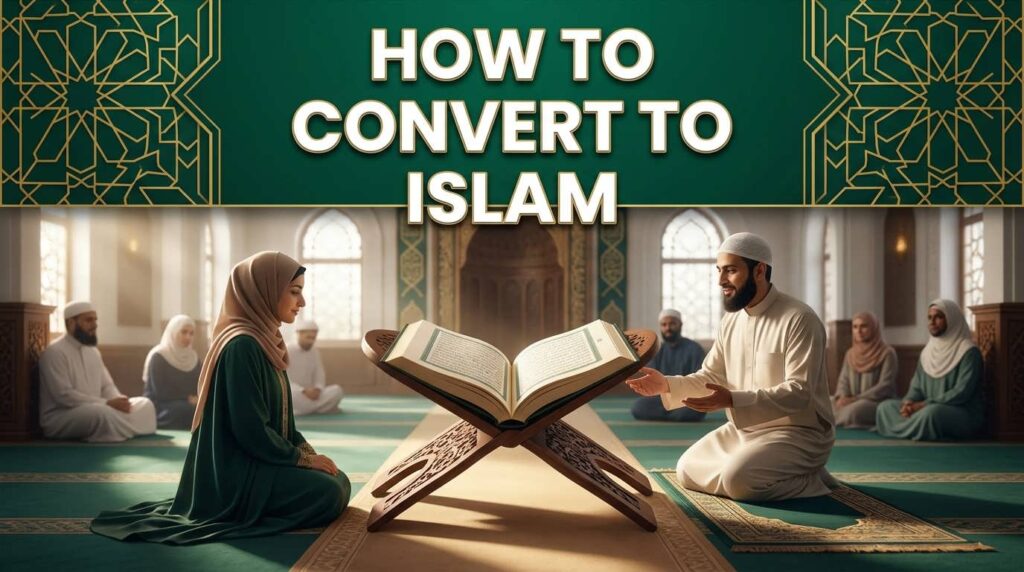
To convert to Islam, a person must sincerely believe that there is no god worthy of worship except Allah and that Muhammad is His Messenger, then declare this belief by saying the Shahadah with sincerity and understanding. A person does not need to know everything about Islam before becoming Muslim. After saying the Shahadah, they are Muslim and can gradually learn about prayer, Quran, Islamic beliefs, and other aspects of their new faith.
If you are searching for how to convert to Islam, you may have many questions.
Do I need to go to a mosque?
Do I need witnesses?
Do I need to learn Arabic first?
What exactly do I have to say?
What happens after I become Muslim?
These questions are completely understandable.
Converting to Islam is not about completing a long list of requirements before you can become Muslim.
At the heart of entering Islam is sincere faith in Allah and acceptance of the message brought by Prophet Muhammad (peace and blessings be upon him).
The declaration of this faith is called the Shahadah.
This guide explains the process simply and answers some of the most common questions people have when considering Islam.
- What Does It Mean to Convert to Islam?
- What Must You Believe to Become Muslim?
- What Is the Shahadah?
- Do I Have to Speak Arabic to Become Muslim?
- Do I Need Witnesses to Convert to Islam?
- Do I Have to Convert in a Mosque?
- What Should I Do Before Saying the Shahadah?
- Step-by-Step: How to Convert to Islam
- Do I Need to Change My Name After Converting?
- Do I Need to Change My Clothes Immediately?
- Do I Need to Know All Five Pillars Before Converting?
- What Happens After You Convert to Islam?
- Do I Need to Learn Quran Reading Immediately?
- Can a New Muslim Learn Islam Online?
- What If I Make Mistakes After Converting?
- Do I Need to Memorize the Entire Quran?
- What If My Family Does Not Support My Conversion?
- What If I Am Still Learning About Islam?
- Can I Convert to Islam Privately?
- What Is the Best Way to Start Learning Islam After Converting?
- A Simple First-30-Days Plan for a New Muslim
- Is Becoming Muslim the End of Learning?
- Conclusion
- Frequently Asked Questions
What Does It Mean to Convert to Islam?
To convert to Islam means to accept Islam as your faith and submit yourself to Allah.
The word Islam is connected with the idea of submission to Allah.
The Quran describes believers as submitting themselves to Allah, and the Quran emphasizes that the message of Islam is centered on devotion to the one true God.
Becoming Muslim is therefore not simply changing your identity or joining an organization.
It is a personal declaration of faith.
A person accepts that Allah alone deserves worship and that Muhammad (peace and blessings be upon him) is the Messenger of Allah.
What Must You Believe to Become Muslim?
Before saying the Shahadah, a person should understand and sincerely accept its meaning.
The essential belief can be summarized in two statements:
- There is no deity worthy of worship except Allah.
- Muhammad is the Messenger of Allah.
This means believing that Allah is One and has no partners, and accepting Prophet Muhammad (peace and blessings be upon him) as Allah’s final Messenger.
The Shahadah is the first and most fundamental pillar of Islam.
A narration in Sahih al-Bukhari describing the five foundations of Islam begins with the testimony that none has the right to be worshipped except Allah and that Muhammad is Allah’s Messenger.
What Is the Shahadah?
The Shahadah is the testimony of faith.
In Arabic, it is:
أشهد أن لا إله إلا الله وأشهد أن محمدًا رسول الله
A common transliteration is:
Ashhadu alla ilaha illallah, wa ashhadu anna Muhammadan rasulullah.
It means:
“I bear witness that there is no deity worthy of worship except Allah, and I bear witness that Muhammad is the Messenger of Allah.”
The Shahadah expresses the two central beliefs required for entering Islam.
A person should say it sincerely, believing what it means.
Do I Have to Speak Arabic to Become Muslim?
No.
You do not need to be fluent in Arabic before becoming Muslim.
The Shahadah is traditionally pronounced in Arabic because it is a well-known declaration of Islamic faith, but understanding its meaning is essential.
Someone who is considering Islam should not delay their faith simply because they are still learning Arabic.
Arabic can be learned gradually after becoming Muslim.
Many Muslims around the world do not speak Arabic as their first language, yet they learn the Arabic phrases needed for prayer and worship over time.
Do I Need Witnesses to Convert to Islam?
A person can sincerely accept Islam and say the Shahadah without needing to first complete a formal registration process.
Having Muslim witnesses can be helpful, especially because they can support a new Muslim and help them learn what to do next.
A mosque or Islamic center may also provide a certificate of conversion if documentation is needed for a particular purpose.
However, the essential matter is sincere belief and declaration of the Shahadah.
If someone is considering Islam, speaking with a knowledgeable and trustworthy local imam or teacher can provide valuable personal guidance.
Do I Have to Convert in a Mosque?
No.
A person does not have to physically enter a mosque to become Muslim.
If someone sincerely believes in the Islamic declaration of faith, they can say the Shahadah.
However, visiting a mosque can be a very helpful experience for someone who is new to Islam.
A welcoming mosque or Islamic center can provide:
- A supportive Muslim community
- Guidance about prayer
- Quran learning
- Help understanding Islamic beliefs
- Opportunities to meet other Muslims
- Practical advice about beginning Islamic life
The most important thing is finding people who are knowledgeable, respectful, and supportive.
What Should I Do Before Saying the Shahadah?
There is no requirement to become an expert in Islam first.
However, you should understand the basic meaning of what you are accepting.
Take time to learn about:
- Who Allah is
- The oneness of Allah
- Prophet Muhammad’s role as Allah’s Messenger
- The Quran
- The basic beliefs of Islam
- The purpose of worship
- The meaning of the Shahadah
If you have serious questions, ask a knowledgeable Muslim scholar or teacher rather than relying entirely on random social media posts.
Learning before making an important religious decision can help you make that decision with understanding and sincerity.
Step-by-Step: How to Convert to Islam
Step 1: Learn the Basic Beliefs
Start by learning what Muslims believe.
You do not need to know every detail.
Focus first on the foundations.
Understand that Islam teaches the worship of one God, Allah, and that Muhammad (peace and blessings be upon him) is His Messenger.
You can also learn about the Quran and the lives of the prophets mentioned in Islam.
Step 2: Believe in the Shahadah
The next step is sincerely accepting the meaning of the declaration of faith.
You are not simply repeating unfamiliar words.
You are affirming your belief.
The Shahadah contains two essential declarations:
There is no deity worthy of worship except Allah.
Muhammad is the Messenger of Allah.
Step 3: Say the Shahadah
When you are ready and sincerely believe, say the Shahadah.
You can say it in Arabic:
Ashhadu alla ilaha illallah, wa ashhadu anna Muhammadan rasulullah.
Then understand its meaning in your own language.
If you are unsure about pronunciation, a Muslim teacher or imam can help you.
Step 4: Begin Learning How to Pray
After becoming Muslim, one of the first practical things to learn is Salah.
You do not have to master everything overnight.
Learn gradually:
- How to make Wudu
- The basic prayer positions
- What to recite
- How many prayers are required
- The prayer times
- How to face the Qiblah
Our beginner-friendly guide on how to pray in Islam can help someone who is starting to learn Salah.
Step 5: Start Learning the Quran
The Quran becomes an important part of a Muslim’s life.
A new Muslim can begin with short Surahs and gradually learn Quran reading, pronunciation, recitation, and meanings.
You do not need to wait until your Arabic is perfect.
Start with manageable lessons and build your knowledge gradually.
For someone starting from the beginning, a daily Quran learning plan for beginners can make the process easier by turning learning into a consistent habit.
Do I Need to Change My Name After Converting?
No.
Becoming Muslim does not automatically require changing your name.
If your name has a good meaning and does not contain anything contrary to Islamic beliefs, there is generally no need to change it simply because you became Muslim.
Some converts choose an Arabic or Muslim name for personal reasons, but this is different from a universal requirement.
A person’s faith is not determined by whether their name sounds Arabic.
Do I Need to Change My Clothes Immediately?
Islam has guidelines regarding modesty and appropriate dress, but a new Muslim should approach these changes gradually and learn what is required.
Someone who has just become Muslim should not feel that they must instantly understand every Islamic rule.
Islamic knowledge develops over time.
The important thing is to begin learning sincerely and make practical improvements as your understanding grows.
Do I Need to Know All Five Pillars Before Converting?
No.
You do not need to memorize and practice every aspect of Islam before saying the Shahadah.
The Five Pillars are fundamental practices of Islam, including the testimony of faith, prayer, Zakat, fasting Ramadan, and Hajj for those who are able.
A Hadith recorded in Sahih Muslim explains the five foundations of Islam and begins with the testimony of faith.
After becoming Muslim, you can learn these practices one by one.
Do not allow fear of not knowing everything to prevent you from taking a sincere step toward Islam.
What Happens After You Convert to Islam?
Becoming Muslim is the beginning of a journey rather than the end of one.
After saying the Shahadah, a new Muslim can begin learning:
- Salah
- Wudu
- Quran reading
- Islamic beliefs
- Daily supplications
- Fasting
- Islamic manners
- Muslim family and community life
There is no need to master everything immediately.
Give yourself time.
Islamic learning is a lifelong process.
Do I Need to Learn Quran Reading Immediately?
Learning to read the Quran is highly valuable, but a new Muslim should not become discouraged if they cannot read Arabic yet.
Many people begin Quran learning from the alphabet.
A qualified teacher can help with:
- Arabic letters
- Letter pronunciation
- Joining letters
- Reading words
- Quran recitation
- Tajweed
- Memorization
If you are completely new to Quran reading, starting with a structured beginner lesson can be much easier than trying to learn everything alone.
Can a New Muslim Learn Islam Online?
Yes.
Online learning can be particularly useful for converts who do not have easy access to a mosque, Islamic teacher, or Muslim community.
Online lessons can provide structured guidance in areas such as:
- Quran reading
- Tajweed
- Salah
- Islamic studies
- Arabic basics
- Memorization
The important thing is to choose a reliable teacher or academy that understands the needs of beginners.
A new Muslim should feel comfortable asking questions and learning at a manageable pace.
What If I Make Mistakes After Converting?
You will.
Every person learning something new makes mistakes.
A new Muslim should not expect to become perfect immediately.
You may forget a prayer step.
You may struggle with Arabic pronunciation.
You may forget a Surah.
You may not understand an Islamic ruling.
These difficulties are part of learning.
What matters is continuing to learn and improve.
Instead of becoming overwhelmed by everything you do not know, focus on the next thing you can learn.
Do I Need to Memorize the Entire Quran?
No.
Becoming Muslim does not require memorizing the entire Quran.
Many Muslims spend their entire lives gradually learning and memorizing portions of the Quran.
As a beginner, start with short Surahs and the passages needed for Salah.
Focus on correct pronunciation and understanding.
Over time, you can increase your memorization if you wish.
What If My Family Does Not Support My Conversion?
This can be one of the most difficult situations for a new Muslim.
Family reactions can vary greatly.
Some families become supportive quickly, while others may need time to understand the decision.
Try to remain respectful and patient while maintaining your religious convictions.
You do not need to turn every conversation into an argument about religion.
If you are concerned about your personal safety, housing, finances, or family situation, seek confidential guidance from a trustworthy local scholar or appropriate support service before making major decisions.
What If I Am Still Learning About Islam?
You can continue learning.
There is no requirement to know every Islamic teaching before you begin your journey.
However, if you have not yet made up your mind, it is reasonable to continue asking questions and studying.
Read the Quran.
Learn about Prophet Muhammad (peace and blessings be upon him).
Speak with knowledgeable Muslims.
Ask difficult questions.
Take your time understanding what Islam teaches.
If you already sincerely believe the core declaration of faith, you do not need to wait until you have mastered every secondary issue.
Can I Convert to Islam Privately?
Yes.
Faith is fundamentally a matter between a person and Allah.
A person can say the Shahadah privately.
However, connecting with a Muslim community afterward can make the transition much easier.
A supportive community can help with prayer, Quran learning, Islamic celebrations, practical questions, and emotional support.
What Is the Best Way to Start Learning Islam After Converting?
Start with the essentials.
A simple learning order can be:
- Understand Tawhid and the basic beliefs of Islam.
- Learn the meaning of the Shahadah.
- Learn Wudu.
- Learn Salah.
- Begin Quran reading.
- Learn short Surahs.
- Study the life of Prophet Muhammad (peace and blessings be upon him).
- Gradually learn other Islamic practices and teachings.
This approach prevents a new Muslim from becoming overwhelmed.
You do not need to learn everything in one week.
A Simple First-30-Days Plan for a New Muslim
The first month can be focused on building a strong foundation.
Week 1
Focus on understanding:
- Allah and Tawhid
- The Shahadah
- The basic beliefs of Islam
- The purpose of worship
Week 2
Begin learning:
- Wudu
- Salah
- Prayer times
- Basic Surahs and supplications
Week 3
Begin:
- Quran reading
- Basic Islamic manners
- Learning about the life of Prophet Muhammad (peace and blessings be upon him)
Week 4
Build consistency:
- Regular Salah
- Daily Quran reading
- Short daily Islamic study
- Connecting with a supportive Muslim community
The goal is not perfection.
The goal is establishing a sustainable foundation.
Is Becoming Muslim the End of Learning?
No.
It is the beginning.
Islamic knowledge can continue throughout a person’s life.
A new Muslim may first learn how to pray, then learn Quran reading, then study the meanings of Surahs, Islamic beliefs, Hadith, Islamic history, and many other subjects.
There is always more to learn.
This is why approaching Islam as a lifelong learning journey can be more beneficial than expecting yourself to understand everything immediately.
Conclusion
If you are wondering how to convert to Islam, the process begins with sincere belief in the core message of Islam and the declaration of the Shahadah.
You do not need to be an Arabic speaker.
You do not need to memorize the Quran.
You do not need to know every Islamic ruling.
You do not need to become perfect before becoming Muslim.
What matters is sincerely believing that Allah alone deserves worship and that Muhammad (peace and blessings be upon him) is His Messenger, then declaring that belief through the Shahadah.
After that, your journey of learning begins.
Take your time.
Learn the Quran.
Learn Salah.
Ask questions.
Find trustworthy teachers.
Connect with a supportive Muslim community.
And remember that becoming Muslim is not about suddenly knowing everything. It is about beginning a life of faith, worship, learning, and growing closer to Allah.
Frequently Asked Questions
How do I convert to Islam?
To become Muslim, sincerely believe in the Islamic declaration of faith and say the Shahadah, affirming that there is no deity worthy of worship except Allah and that Muhammad is His Messenger.
Can I convert to Islam by myself?
Yes. A person can sincerely say the Shahadah privately. However, connecting with a knowledgeable Muslim, imam, or supportive community afterward can help with learning and practical matters.
Do I need witnesses to convert to Islam?
Witnesses are not the essence of becoming Muslim. However, having witnesses can be helpful for community support and, in some situations, documentation.
Do I need to speak Arabic to become Muslim?
No. You do not need to speak Arabic fluently. You should understand the meaning of the Shahadah, and you can gradually learn the Arabic needed for prayer and Quran recitation.
What do I say when converting to Islam?
The Shahadah is commonly said as: Ashhadu alla ilaha illallah, wa ashhadu anna Muhammadan rasulullah, meaning that you bear witness that there is no deity worthy of worship except Allah and that Muhammad is the Messenger of Allah.
Do I need to change my name after becoming Muslim?
No. Changing your name is not automatically required. A person may choose to change their name for personal reasons, but becoming Muslim does not itself require an Arabic name.
Do I need to learn the Quran before converting?
No. You can begin learning the Quran after becoming Muslim. Many new Muslims start with the Arabic alphabet and gradually develop their reading and recitation skills.
What should I learn first after becoming Muslim?
Begin with the fundamentals: Tawhid, the Shahadah, Wudu, Salah, basic Quran reading, and the essential beliefs and practices of Islam.
Can I learn Islam online after converting?
Yes. Online lessons can provide structured support in Quran reading, Tajweed, Salah, Islamic studies, and other areas, especially for people who do not have convenient access to a local teacher.
Is it okay if I make mistakes after converting?
Yes. Learning takes time. A new Muslim should focus on gradually improving rather than expecting immediate perfection.