Should you read Quran slowly or quickly?
This is a common question, especially for people who are trying to improve their Quran reading or complete a daily reading target.
Some people naturally read slowly because they are still learning Arabic letters, pronunciation, or Tajweed. Others read quickly because they have become fluent and want to cover more pages.
But Quran reading is not simply about how many pages you can finish.
The quality of your recitation matters.
The Quran instructs believers to recite it with tartil, meaning a measured and deliberate manner of recitation. Surah Al-Muzzammil 73:4 says to recite the Quran with measured recitation. (Quran.com)
This does not mean that every person must read at exactly the same speed.
The better goal is to find a pace that allows you to pronounce the words correctly, observe Tajweed rules, maintain clarity, and remain attentive to what you are reading.
- Should You Read Quran Slowly or Quickly?
- What Does the Quran Say About Reading Slowly?
- What Is Tartil in Quran Recitation?
- Is Reading Quran Fast Wrong?
- Why Beginners Should Read Quran Slowly
- Does Reading Slowly Help With Tajweed?
- Is Slow Quran Reading Better for Understanding?
- Does Reading Quran Quickly Give More Reward?
- What Is the Best Quran Reading Speed?
- Slow Reading vs Fast Reading
- Should Children Read Quran Slowly or Quickly?
- Should Adults Read Quran Slowly?
- Should You Slow Down When Learning Tajweed?
- What Happens If You Read Quran Too Quickly?
- Does Slow Reading Make Quran Recitation Better?
- How to Know If You Are Reading Too Fast
- How to Know If You Are Reading Too Slowly
- How Can You Improve Quran Reading Speed Without Losing Accuracy?
- Should You Practice Quran Reading With a Teacher?
- How Long Should You Practice Quran Reading Every Day?
- Should You Read Slowly During Hifz?
- Is Fast Reading Useful During Quran Revision?
- How Can Parents Help Children Improve Quran Reading?
- Is It Better to Finish More Quran or Read Less With Better Recitation?
- What If I Cannot Read Quran Slowly Because I Am Used to Reading Fast?
- Can Listening to Quran Help Improve Reading?
- Should You Read Quran Word by Word?
- What Is the Difference Between Slow Reading and Tartil?
- Should You Read Quran Quickly During Ramadan?
- What Is the Best Approach for Quran Reading?
- A Simple Daily Quran Reading Method
- When Should You Slow Down Your Quran Recitation?
- When Can You Read Quran Faster?
- Should You Take a Quran Trial Class?
- Final Thoughts
- Frequently Asked Questions
Should You Read Quran Slowly or Quickly?
For most learners, reading slowly and clearly is better than rushing through the Quran.
A slower pace gives you more time to:
- Pronounce Arabic letters correctly.
- Apply Tajweed rules.
- Observe vowel lengths.
- Stop at appropriate places.
- Recognize mistakes.
- Follow the words carefully.
- Focus on the meaning.
- Develop accurate reading habits.
However, “slowly” does not mean unnecessarily dragging every word.
The goal is measured, clear recitation, not simply reading as slowly as possible.
Someone who has strong Quran reading skills may naturally read faster while still maintaining correct pronunciation and Tajweed.
So the real question is not:
“How fast can I read?”
It is:
“Can I maintain correct and clear recitation at this speed?”
What Does the Quran Say About Reading Slowly?
The Quran uses the concept of tartil when describing how the Quran should be recited.
In Surah Al-Muzzammil, Allah says:
“And recite the Quran with measured recitation.” (Quran.com)
The idea behind measured recitation is that the words should be pronounced clearly and deliberately rather than rushed.
This is particularly important for learners because rushing can make it easier to overlook pronunciation and Tajweed mistakes.
For a deeper understanding of the concept, the Quranic Arabic Corpus provides the Arabic verse along with multiple English translations.
What Is Tartil in Quran Recitation?
Tartil refers to reciting the Quran in a measured, clear, and deliberate manner.
It involves giving the words and letters their proper pronunciation rather than rushing through them.
Tartil is therefore not simply a question of “slow versus fast.”
A person can read at a moderate pace while still maintaining tartil.
The important qualities include:
- Clarity
- Correct pronunciation
- Proper Tajweed
- Appropriate pauses
- Measured pace
- Attention to the words
This is why someone reading quickly is not automatically reading incorrectly, and someone reading slowly is not automatically reading correctly.
The quality of recitation is what matters.
Is Reading Quran Fast Wrong?
Reading Quran quickly is not automatically wrong.
The problem begins when speed causes the reader to sacrifice correctness.
For example, if reading faster causes you to:
- Skip letters.
- Mispronounce words.
- Ignore Tajweed.
- Shorten required elongations.
- Join words incorrectly.
- Miss important stopping points.
- Lose concentration.
then you should slow down.
Speed should never become more important than accurate recitation.
A fluent reader may be able to maintain correct Tajweed at a faster pace than a beginner.
Therefore, Quran reading speed should be appropriate for the individual’s ability.
Why Beginners Should Read Quran Slowly
Beginners usually need more time to process each word.
They may still be learning:
- Arabic letters.
- Letter combinations.
- Harakat.
- Madd.
- Sukoon.
- Shaddah.
- Basic Tajweed.
- Correct pronunciation.
Reading quickly can make it difficult to notice mistakes.
A beginner should therefore prioritize accuracy before speed.
Once correct reading becomes more natural, speed can gradually improve.
Does Reading Slowly Help With Tajweed?
Yes.
A measured pace can make it easier to notice Tajweed rules during recitation.
For example, a student can pay closer attention to:
- Madd.
- Ghunnah.
- Qalqalah.
- Ikhfa.
- Idgham.
- Iqlab.
- Izhar.
- Heavy and light letters.
- Correct stopping points.
When students rush, they may technically know a Tajweed rule but fail to apply it during actual recitation.
Slowing down gives them more time to apply what they have learned.
If you are working specifically on your pronunciation and recitation, learning how to improve Tajweed can help you build a more accurate reading routine.
Is Slow Quran Reading Better for Understanding?
A slower, more deliberate pace can give you more opportunity to pay attention to the words and their meaning.
This is especially useful when you are reading a translation alongside the Arabic Quran or studying Tafsir.
However, reading slowly by itself does not guarantee understanding.
Understanding also requires learning the meaning of the verses.
You can combine Quran recitation with trusted study resources such as Quran.com, where you can access Quran translations, Tafsir, recitations, and other study tools.
The important point is to avoid treating Quran reading as a race.
Does Reading Quran Quickly Give More Reward?
Many people assume that reading more pages automatically means better Quran engagement.
That is not necessarily the right way to think about it.
If you read quickly but make frequent pronunciation mistakes, you may need to slow down and work on accuracy.
On the other hand, a fluent reader who can maintain proper recitation at a quicker pace may be able to read more without sacrificing quality.
The goal should therefore be consistent and correct Quran recitation, rather than chasing a particular reading speed.
What Is the Best Quran Reading Speed?
There is no single number of words or pages per minute that is ideal for everyone.
Your appropriate speed depends on:
- Your Quran reading ability.
- Your Tajweed knowledge.
- Your Arabic pronunciation.
- Your familiarity with the Surah.
- Whether you are learning or reviewing.
- Whether you are reading for reflection.
- Whether you are memorizing.
A beginner may need to read very slowly.
An intermediate student may use a moderate pace.
An experienced reader may read faster while maintaining proper recitation.
The best speed is the one at which you can read accurately and clearly without unnecessary rushing.
Slow Reading vs Fast Reading
Let’s compare the two approaches.
Slow Quran Reading
Advantages:
- Easier pronunciation.
- More time for Tajweed.
- Better for beginners.
- Easier to identify mistakes.
- Can support reflection.
- Helps develop accurate habits.
Possible disadvantage:
- You may cover fewer pages in the same amount of time.
Fast Quran Reading
Advantages:
- Allows fluent readers to cover more Quran.
- Can be useful when reviewing familiar passages.
- May help with completing a planned reading target.
Possible disadvantages:
- Mistakes can become easier to overlook.
- Tajweed may be weakened.
- Pronunciation may become less clear.
- Beginners may develop poor habits.
The important factor is not simply the speed.
It is whether the speed is compatible with correct recitation.
Should Children Read Quran Slowly or Quickly?
Children should generally prioritize correctness over speed.
A child who is still learning Quran reading should not be pressured to finish pages quickly.
Instead, encourage the child to:
- Recognize the letters.
- Pronounce them correctly.
- Read words carefully.
- Apply basic Tajweed.
- Gradually improve fluency.
- Increase speed naturally.
Parents should avoid comparing one child’s reading speed with another child’s.
Children develop at different rates.
A consistent Quran learning routine is more valuable than forcing a child to read quickly.
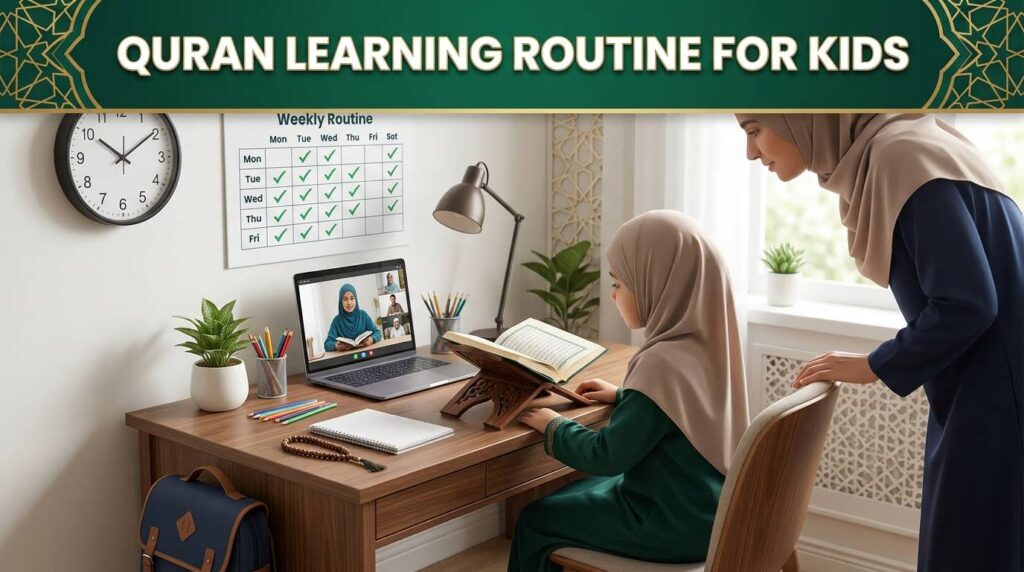
You can also use a structured Quran learning routine for kids to build consistency without making speed the main target.
Should Adults Read Quran Slowly?
Adults can benefit from slow reading when they are learning or correcting their recitation.
Many adults return to Quran learning after years away from formal study.
They may remember some Arabic reading but struggle with:
- Pronunciation.
- Fluency.
- Tajweed.
- Confidence.
- Certain Arabic letters.
In such cases, slowing down can help rebuild accuracy.
Once reading becomes more comfortable, the pace can naturally increase.
Should You Slow Down When Learning Tajweed?
Yes.
When learning a new Tajweed rule, it is usually helpful to slow the recitation down.
For example, if you are learning how to pronounce a particular letter correctly, focus on that letter rather than trying to finish the page quickly.
You can use this learning cycle:
Learn → Read slowly → Receive correction → Repeat → Practice → Gradually increase speed
This approach helps prevent incorrect pronunciation from becoming a habit.
What Happens If You Read Quran Too Quickly?
Reading too quickly can create several problems.
Pronunciation Mistakes
You may not give each letter its proper sound.
Tajweed Mistakes
Rules may be overlooked during fast reading.
Lost Concentration
You may focus more on finishing than on reciting.
Weak Fluency
Ironically, rushing can sometimes make your reading sound less smooth.
Reduced Reflection
You may have less time to think about what you are reading.
Repeated Errors
If mistakes are not noticed, they can become habits.
This is why slowing down can be particularly useful when you are trying to improve your recitation.
Does Slow Reading Make Quran Recitation Better?
Slow reading can help, but slow speed alone does not make a recitation correct.
Imagine two people.
Person A reads very slowly but repeatedly mispronounces Arabic letters.
Person B reads at a moderate pace with accurate pronunciation and Tajweed.
Person B is demonstrating better recitation even though they are faster.
So do not confuse slowness with correctness.
The goal is measured and accurate recitation.
How to Know If You Are Reading Too Fast
Ask yourself:
- Am I pronouncing every letter clearly?
- Am I applying the Tajweed rules I know?
- Am I maintaining correct vowel lengths?
- Am I observing appropriate pauses?
- Am I accidentally skipping or merging words?
- Can a teacher understand my recitation clearly?
- Am I concentrating on what I am reading?
If the answer to several of these questions is no, slow down.
How to Know If You Are Reading Too Slowly
Being slow is not necessarily a problem.
However, you may be unnecessarily slow if:
- You stop after almost every word without a reason.
- Your reading becomes unnatural.
- You exaggerate vowel lengths.
- You struggle to maintain the flow of the verse.
- You spend so much time on individual words that the overall recitation loses continuity.
Remember that the goal is not “as slow as possible.”
The goal is clear, measured, and correct.
How Can You Improve Quran Reading Speed Without Losing Accuracy?
The best way to increase speed is to improve fluency gradually.
Step 1: Correct Your Pronunciation
Work on difficult letters and sounds.
Step 2: Learn Basic Tajweed
Understand the rules you encounter regularly.
Step 3: Practice Familiar Surahs
Repeated reading can make words more familiar.
Step 4: Read Aloud
Silent reading does not give you the same opportunity to evaluate your pronunciation.
Step 5: Record Yourself
Listening to your own recitation can help you notice problems.
Step 6: Get Teacher Feedback
A qualified teacher can identify mistakes you may not notice yourself.
Step 7: Increase Speed Gradually
Once your accuracy is stable, allow your pace to increase naturally.
Do not force it.
Should You Practice Quran Reading With a Teacher?
If you are struggling with pronunciation or Tajweed, working with a qualified teacher can be extremely useful.
A teacher can hear mistakes that you may not recognize yourself.
For example, you may think your pronunciation is correct because the word sounds familiar to you.
A teacher can identify exactly where the problem occurs and demonstrate the correct pronunciation.
This is one reason structured Quran recitation classes can be useful for students who want to improve accuracy and fluency.
How Long Should You Practice Quran Reading Every Day?
There is no universal number of minutes that every person must follow.
Consistency matters more than forcing an unrealistic schedule.
For example, you might choose:
- 10 minutes for a beginner.
- 15 to 20 minutes for regular practice.
- Longer sessions for memorization or advanced study.
The right amount depends on your schedule and goals.
A short daily practice session can be more sustainable than an occasional long session.
Should You Read Slowly During Hifz?
During Quran memorization, accuracy should be prioritized.
When learning a new passage, reading slowly can help you:
- Notice every word.
- Correct pronunciation.
- Understand the verse structure.
- Establish the correct sequence.
- Avoid memorizing mistakes.
After memorizing the passage accurately, your recitation may naturally become faster.
However, revision should still maintain proper pronunciation and Tajweed.
Students concerned about maintaining their memorization can also learn about why people forget their Hifz and how regular revision can help.
Is Fast Reading Useful During Quran Revision?
It can be.
An experienced student may read familiar passages faster during revision because the words are already familiar.
But revision should not become so fast that pronunciation and Tajweed deteriorate.
A useful approach is to vary your pace depending on the purpose.
Learning new material: Slow and careful.
Correcting mistakes: Slow and focused.
Memorization: Measured and accurate.
Regular revision: Comfortable and fluent.
Reflection: Calm and deliberate.
This gives each type of practice an appropriate pace.
How Can Parents Help Children Improve Quran Reading?
Parents should focus on encouragement rather than speed competitions.
Instead of saying:
“Why are you reading so slowly?”
Try asking:
“Can you read this word clearly?”
“Which Tajweed rule are you practicing?”
“Can you read this verse one more time?”
Praise improvement in accuracy.
When children are constantly pressured to finish quickly, they may start viewing Quran reading as a race.
The objective should be to build a positive and sustainable relationship with Quran learning.
Is It Better to Finish More Quran or Read Less With Better Recitation?
This depends on your circumstances and purpose.
If you are still learning Quran reading, accurate recitation should take priority.
If you are already fluent, you may be able to read more while maintaining accuracy.
The important principle is:
Do not sacrifice correctness simply to increase the number of pages you complete.
A smaller amount of accurate, attentive recitation can be more beneficial for learning than rushing through a larger amount while repeatedly making mistakes.
What If I Cannot Read Quran Slowly Because I Am Used to Reading Fast?
You can retrain your reading pace.
Start with a short Surah.
Read it slowly and deliberately.
Focus on:
- Letter pronunciation.
- Tajweed.
- Madd.
- Pauses.
- Word clarity.
Then read the same passage again at your natural pace.
Compare the two.
With regular practice, you can develop a balanced pace that feels natural without rushing.
Can Listening to Quran Help Improve Reading?
Listening can be useful as part of learning.
You can listen to an experienced reciter and follow the Arabic text.
Pay attention to:
- Pronunciation.
- Pauses.
- Elongation.
- Rhythm.
- Letter clarity.
Then try reading the same passage yourself.
However, listening should complement active reading rather than replace it.
You need to actually practice reciting if you want to improve your own Quran reading.
Should You Read Quran Word by Word?
Beginners may need to focus heavily on individual words.
As their fluency improves, they can gradually move toward reading connected phrases and verses.
A useful progression is:
Letters → Words → Short phrases → Verses → Complete passages
The goal is eventually to read naturally without losing accuracy.
What Is the Difference Between Slow Reading and Tartil?
This distinction is important.
Slow reading simply describes speed.
Tartil describes a measured and deliberate manner of recitation.
Someone could technically read slowly while still making mistakes.
Likewise, a skilled reader could recite at a moderate pace while maintaining clarity and Tajweed.
Therefore:
Tartil is not simply “reading slowly.”
It is about reciting the Quran properly, clearly, and in a measured way.
Should You Read Quran Quickly During Ramadan?
During Ramadan, many Muslims increase their Quran reading.
This may mean completing more pages than usual.
However, increasing your daily reading does not mean you should abandon correct recitation.
If you are fluent, you may be able to increase your pace while maintaining accuracy.
If you are still learning, it may be better to set a realistic reading target that allows you to recite correctly.
The goal should be consistency and connection with the Quran, not simply reaching a page count.
What Is the Best Approach for Quran Reading?
A balanced approach works best.
For Beginners
Slow + accurate + consistent
For Intermediate Readers
Measured + accurate + gradually improving
For Fluent Readers
Comfortable + clear + Tajweed-conscious
For Memorization
Careful + repetitive + accurate
For Revision
Fluent + controlled + accurate
For Reflection
Calm + measured + attentive
There is no need to force everyone into the same reading speed.
A Simple Daily Quran Reading Method
If you want to improve your reading, try this routine:
First: Read a short passage slowly.
Second: Identify any pronunciation problems.
Third: Repeat difficult words.
Fourth: Read the passage again.
Fifth: Try your natural pace.
Sixth: Check whether your accuracy remained the same.
Seventh: Note one mistake to work on tomorrow.
Over time, your natural reading speed can improve without sacrificing correctness.
When Should You Slow Down Your Quran Recitation?
Slow down whenever:
- You encounter unfamiliar words.
- You are learning a new Tajweed rule.
- You are correcting pronunciation.
- You are memorizing a new passage.
- You notice repeated mistakes.
- You are losing concentration.
- Your reading becomes unclear.
- You are unsure about a stopping point.
Slowing down is a learning tool.
It does not mean you are a poor reader.
When Can You Read Quran Faster?
You can gradually increase your pace when:
- Your pronunciation is accurate.
- You understand the Tajweed rules you need.
- Your reading is fluent.
- You are not skipping letters.
- Your vowel lengths remain correct.
- Your pauses remain appropriate.
- You can maintain concentration.
Speed should be the result of improved fluency, not something you force from the beginning.
Should You Take a Quran Trial Class?
If you are unsure whether your Quran reading speed is affecting your pronunciation or Tajweed, a teacher can give you useful feedback.
During a trial class, you can ask the teacher to assess:
- Your pronunciation.
- Your reading fluency.
- Your Tajweed.
- Your reading pace.
- Your strengths and weaknesses.
- What you should practice next.
A teacher can often identify problems that are difficult to notice when you practice alone.
You can book a Quran trial class and use the session to understand your current level and what kind of instruction would suit you.
Final Thoughts
So, should you read Quran slowly or quickly?
For most learners, the answer is simple:
Read at a pace that allows you to recite correctly, clearly, and with attention.
If you are a beginner, slow down.
If you are learning Tajweed, slow down.
If you are memorizing, prioritize accuracy.
If you are fluent, you may naturally read faster, provided that your pronunciation and Tajweed remain correct.
The Quran encourages measured recitation through the concept of tartil. The purpose is not to turn Quran reading into a race.
Your goal should be to develop a recitation that is accurate, clear, consistent, and meaningful.
As your skills improve, your reading speed may increase naturally.
Do not chase speed.
Build accuracy first, and let fluency follow.
Frequently Asked Questions
Is it better to read Quran slowly or quickly?
For most learners, reading slowly and clearly is better because it gives more time to pronounce letters correctly and apply Tajweed. Fluent readers can read faster as long as accuracy is maintained.
Does the Quran tell us to read slowly?
The Quran instructs believers to recite with tartil, or measured recitation, in Surah Al-Muzzammil 73:4. This emphasizes clear and deliberate recitation rather than rushing.
Is reading Quran fast haram?
Reading quickly is not automatically prohibited. The concern is whether excessive speed causes incorrect pronunciation, neglected Tajweed, or unclear recitation.
What does tartil mean?
Tartil refers to a measured and deliberate manner of Quran recitation in which words and letters are pronounced clearly and properly.
Should beginners read Quran slowly?
Yes. Beginners should generally prioritize accurate pronunciation and Tajweed before trying to increase their reading speed.
Can I improve my Quran reading speed?
Yes. Improving pronunciation, Tajweed, fluency, and familiarity with Quranic words can gradually increase your reading speed without sacrificing accuracy.
Does reading Quran slowly improve Tajweed?
A slower pace can make it easier to notice and apply Tajweed rules, particularly while learning.
Should children read Quran quickly?
Children should not be pressured to read quickly. They should first develop correct pronunciation, confidence, and fluency.
Can I read Quran quickly during Ramadan?
If you are fluent and can maintain correct recitation, you may increase your pace. If faster reading causes mistakes, maintain a slower pace.
Should I read Quran slowly during Hifz?
When learning new verses, a careful and measured pace can help establish accurate pronunciation and memorization. Speed can increase naturally after the passage becomes familiar.
How do I know if I am reading Quran too fast?
If you regularly skip letters, mispronounce words, lose Tajweed, miss pauses, or struggle to concentrate, your reading speed may be too fast.
How do I know if I am reading Quran too slowly?
Being slow is not necessarily a problem. It may become excessive if you unnecessarily interrupt the flow, exaggerate elongations, or struggle to maintain natural recitation.
Is slow Quran reading more rewarding?
The objective should not be to compare reward based solely on reading speed. Focus on sincere, accurate, consistent recitation and following the proper manner of Quran reading.
Can a Quran teacher help me improve my reading speed?
Yes. A qualified teacher can identify pronunciation and Tajweed problems, correct them, and help you gradually develop better fluency.
Can I learn Quran reading online?
Yes. Live online Quran classes can provide direct teacher feedback on pronunciation, Tajweed, fluency, and reading pace.