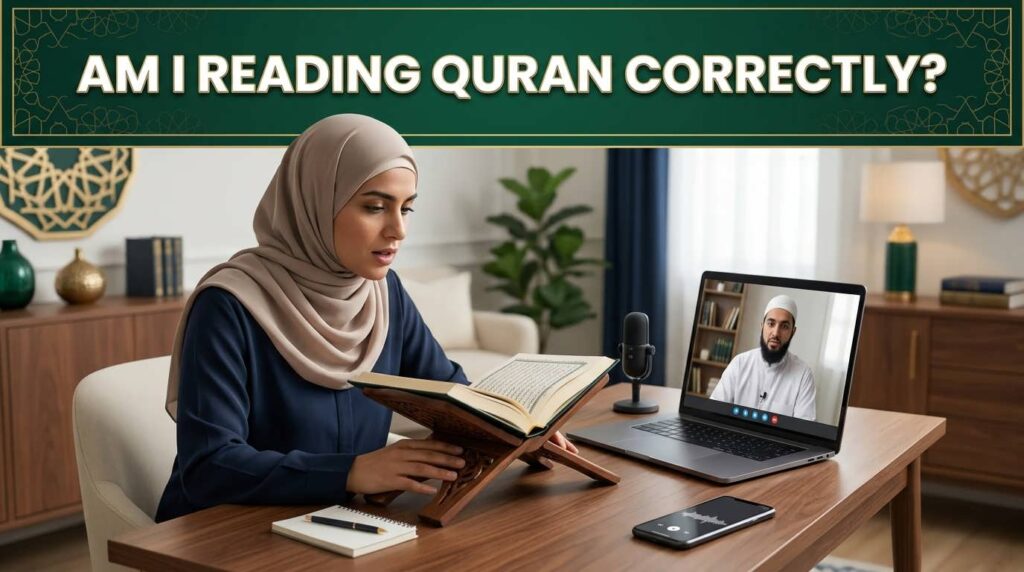
If you are wondering how to know if I am reading Quran correctly, the most reliable method is to have a qualified Quran teacher listen to an unfamiliar passage and check your pronunciation, Makharij, vowels, Tajweed, stopping points, and reading accuracy. You can also check yourself by reading aloud, comparing your recitation with a reliable Qari, recording your voice, and tracking repeated mistakes. However, self-checking alone can miss errors that have become normal to your ear.
Many people learned Quran as children and continue reading for years without regular correction. Others learned through Qaida but are unsure whether their pronunciation is still accurate.
You may be able to read fluently and still wonder:
Am I pronouncing every letter correctly?
Am I stretching Madd correctly?
Am I stopping in the right places?
Am I applying Tajweed or simply reading Arabic?
Would I even notice if I were making a mistake?
This guide gives you practical ways to find out.
| What to check | Warning sign |
|---|---|
| Arabic letters | Similar letters sound almost identical |
| Harakat | Short vowels are occasionally guessed |
| Makharij | You are unsure where letters originate |
| Madd | Lengthening changes from one reading to another |
| Tajweed | You know rules but rarely notice them while reading |
| Waqf | You stop wherever you run out of breath |
| Fluency | You guess difficult words to maintain speed |
| Accuracy | Nobody has checked your recitation recently |
- How to Know If I Am Reading Quran Correctly: Start With an Unfamiliar Page
- 1. Check Whether You Pronounce Similar Arabic Letters Differently
- 2. Check Short Vowels, Sukoon and Shaddah Carefully
- 3. Check Whether Your Tajweed Works During Real Recitation
- 4. Record Yourself Reading Quran
- 5. Compare Your Reading With a Reliable Qari
- 6. Check Your Stopping and Starting
- 7. Let a Qualified Teacher Listen to You
- A 10-Minute Quran Reading Accuracy Test You Can Do Today
- 7 Signs Your Quran Reading May Need Correction
- Can I Know If My Quran Reading Is Correct Without a Teacher?
- Does Reading Fluently Mean I Am Reading Correctly?
- What If I Can Read Quran but Don't Know Tajweed?
- What If My Quran Reading Sounds Different From a Famous Qari?
- Can Quran Apps Tell Me If I Am Reading Correctly?
- Should I Record Myself Reading Quran Every Week?
- Should I Restart Noorani Qaida If My Reading Is Wrong?
- What Should a Quran Teacher Check in My Recitation?
- Ask for Your Three Biggest Mistakes
- How Often Should Someone Check My Quran Reading?
- What If I Discover That I Have Been Reading Quran Incorrectly for Years?
- A Simple Quran Reading Correctness Checklist
- The Most Reliable Way to Know Your Quran Reading Is Correct
- Frequently Asked Questions
How to Know If I Am Reading Quran Correctly: Start With an Unfamiliar Page
Do not test yourself only with Al-Fatihah or short Surahs you have memorized.
Memorization can hide reading problems.
Instead, open a Quran page you have not memorized and read approximately half a page aloud.
Pay attention to what happens.
Ask yourself:
- Do I recognize every word or sometimes guess?
- Do I confuse similar-looking letters?
- Can I pronounce difficult letters consistently?
- Do I know when to lengthen a sound?
- Do I notice Shaddah and Sukoon?
- Do I know where to stop?
- Can I restart correctly after stopping?
- Does my reading remain accurate when the verse becomes long?
- Do I rush through difficult words?
This gives you a much better test of your actual Quran-reading ability.
QuranJourney’s live guide to building fluency in Quran reading explains an important distinction: fluency means smooth reading while maintaining accuracy. Reading quickly is not evidence that your recitation is correct.
1. Check Whether You Pronounce Similar Arabic Letters Differently
One of the clearest tests of Quran-reading accuracy is whether different Arabic letters actually sound different when you pronounce them.
Pay particular attention to pairs such as:
- س and ص
- ت and ط
- د and ض
- ذ and ظ
- ح and ه
- ح and خ
- ك and ق
- ع and ا
If two different letters consistently sound almost identical when you recite, your Makharij may need correction.
Try a simple test
Choose several Quranic words containing a letter you find difficult.
Read each word slowly.
Record yourself.
Then ask:
Does the letter sound consistent every time?
You may discover, for example, that your ق sounds correct when practiced alone but becomes weaker when it appears inside a complete Quranic word.
That distinction matters.
Correct pronunciation needs to survive inside actual recitation, not only during isolated letter exercises.
Umm Al-Qura University’s Electronic Quranic Recitation Portal places recitation correction together with articulation points and characteristics of letters in its structured Quran-recitation curriculum.
See Umm Al-Qura University’s Quranic Recitation curriculum
2. Check Short Vowels, Sukoon and Shaddah Carefully
Some reading mistakes have little to do with advanced Tajweed.
They happen at the basic reading level.
Check whether you consistently recognize:
- Fathah
- Kasrah
- Dammah
- Tanween
- Sukoon
- Shaddah
- Long vowels
A reader may be fluent enough to move quickly through a page but occasionally anticipate a word instead of reading every mark carefully.
Watch for guessing
Suppose you recognize the general shape of a familiar Quranic word.
Your brain may complete it before your eyes process every mark.
This is especially likely when:
- You read quickly
- The passage is familiar
- You have partially memorized it
- You are trying to sound fluent
- You are nervous in front of someone
Slow down when testing your accuracy.
You are not measuring how quickly you can finish the page.
You are checking whether you are reading what is actually written.
If basic decoding still causes frequent difficulty, returning temporarily to foundational exercises may be more useful than adding advanced Tajweed rules.
QuranJourney’s daily Quran learning plan for beginners includes regular review, new learning, aloud recitation, and focused repetition rather than treating progress as simply completing more pages.
3. Check Whether Your Tajweed Works During Real Recitation
Knowing Tajweed terminology and applying Tajweed are different skills.
You may know what Ikhfa means.
You may be able to explain Qalqalah.
You may know that Madd involves lengthening.
But what happens when you encounter these rules unexpectedly while reading?
That is the real test.
Common areas worth checking include:
- Noon Sakinah and Tanween
- Meem Sakinah
- Ghunnah
- Qalqalah
- Madd
- Rules of Lam
- Rules of Raa
- Makharij
- Characteristics of letters
- Stopping and starting
Umm Al-Qura University’s recitation program progresses through practical recitation correction and application of Tajweed areas including Noon Sakinah and Tanween, Meem Sakinah, Qalqalah, Mudood, articulation points, and letter characteristics.
Test one rule at a time
Do not try to evaluate every Tajweed rule simultaneously.
Choose one.
For example:
Today I am checking Madd.
Read half a page.
Every time you encounter Madd, ask whether you applied what you learned.
On another day:
Today I am checking Ghunnah.
Then:
Today I am checking Qalqalah.
This makes self-assessment much more manageable.
If you previously learned Tajweed but no longer remember how to apply it, QuranJourney’s live guide for people who have forgotten Tajweed rules provides a structured refresher rather than assuming you need to restart everything.
4. Record Yourself Reading Quran
Your voice sounds different when you listen to a recording than when you hear yourself while speaking.
That makes recording useful.
Choose approximately five to ten lines from an unfamiliar passage.
First reading
Read normally.
Do not stop the recording when you make a mistake.
Listen back
Pay attention to:
- Unclear letters
- Inconsistent pronunciation
- Rushing
- Long pauses
- Incorrect lengthening
- Words you repeated
- Places where you sounded uncertain
- Sudden changes in pace
Second reading
Practice the difficult areas and record the same passage again.
Compare both recordings.
You may immediately notice some problems.
But recording has an important limitation:
You can only recognize errors that you already know are errors.
If you learned a letter incorrectly ten years ago, your pronunciation may sound completely normal to you.
That is why recording is useful for self-monitoring but should not replace knowledgeable correction.
5. Compare Your Reading With a Reliable Qari
Listening can help train your ear.
Choose a reliable recitation of the exact passage you are reading.
Use this sequence:
Listen → pause → read → listen again → compare
Do not simply play the recitation in the background.
Actively compare:
- Letter pronunciation
- Lengthening
- Ghunnah
- Qalqalah
- Rhythm
- Pauses
- Stopping points
Quran.com provides verse-by-verse recitations that can be useful for listening to individual verses repeatedly. Its presentation of Surah Al-Muzzammil 73:4 also gives the instruction to recite the Quran in a measured manner.
Read and listen to Surah Al-Muzzammil 73:4 on Quran.com
Do not imitate only the melody
A beautiful voice is not the same as correct Quran reading.
Your objective is not to reproduce another Qari’s voice.
Listen for:
pronunciation + Tajweed + measured recitation
rather than musical style.
You do not need to sound like a famous reciter to read Quran correctly.
6. Check Your Stopping and Starting
Correct Quran reading is not only about individual letters.
Where you stop also matters.
Many learners stop according to lung capacity:
“I need a breath, so I’ll stop here.”
But a good reader also learns to notice the stopping signs in the Mushaf and how to resume appropriately.
During your self-check, ask:
- Am I noticing Waqf signs?
- Do I regularly stop in the middle of phrases?
- Do I know where to restart after taking a breath?
- Do I automatically stop at the end of every printed line?
- Do I understand that a printed line ending is not necessarily a stopping point?
If you regularly ignore stopping signs because you do not understand them, add Waqf and Ibtida to your learning plan.
Umm Al-Qura University’s formal Quran curriculum includes Waqf and Ibtida among the Tajweed topics taught alongside Makharij and other recitation rules.
7. Let a Qualified Teacher Listen to You
This is the most important check.
You cannot reliably diagnose every mistake in your own recitation.
A teacher can hear things you may have stopped noticing.
For example:
You think your ق is correct.
The teacher hears that it is too close to ك.
You think your Madd is consistent.
The teacher notices that you shorten it whenever you increase speed.
You think you understand Qalqalah.
The teacher notices that you exaggerate it.
You think you read fluently.
The teacher notices that you are guessing endings of familiar words.
This is why traditional recitation learning includes listening and correction rather than relying entirely on independent reading.
Umm Al-Qura University’s Quranic Recitation Portal itself uses recitation and correction as a core part of its levels rather than teaching Tajweed theory alone.
QuranJourney’s live Nazara Quran reading course similarly focuses on one-to-one recitation, Makharij, Tajweed, fluency, and real-time pronunciation correction. The live course page states that tutors focus on individual mistakes and provide feedback during lessons.
A 10-Minute Quran Reading Accuracy Test You Can Do Today
If you are unsure about your reading, try this simple test.
Minute 1: Choose an unfamiliar passage
Do not choose a Surah you know by heart.
Minutes 2–4: Read aloud without assistance
Read naturally but carefully.
Record yourself if possible.
Do not listen to a Qari first.
You want to test your current reading, not your short-term ability to imitate what you just heard.
Minutes 5–6: Mark uncertain places
Mark words where you:
- Hesitated
- Guessed
- Restarted
- Were unsure of pronunciation
- Were unsure of Tajweed
- Did not know where to stop
Minutes 7–8: Listen to a reliable recitation
Now listen to the same verses.
Follow the Mushaf while listening.
Minutes 9–10: Read again
Read the passage again.
Notice what changed.
This can reveal obvious weaknesses.
However, do not conclude:
“I matched the audio, therefore my recitation is completely correct.”
For a proper assessment, have someone qualified listen to you.
7 Signs Your Quran Reading May Need Correction
You should consider having your recitation checked if several of these sound familiar.
1. Nobody has listened to your reading for years
You learned as a child and have mostly read independently since then.
2. You avoid reading in front of knowledgeable people
You worry they will notice mistakes.
If this is mainly a confidence issue, QuranJourney’s live guide on how to gain confidence reading Quran explains how to separate nervousness from actual reading weakness.
3. Similar Arabic letters sound the same
Especially letters with different articulation points.
4. You know Tajweed names but cannot identify the rules while reading
Theory is not consistently becoming practice.
5. You copy a Qari but struggle without audio
This may indicate that you are imitating rather than independently decoding the Quran.
6. You read familiar Surahs smoothly but unfamiliar pages slowly
Your memorization may be stronger than your reading ability.
7. You frequently guess difficult words
Guessing is particularly important to address because it can be hidden by speed.
None of these automatically means your entire reading foundation is poor.
They simply give you reasons to check more carefully.
Can I Know If My Quran Reading Is Correct Without a Teacher?
You can identify some problems without a teacher.
Self-checking can help you notice:
- Hesitation
- Forgotten rules
- Inconsistent pace
- Words you cannot decode
- Obvious differences from reliable recitation
- Repeated difficult letters
But there is a fundamental problem with evaluating yourself:
You do not know what you do not hear.
Imagine you have pronounced ض incorrectly since childhood.
You hear yourself say it.
It sounds normal.
You listen again.
It still sounds normal.
The problem is not your hearing.
The problem is that your brain has learned that pronunciation as the expected sound.
An experienced teacher provides an external reference.
This is also why QuranJourney’s guide to your first online Quran class describes a simple reading assessment in which the teacher listens to letters, words, Surahs, or Tajweed according to the learner’s current level.
Does Reading Fluently Mean I Am Reading Correctly?
No.
Fluency and accuracy are related, but they are not identical.
You can read:
quickly + incorrectly
or:
slowly + accurately.
QuranJourney’s live fluency guide distinguishes accuracy from fluency: accuracy involves correct pronunciation and Tajweed, while fluency concerns smooth, confident reading with minimal hesitation.
For someone checking their recitation, use this order:
Accuracy → consistency → fluency → speed
Do not reverse it.
Trying to increase speed before fixing pronunciation can make errors harder to notice.
What If I Can Read Quran but Don’t Know Tajweed?
First determine what you mean by “don’t know Tajweed.”
There are two possibilities.
You don’t know the names of Tajweed rules
You may still apply some rules correctly because a teacher taught you through repetition.
For example, you might make Ghunnah correctly without remembering its technical name.
You don’t apply the rules correctly
This needs instruction and practice.
A teacher can identify which rules are actually missing.
Do not assume you must memorize an entire Tajweed textbook before continuing Quran reading.
Learn the rule.
Hear it.
Practice it.
Then apply it during actual Quran recitation.
If you learned Tajweed previously but it has faded, use a targeted refresher rather than automatically starting from zero. QuranJourney’s Forgot Tajweed Rules guide is specifically designed around that situation.
What If My Quran Reading Sounds Different From a Famous Qari?
Different does not automatically mean wrong.
Your:
- Voice
- Pitch
- Breath capacity
- Tone
- Natural rhythm
do not need to match another reciter.
Focus on whether the letters and recitation rules are correct.
Do not judge your reading by whether it sounds equally beautiful.
A person can have a beautiful voice and still need Tajweed correction.
Another person can have an ordinary voice while reading accurately.
Correctness comes before vocal beauty.
Can Quran Apps Tell Me If I Am Reading Correctly?
Apps can be useful tools.
They may help you:
- Listen verse by verse
- Repeat recitation
- Follow Quran text
- Practice difficult passages
- Compare your reading
- Review Tajweed material
Some technology may also attempt pronunciation analysis.
But do not assume an app’s acceptance means your complete recitation is correct.
Subtle issues involving Makharij, letter characteristics, Tajweed application, and stopping may require knowledgeable human feedback.
Use technology as:
practice support
rather than:
final certification of accuracy.
Should I Record Myself Reading Quran Every Week?
You can.
A weekly recording can make progress easier to hear.
Choose one passage and record yourself.
Track:
- Pronunciation
- Hesitation
- Repeated errors
- Tajweed
- Fluency
- Stopping
Then repeat the same passage several weeks later.
You can also keep a simple correction log.
| Date | Main correction | Practice focus |
|---|---|---|
| Week 1 | ق pronunciation | Makharij |
| Week 2 | Madd inconsistent | Lengthening |
| Week 3 | Weak Ghunnah | Noon/Meem practice |
| Week 4 | Poor stopping | Waqf |
This is more useful than writing:
“Need to improve Quran.”
Specific problems create specific practice.
For a sustainable routine, QuranJourney’s 30-minute daily Quran learning plan shows how revision, new learning, recitation, and reflection can fit into one structured session.
Should I Restart Noorani Qaida If My Reading Is Wrong?
Not automatically.
Restarting Qaida may be useful if you struggle with fundamentals such as:
- Letter recognition
- Joined letters
- Harakat
- Sukoon
- Shaddah
- Tanween
- Basic decoding
But suppose you can read Quran independently and your main problem is:
- Makharij
- Madd
- Ghunnah
- Qalqalah
- Waqf
- Advanced Tajweed
Restarting every Qaida lesson may waste time.
A better approach is assessment first.
Identify where the weakness begins.
Then work from that point.
For adults returning after a long gap, QuranJourney’s live Quran refresher course guide for adults explains how to distinguish foundational reading problems from pronunciation, Tajweed, and fluency issues.
What Should a Quran Teacher Check in My Recitation?
Ask the teacher for specific feedback rather than simply:
“Was that okay?”
A useful assessment can look at:
Reading accuracy
Are you reading the written words correctly?
Makharij
Are Arabic letters coming from appropriate articulation points?
Letter characteristics
Are similar letters sufficiently distinct?
Harakat
Are short vowels correct?
Madd
Are you applying lengthening appropriately?
Ghunnah
Are nasal sounds applied where required?
Qalqalah
Is it present without being exaggerated?
Tajweed
Can you apply rules during continuous reading?
Waqf and Ibtida
Are stopping and restarting appropriate?
Fluency
Can you maintain controlled reading without excessive hesitation or guessing?
QuranJourney’s live Nazara course currently covers pronunciation, Makharij, Tajweed, fluency, and individual correction in one-to-one lessons.
Ask for Your Three Biggest Mistakes
A useful question after an assessment is:
“What are the three most important things I should correct first?”
This prevents you from leaving the lesson with twenty unrelated corrections.
For example, your teacher might say:
Priority 1: ص and س
Priority 2: Madd
Priority 3: stopping
For the next week, focus on those.
Once they improve, move to the next priorities.
QuranJourney’s live guide to a personalized Quran course describes this assessment-based approach, where teaching is adjusted to the student’s actual reading level and learning needs rather than forcing every learner through identical material.
How Often Should Someone Check My Quran Reading?
There is no single required schedule.
If you are actively learning, regular teacher feedback is useful because mistakes can be corrected before they become familiar habits.
If you already read reasonably well, periodic assessment can still reveal:
- Pronunciation drift
- Forgotten Tajweed
- Repeated mistakes
- Weak stopping
- Rushing
- Fluency problems
Do not wait until you feel your reading is “bad enough” to deserve correction.
Feedback is part of learning.
What If I Discover That I Have Been Reading Quran Incorrectly for Years?
Do not turn discovery into a reason to stop reading.
Now you know what needs attention.
Write down the corrections.
Practice them.
Ask your teacher to check them again.
Then continue.
If several areas need work, prioritize them instead of trying to repair everything in one session.
For example:
Month 1: Makharij
Month 2: common Tajweed errors
Month 3: Waqf and fluency
Your actual plan should depend on the assessment rather than this example timeline.
If embarrassment is preventing you from reading to a teacher, QuranJourney’s article on gaining confidence while reading Quran offers a separate plan specifically for that problem.
A Simple Quran Reading Correctness Checklist
Use this checklist occasionally while reading an unfamiliar passage.
Basic reading
- Am I reading every written letter?
- Am I reading Harakat correctly?
- Am I recognizing Shaddah and Sukoon?
- Am I avoiding guessing?
Pronunciation
- Are similar letters distinct?
- Are my difficult Makharij consistent?
- Do letters remain correct inside words?
Tajweed
- Am I noticing the rules I have learned?
- Is my Madd consistent?
- Am I applying Ghunnah appropriately?
- Am I applying Qalqalah correctly?
Stopping
- Am I noticing Waqf signs?
- Am I choosing reasonable stopping points?
- Can I restart correctly?
Fluency
- Am I reading accurately before increasing speed?
- Do unfamiliar passages expose weaknesses?
- Am I repeatedly hesitating at the same patterns?
Feedback
- Has a qualified teacher listened to me recently?
- Do I know my three most common mistakes?
- Am I practicing those specific mistakes?
If you cannot answer several of these questions confidently, that does not prove your reading is wrong.
It tells you what needs checking.
The Most Reliable Way to Know Your Quran Reading Is Correct
If you keep asking how to know if I am reading Quran correctly, don’t rely only on how fluent you sound.
Test your reading with unfamiliar Quran text.
Listen for your Makharij.
Check Harakat.
Review Tajweed.
Pay attention to stopping.
Record yourself.
Compare carefully with reliable recitation.
Most importantly, let a qualified teacher hear your actual reading.
The purpose of an assessment is not to prove that your recitation is poor. It is to replace uncertainty with specific information:
This is correct.
This needs work.
This is what you should practice next.
QuranJourney currently offers live one-to-one Nazara Quran lessons with real-time pronunciation and Tajweed correction, male and female tutors, individualized feedback, and a free trial.
You can book a free Quran trial class and specifically ask the teacher to assess your Quran reading, Makharij, Tajweed, fluency, and stopping before recommending what you should work on next.
Frequently Asked Questions
How do I know if I am pronouncing Quran correctly?
Read an unfamiliar passage to a qualified Quran teacher. They can check your Makharij, vowels, Tajweed, and repeated pronunciation mistakes that may be difficult to notice yourself.
Can I check my Quran recitation myself?
Partly. Recording yourself and comparing with a reliable Qari can reveal obvious mistakes, but teacher feedback is more reliable for errors you cannot hear yourself.
Does fluent Quran reading mean correct reading?
No. Fluency means reading smoothly, while accuracy involves correct letters, pronunciation, vowels, and Tajweed. A person can read quickly while still making mistakes.
How can I check my Tajweed?
Choose one Tajweed rule at a time and look for it while reciting. For a fuller assessment, read to a qualified Tajweed teacher who can check practical application.
Should I read Quran slowly when checking mistakes?
Yes. Reading at a controlled pace makes it easier to notice pronunciation, vowels, Tajweed, and stopping. Accuracy should come before speed.
Do I need a teacher to read Quran correctly?
Independent practice is valuable, but a qualified teacher can detect pronunciation and Tajweed mistakes that you may not recognize in your own recitation.
Should I restart Qaida if I make Quran reading mistakes?
Not necessarily. Restart Qaida only if foundational skills are weak. If the problem is mainly Tajweed, Makharij, or fluency, targeted correction may be more appropriate.
Can I use Quran audio to correct my recitation?
Yes, as a practice tool. Listen to a reliable reciter, pause, repeat, and compare. However, audio cannot tell you whether your own pronunciation is fully correct.