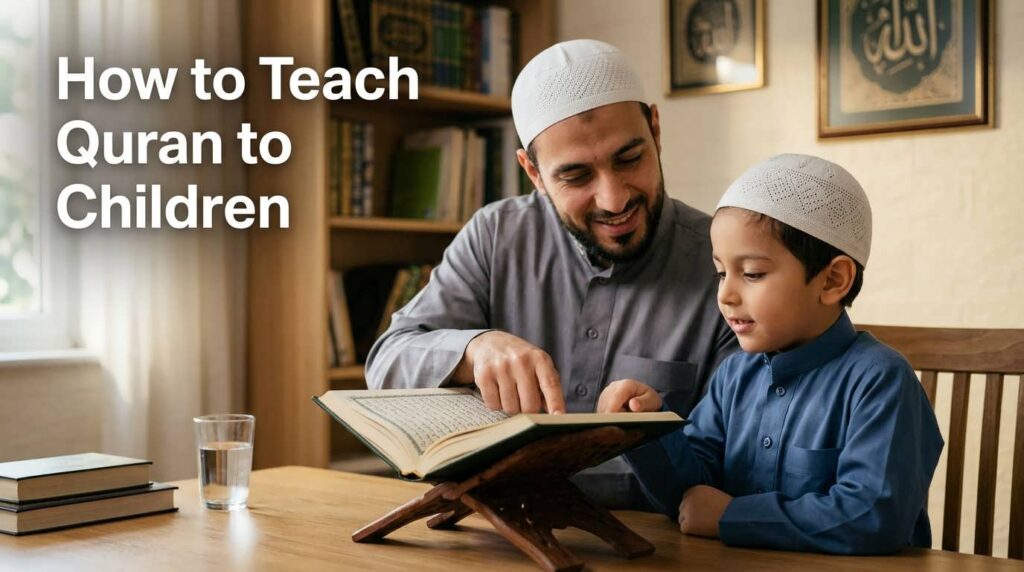
To teach Quran to children effectively, start with age-appropriate lessons, focus on consistency rather than speed, use positive encouragement, and build strong Quran learning habits. Begin with Arabic letters and Noorani Qaida, then gradually progress to Quran reading, Tajweed, memorization, and understanding while keeping lessons engaging and manageable.
Every Muslim parent wants their child to develop a strong connection with the Quran. However, many parents wonder where to begin, how much to teach at each stage, and how to keep children motivated throughout the learning journey.
The good news is that teaching the Quran does not require parents to be professional scholars. What matters most is creating a positive learning environment, establishing consistency, and providing children with the guidance and support they need to grow in their understanding of Allah’s Book.
- Why Teaching the Quran to Children Matters
- When Should Children Start Learning the Quran?
- Start With the Basics
- Focus on Consistency, Not Speed
- Create a Positive Learning Environment
- Use Age-Appropriate Teaching Methods
- Teach Proper Quran Recitation
- Encourage Memorization Gradually
- Help Children Understand the Meaning
- Make Quran Learning Part of Daily Life
- The Role of Parents in Quran Education
- Should You Teach the Quran Yourself or Hire a Teacher?
- Benefits of Online Quran Classes for Children
- Common Mistakes Parents Should Avoid
- Building a Lifelong Love for the Quran
- Conclusion
- Frequently Asked Questions
Why Teaching the Quran to Children Matters
The Quran is more than a book that children learn to read.
It serves as a foundation for:
- Islamic identity
- Good character
- Daily worship
- Spiritual growth
- Understanding Islamic values
Introducing children to the Quran at an early age helps nurture a lifelong relationship with Islamic learning.
The Quran itself encourages reflection, recitation, and learning. Parents can explore translations and recitation resources through Quran.com.
When Should Children Start Learning the Quran?
There is no single age that works for every child.
Most children begin learning basic Quran skills between the ages of 4 and 7.
The right time depends on:
- Attention span
- Language development
- Interest level
- Readiness to learn
Rather than focusing on age alone, parents should look for signs that a child is ready to participate in short, structured lessons.
Start With the Basics
One of the biggest mistakes parents make is trying to move too quickly.
Children need a strong foundation before they can read the Quran confidently.
Begin With Arabic Letters
The first stage usually includes:
- Letter recognition
- Pronunciation practice
- Basic sounds
- Letter shapes
Children should become comfortable identifying and pronouncing Arabic letters before progressing further.
Teach Noorani Qaida
Noorani Qaida introduces children to the building blocks of Quran reading.
Students learn:
- Harakat (vowel marks)
- Joining letters
- Reading patterns
- Pronunciation rules
Many children begin through a structured Nazara Quran Course that gradually develops reading fluency and confidence.
Focus on Consistency, Not Speed
Parents often compare their children to others.
However, Quran learning is not a race.
A child who learns consistently for 15 to 20 minutes daily may make better long-term progress than a child who studies for several hours only occasionally.
Consistency helps children:
- Retain information
- Develop habits
- Improve confidence
- Avoid frustration
Small daily efforts often produce the strongest results over time.
Create a Positive Learning Environment
Children learn best when they enjoy the experience.
Parents can create a positive environment by:
- Offering encouragement
- Celebrating progress
- Avoiding harsh criticism
- Maintaining patience
- Setting realistic expectations
When Quran learning becomes associated with positive experiences, children are more likely to remain motivated.
Use Age-Appropriate Teaching Methods
Teaching a five-year-old differs significantly from teaching a teenager.
For Younger Children
Focus on:
- Short lessons
- Repetition
- Visual learning
- Positive reinforcement
For Older Children
Introduce:
- Tajweed concepts
- Quran meanings
- Memorization goals
- Independent practice
Adapting instruction to a child’s age and development level improves learning outcomes.
Teach Proper Quran Recitation
Correct recitation should be emphasized from the beginning.
This includes:
- Pronunciation accuracy
- Letter articulation
- Reading fluency
- Basic Tajweed
Children who develop correct habits early often find advanced Quran learning much easier later.
Parents who are not confident teaching Tajweed themselves may benefit from enrolling their child with a qualified Female Quran Teacher for Kids or another experienced Quran instructor.
Encourage Memorization Gradually
Memorization is an important part of Quran education, but it should be introduced thoughtfully.
Start with:
- Short Surahs
- Daily duas
- Frequently recited verses
Children should understand that revision is just as important as memorization.
A structured Hifz Ul Quran Course can help students develop effective memorization and revision habits.
Help Children Understand the Meaning
Teaching children to read the Quran is important, but understanding should also be encouraged.
Parents can:
- Explain simple meanings
- Discuss lessons from Surahs
- Relate Quranic teachings to daily life
- Encourage reflection
This helps children develop a deeper connection with the Quran beyond recitation alone.
For deeper study, families may explore a structured Dars-e-Quran Course.
Make Quran Learning Part of Daily Life
Children learn best when Islamic education becomes part of everyday routines.
Simple ideas include:
- Reading together after Salah
- Reviewing memorized Surahs before bedtime
- Listening to Quran recitation in the car
- Discussing Islamic lessons during family time
These habits reinforce classroom learning and strengthen retention.
The Role of Parents in Quran Education
Even when children have professional teachers, parents remain important partners in the learning process.
Parents can support success by:
- Monitoring progress
- Encouraging revision
- Maintaining schedules
- Communicating with teachers
- Providing emotional support
A child’s motivation often increases when parents show interest in their Quran education.
Should You Teach the Quran Yourself or Hire a Teacher?
Many parents ask whether they should teach their children personally or seek professional instruction.
Both approaches can be effective.
Teaching at Home
Advantages include:
- Strong parent-child interaction
- Flexible learning pace
- Greater involvement
Learning With a Qualified Teacher
Advantages include:
- Tajweed expertise
- Structured curriculum
- Professional guidance
- Regular assessments
Many families combine both approaches by using professional lessons while reinforcing learning at home.
If you’re considering professional instruction, our guide on How to Choose a Female Quran Teacher can help you evaluate teaching options.
Benefits of Online Quran Classes for Children
Online Quran learning has become increasingly popular among Muslim families worldwide.
Benefits include:
- Flexible schedules
- One-on-one instruction
- Access to qualified teachers
- Learning from home
- Personalized lesson plans
Families in the USA, UK, Canada, Germany, New Zealand, and across Europe often choose online learning because it provides access to experienced teachers regardless of location.
Parents who are new to virtual learning can read How Online Quran Classes Work to better understand the process.
Common Mistakes Parents Should Avoid
Expecting Fast Results
Quran learning is a long-term journey.
Comparing Children
Every child progresses differently.
Inconsistent Schedules
Irregular lessons often slow progress.
Focusing Only on Memorization
Children should learn recitation, understanding, and application alongside memorization.
Using Excessive Pressure
Encouragement is usually more effective than constant criticism.
Avoiding these mistakes helps maintain a positive learning experience.
Building a Lifelong Love for the Quran
The ultimate goal is not simply completing lessons or memorizing Surahs.
The goal is helping children:
- Love the Quran
- Understand its importance
- Apply its teachings
- Continue learning throughout life
When children develop a positive relationship with the Quran, they are more likely to remain connected to it as adults.
Families seeking additional support can begin with a free Trial Class to evaluate a structured Quran learning program.
You can also learn more about the academy’s educational approach through the About Us page or discuss your child’s learning needs through the Contact Us page.
Conclusion
Learning how to teach Quran to children begins with patience, consistency, and realistic expectations. By starting with strong foundations, using age-appropriate teaching methods, encouraging regular practice, and creating a positive learning environment, parents can help their children build lifelong Quran learning habits.
Whether children learn at home, through online Quran classes, or with a qualified teacher, the most important factor is maintaining a steady and supportive approach that nurtures both knowledge and love for the Quran.
Frequently Asked Questions
What is the best age to start teaching the Quran to children?
Most children begin learning between ages 4 and 7, but readiness depends on individual development, attention span, and interest.
Should children learn Noorani Qaida before reading the Quran?
Yes. Noorani Qaida provides the foundation for Arabic reading and helps children develop proper pronunciation and reading skills.
How long should Quran lessons be for children?
For younger children, 15 to 30 minutes is often sufficient. Lesson length can gradually increase as concentration improves.
Is memorization more important than understanding?
Both are important. Children should memorize Quranic passages while also learning basic meanings and lessons.
Can parents teach the Quran without being scholars?
Yes. Parents can support Quran learning at home, although professional teachers may be helpful for Tajweed and advanced instruction.
Are online Quran classes effective for children?
Yes. Many children benefit from one-on-one attention, structured lessons, and flexible scheduling available through online Quran programs.
How can I motivate my child to learn the Quran?
Use encouragement, celebrate progress, maintain consistency, and create positive learning experiences rather than relying on pressure or criticism.
Should children learn Tajweed from the beginning?
Basic Tajweed principles should be introduced early so children develop correct recitation habits as they progress.