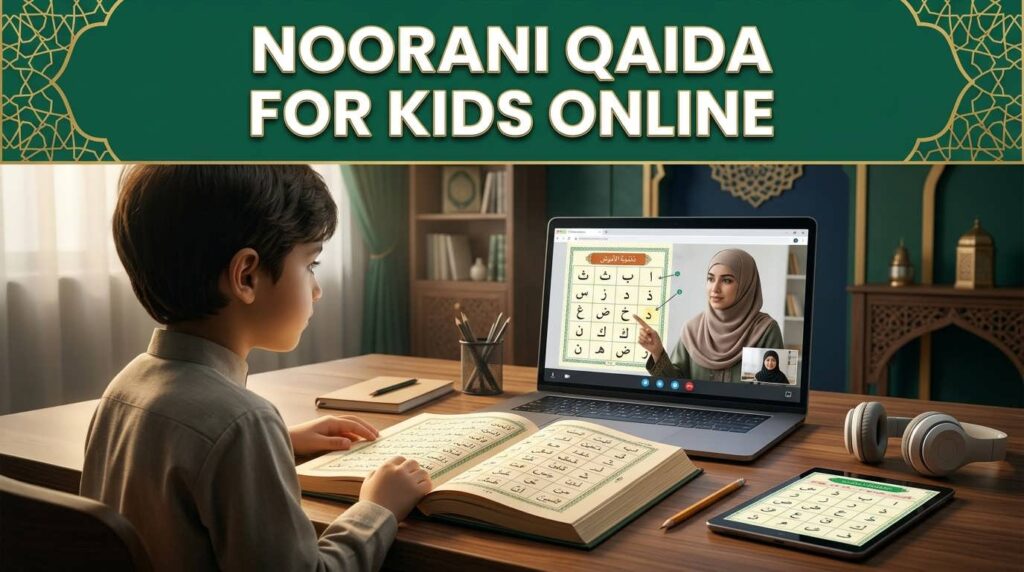
Noorani Qaida for kids online is a structured way for children to learn the basic skills they need before progressing to regular Quran reading.
Instead of asking a child to immediately read complete Quranic verses, Noorani Qaida introduces the foundations step by step.
Children gradually learn:
- Arabic letters
- Letter sounds
- Harakat
- Joining letters
- Basic pronunciation
- Madd
- Sukoon
- Shaddah
- Tanween
- Basic Tajweed concepts
This foundation can make the transition to Quran reading much easier.
The sequence is generally designed to move from simple exercises toward increasingly complex reading patterns.
- Why Should Kids Learn Noorani Qaida Before the Quran?
- What Do Kids Learn in Noorani Qaida?
- How Do Noorani Qaida Classes Work Online?
- Is Online Noorani Qaida Suitable for Young Children?
- At What Age Can Children Start Noorani Qaida?
- Why One-on-One Noorani Qaida Classes Can Help Kids
- Can Kids Learn Noorani Qaida in a Group?
- What Makes Online Noorani Qaida Classes Interactive?
- How Long Should a Noorani Qaida Lesson Be for a Child?
- How Often Should Kids Practice Noorani Qaida?
- Should Parents Sit With Children During Online Classes?
- How Can Parents Keep Kids Interested in Noorani Qaida?
- Should Kids Be Pressured to Finish Noorani Qaida Quickly?
- How Can Parents Tell If Their Child Is Improving?
- Common Mistakes Parents Make During Noorani Qaida Learning
- Can Noorani Qaida Help Children With Tajweed?
- Why Correct Pronunciation Matters for Children
- What Are Makharij?
- Can Kids Learn Noorani Qaida Without Knowing Arabic?
- Can Noorani Qaida Be Learned on a Tablet or Phone?
- What Equipment Does a Child Need?
- Is Online Learning Better Than a Physical Noorani Qaida Book?
- Can Children Practice Noorani Qaida Without a Teacher?
- Can Parents Teach Noorani Qaida at Home?
- How Can a Teacher Make Noorani Qaida Fun for Kids?
- What Happens After a Child Completes Noorani Qaida?
- Can Children Start Quran Reading Before Finishing the Entire Qaida?
- How Can Parents Create a Good Home Practice Routine?
- Should Kids Read Noorani Qaida Slowly?
- How Can Parents Help a Child Who Is Struggling?
- When Should Parents Consider a Different Teacher?
- Can a Female Quran Teacher Teach Noorani Qaida to Girls?
- What Should Parents Ask Before Enrolling?
- How to Choose the Right Online Noorani Qaida Course
- Is Online Noorani Qaida Safe for Children?
- How Can Noorani Qaida Build Quran Reading Confidence?
- Start With a Quran Trial Class
- Final Thoughts
- Frequently Asked Questions
Why Should Kids Learn Noorani Qaida Before the Quran?
A child may recognize Arabic letters without actually being able to read Quranic words correctly.
Noorani Qaida helps bridge that gap.
Instead of memorizing random words, children gradually learn how letters behave and how different reading signs affect pronunciation.
This can help children develop:
- Better letter recognition
- More accurate pronunciation
- Reading confidence
- Familiarity with Arabic script
- Basic Tajweed awareness
- Better Quran reading habits
A strong foundation is particularly valuable because pronunciation mistakes can become difficult to correct if they are repeatedly practiced.
What Do Kids Learn in Noorani Qaida?
The exact lesson sequence can vary, but children commonly progress through several important areas.
Arabic Letters
Children first become familiar with the Arabic alphabet and learn to distinguish between letters that may look or sound similar.
Letter Pronunciation
The teacher demonstrates how each letter should sound and listens to the child’s pronunciation.
Harakat
Children learn common short vowel signs such as:
- Fatha
- Kasra
- Damma
Joining Letters
Students learn how individual letters connect to form readable combinations.
Sukoon and Shaddah
Children gradually learn how these signs affect pronunciation.
Madd
Students learn how certain sounds are extended during recitation.
Basic Tajweed
As children progress, they can begin learning foundational Tajweed concepts that support correct Quran recitation.
These building blocks are commonly included in structured Noorani Qaida programs for children.
How Do Noorani Qaida Classes Work Online?
Online Noorani Qaida classes usually take place through a live video lesson.
The child connects with the teacher using a computer, tablet, or phone.
During the class, the teacher can:
- Display the Qaida lesson.
- Explain the exercise.
- Demonstrate pronunciation.
- Ask the child to read.
- Listen carefully.
- Correct mistakes.
- Ask the child to repeat.
- Review previous lessons.
- Introduce new material when the child is ready.
This makes the class interactive rather than simply asking a child to watch a recording.
Live one-to-one courses commonly use this approach so the teacher can adjust the pace according to the child’s level.
Is Online Noorani Qaida Suitable for Young Children?
Yes, provided the class is designed around the child’s age and attention span.
Young children usually benefit from:
- Short focused lessons
- Repetition
- Visual examples
- Teacher interaction
- Frequent encouragement
- Simple explanations
- Regular review
The teacher should not expect a young child to concentrate in exactly the same way as an adult.
A patient teaching style can make a significant difference.
At What Age Can Children Start Noorani Qaida?
There is no single age that is perfect for every child.
Some children are ready when they can recognize basic letters and follow simple instructions.
Others may need more time.
The child’s:
- Attention span
- Letter recognition
- Language development
- Interest
- Ability to sit for a lesson
should all be considered.
Some online Noorani Qaida programs specifically advertise courses for children from around age four, while other programs use different age ranges.
Parents should therefore focus on readiness rather than simply choosing an age based on another child.
Why One-on-One Noorani Qaida Classes Can Help Kids
One-on-one classes allow the teacher to focus entirely on one child’s reading.
This is especially useful when a child:
- Confuses Arabic letters.
- Has pronunciation difficulties.
- Needs repeated explanations.
- Learns more slowly than classmates.
- Moves ahead quickly.
- Needs extra practice.
The teacher can spend additional time on a difficult letter instead of moving on because the rest of the class is ready.
This individualized approach is one reason many online Quran programs use one-to-one teaching for children.
Can Kids Learn Noorani Qaida in a Group?
Yes, group classes can work.
However, parents should check how much individual reading time each child receives.
A child who only listens to other students may not get enough opportunity to practice.
For a beginner, it is important that the teacher actually hears the child read and provides correction.
If a group class has a small number of students and sufficient interaction, it can still be effective.
What Makes Online Noorani Qaida Classes Interactive?
A good online class should not feel like a child is simply watching a screen.
The teacher can make the lesson interactive by:
- Asking the child to identify letters.
- Highlighting individual letters.
- Demonstrating sounds.
- Asking the child to repeat.
- Giving quick reading exercises.
- Reviewing previous lessons.
- Correcting mistakes immediately.
- Using visual learning material.
Interactive online Quran classrooms can also use shared screens, highlighting, and digital writing tools to make the lesson more engaging.
How Long Should a Noorani Qaida Lesson Be for a Child?
The ideal lesson duration depends on the child’s age and concentration.
A younger child may benefit from shorter sessions.
Older children may be able to handle longer lessons.
The objective should not be to keep a child online for as long as possible.
Instead, the lesson should provide enough time to:
- Review.
- Learn.
- Practice.
- Receive correction.
- Finish with a clear task for home practice.
Quality and consistency are more important than simply counting minutes.
How Often Should Kids Practice Noorani Qaida?
Regular practice is important.
Children do not need to spend hours practicing every day.
A short review after class can help reinforce what they learned.
For example, parents can ask the child to review:
- Today’s letters.
- Difficult sounds.
- Previous exercises.
- New Harakat.
- Words the teacher marked for practice.
Consistency helps prevent children from forgetting material between lessons.
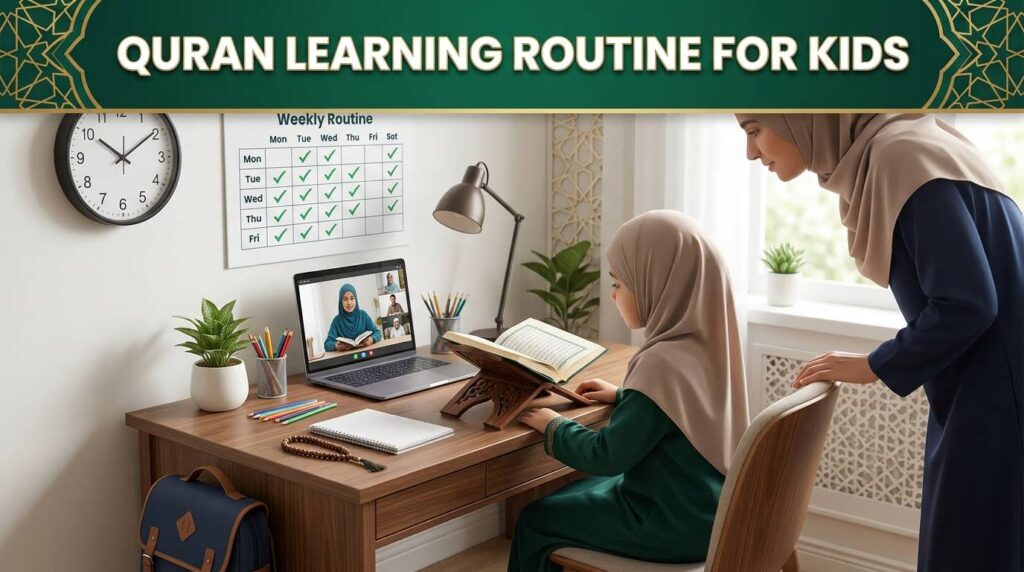
A structured Quran learning routine for kids can help parents make Quran study part of the child’s regular schedule.
Should Parents Sit With Children During Online Classes?
It depends on the child’s age.
Very young children may need a parent nearby to:
- Help with technology.
- Keep the child focused.
- Resolve connection problems.
- Ensure the child is ready for class.
As children become more independent, parents may not need to sit beside them throughout the entire lesson.
However, parents should still monitor progress and communicate with the teacher.
How Can Parents Keep Kids Interested in Noorani Qaida?
Children can lose interest when every lesson feels exactly the same.
Parents and teachers can keep learning engaging by using:
- Short activities
- Repetition
- Positive feedback
- Small achievable goals
- Visual exercises
- Regular progress reviews
- Encouraging words
Avoid turning every mistake into criticism.
A child should understand that mistakes are a normal part of learning.
Should Kids Be Pressured to Finish Noorani Qaida Quickly?
No.
Finishing the Qaida quickly does not necessarily mean the child has learned it well.
A child might complete many pages while still struggling with pronunciation.
Another child might progress more slowly but develop a much stronger foundation.
The better question is:
Can the child read the material correctly and confidently?
The objective is mastery, not speed.
How Can Parents Tell If Their Child Is Improving?
Look for practical changes.
Your child may begin to:
- Recognize letters faster.
- Make fewer pronunciation mistakes.
- Read combinations more confidently.
- Remember previously learned lessons.
- Need fewer corrections.
- Read without constant prompting.
- Understand common reading signs.
Progress may seem slow at first.
Then, once the foundations become familiar, improvement can become more noticeable.
Common Mistakes Parents Make During Noorani Qaida Learning
Expecting Fast Results
Every child learns at a different pace.
Comparing Children
Comparing siblings or classmates can reduce confidence.
Focusing Only on Page Numbers
Completing pages does not guarantee understanding.
Ignoring Pronunciation
Reading quickly with incorrect pronunciation creates poor habits.
Skipping Practice
Infrequent practice makes retention harder.
Changing Teachers Too Often
Frequent changes can interrupt continuity.
Correcting Harshly
Constant criticism can make children associate Quran learning with pressure.
Making Classes a Punishment
Quran learning should be treated as an important and positive part of the child’s life.
Parents can learn more about common Quran learning mistakes parents make before establishing a routine.
Can Noorani Qaida Help Children With Tajweed?
Noorani Qaida can introduce children to important pronunciation and reading foundations that support later Tajweed learning.
However, parents should not assume that completing Qaida means the child has mastered Tajweed.
Tajweed develops progressively through instruction and practice.
The teacher can introduce age-appropriate concepts as the child’s reading ability develops.
Once the child has stronger reading foundations, dedicated Quran recitation classes can provide more focused practice.
Why Correct Pronunciation Matters for Children
Arabic contains sounds that may not exist in a child’s native language.
A child may therefore pronounce a letter according to familiar sounds instead of its correct Arabic articulation.
A teacher can identify these issues early.
This is important because repeated incorrect pronunciation can become a habit.
Teaching correct pronunciation from the beginning gives the child a stronger foundation for Quran reading.
What Are Makharij?
Makharij refers to the articulation points of Arabic letters.
Children gradually learn where different letters are produced and how their sounds differ.
For young learners, this should be taught practically rather than through complicated terminology.
The teacher can demonstrate the sound and then ask the child to repeat it.
The child receives immediate correction when necessary.
Can Kids Learn Noorani Qaida Without Knowing Arabic?
Yes.
A child does not need to speak Arabic conversationally before beginning Noorani Qaida.
The purpose of the course is to help the child understand the Arabic script and learn how to read it.
Children can gradually learn:
Letters → sounds → combinations → words → Quranic reading
Understanding the meaning of Quranic Arabic is a separate learning goal that can be introduced later.
Can Noorani Qaida Be Learned on a Tablet or Phone?
Yes.
A child can attend online lessons using:
- Laptop
- Desktop computer
- Tablet
- Smartphone
For younger children, a larger screen may be easier because Arabic letters and exercises are more visible.
Whatever device is used, the child should be able to clearly see the lesson and hear the teacher.
What Equipment Does a Child Need?
The basic requirements are simple:
- Stable internet
- Laptop, tablet, or phone
- Headphones if needed
- Noorani Qaida
- Quiet learning space
A dedicated study area can help children understand that class time is different from normal screen time.
Is Online Learning Better Than a Physical Noorani Qaida Book?
The two serve different purposes.
A physical Qaida gives the child something to read and practice.
An online teacher provides:
- Demonstration
- Listening
- Correction
- Guidance
- Progress assessment
The strongest approach can combine both.
The child learns from the teacher during class and uses the Qaida for practice between lessons.
Can Children Practice Noorani Qaida Without a Teacher?
They can practice material they have already learned.
However, beginners can struggle to identify their own pronunciation mistakes.
A teacher provides an important feedback loop:
Read → Teacher listens → Correction → Repeat → Improve
For that reason, independent practice is best used alongside proper instruction.
Can Parents Teach Noorani Qaida at Home?
Parents who have strong Quran reading and teaching skills may be able to guide their children.
However, parents should be careful about teaching pronunciation rules incorrectly.
If the parent is unsure about a sound or Tajweed rule, a qualified teacher can provide professional correction.
Parents can then reinforce the same material at home.
How Can a Teacher Make Noorani Qaida Fun for Kids?
A teacher can make lessons more child-friendly without turning them into games all the time.
Useful approaches include:
- Asking questions.
- Giving small challenges.
- Celebrating improvement.
- Using visual examples.
- Switching activities when attention drops.
- Revisiting familiar material.
- Letting the child read frequently.
The child should feel that they are participating in the lesson.
What Happens After a Child Completes Noorani Qaida?
Once the child has developed a solid foundation, the next stage is usually Quran reading.
The progression may look like:
Noorani Qaida → Quran Reading → Tajweed → Fluency → Hifz or Advanced Quran Study
Not every child needs to follow exactly the same route.
A teacher can assess the child’s ability and recommend the next step.
Can Children Start Quran Reading Before Finishing the Entire Qaida?
This depends on the child’s ability.
A teacher may introduce simple Quranic words or short passages once the child has learned enough foundational material.
There is no need to treat the Qaida as a rigid barrier where the child cannot see the Quran until every page has been completed.
The important thing is that the child has enough skills to read without developing incorrect habits.
How Can Parents Create a Good Home Practice Routine?
Keep it simple.
Choose a regular time when the child is:
- Alert.
- Not hungry.
- Not overly tired.
- Away from major distractions.
Then spend a short amount of time reviewing the lesson.
Parents can ask the child to read the same material that was covered during class.
Avoid turning practice into a long struggle.
If the child becomes tired, finish positively and continue another time.
Should Kids Read Noorani Qaida Slowly?
Yes, especially while learning new material.
The Quran itself describes recitation as being done in a measured manner in Surah Al-Muzzammil 73:4, which parents can read on Quran.com for the full verse and context.
Children need time to recognize the letter, remember its sound, and produce it correctly.
Reading slowly can help them focus on accuracy.
As they become more comfortable, their reading speed can naturally improve.
The goal is not to make the child read as slowly as possible.
The goal is clear and correct reading.
The Quran itself describes recitation as being done in a measured manner in Surah Al-Muzzammil 73:4.
How Can Parents Help a Child Who Is Struggling?
First, identify the exact problem.
Is the child struggling with:
- Letter recognition?
- Pronunciation?
- Harakat?
- Joining letters?
- Attention?
- Memory?
- Confidence?
The solution depends on the problem.
A good teacher should be able to explain where the difficulty lies and adjust the lesson accordingly.
Parents should avoid assuming that the child is simply “not trying.”
Sometimes the teaching pace or method needs to change.
When Should Parents Consider a Different Teacher?
Consider changing the teacher if:
- The child consistently feels discouraged.
- Mistakes are not being corrected.
- The teacher rarely lets the child read.
- Lessons lack structure.
- The child is repeatedly taught material they have already mastered.
- The teacher does not communicate progress.
- The teaching style is unsuitable for the child’s age.
However, give a teacher enough time to understand the child before making a decision.
Can a Female Quran Teacher Teach Noorani Qaida to Girls?
Yes.
Some parents prefer a female teacher for their daughters because they feel more comfortable with a female instructor.
The most important considerations should still include:
- Teaching ability
- Quran knowledge
- Pronunciation
- Patience
- Experience with children
- Communication
- Ability to correct mistakes
Parents considering this option can read about how to choose a female Quran teacher.
What Should Parents Ask Before Enrolling?
Before choosing an online Noorani Qaida program, ask:
- Is the course designed for children?
- What age groups do you teach?
- Are classes one-on-one?
- How does the teacher correct pronunciation?
- How long is each class?
- How frequently are lessons held?
- How is progress tracked?
- Can parents receive feedback?
- What happens if the child misses a class?
- Is a trial class available?
These questions can help parents understand whether the course is genuinely suitable.
How to Choose the Right Online Noorani Qaida Course
Look for a course that provides:
Qualified Teachers
The teacher should understand Quran pronunciation and beginner instruction.
Individual Attention
Children should receive enough time to actually read.
Structured Lessons
There should be a clear progression rather than random exercises.
Regular Correction
The teacher should identify mistakes and explain how to correct them.
Child-Friendly Teaching
The teacher should understand how to communicate with young learners.
Consistent Scheduling
Regular classes make progress easier to maintain.
Parent Communication
Parents should know how their child is progressing.
Trial Opportunity
A trial can help you evaluate the teacher before committing.
Is Online Noorani Qaida Safe for Children?
Parents should treat online Quran learning like any other online activity involving children.
Choose a class environment where:
- The teacher is known and verified.
- Parents understand the communication process.
- The child uses an appropriate learning device.
- Class times are clearly defined.
- Parents can monitor the learning environment.
Parents should also teach children basic online safety habits.
The goal is to combine the convenience of online learning with responsible parental supervision.
How Can Noorani Qaida Build Quran Reading Confidence?
Confidence develops when children experience small successes.
A child who initially struggles to recognize letters may eventually read combinations independently.
That progress can be motivating.
Instead of focusing only on what the child cannot do, acknowledge improvements such as:
“You recognized that letter without help.”
“You remembered the Harakat.”
“You corrected that pronunciation yourself.”
Positive feedback can encourage children to keep practicing.
Start With a Quran Trial Class
If you are unsure whether your child is ready for online Noorani Qaida lessons, a trial class can help you evaluate the experience before making a longer commitment.
During the trial, pay attention to:
- Whether the teacher assesses your child’s current level.
- How the teacher communicates with your child.
- Whether your child gets enough reading time.
- How pronunciation mistakes are corrected.
- Whether the lesson feels age-appropriate.
- Whether your child feels comfortable.
You can book a Quran trial class and use the session to understand your child’s current reading level and the teaching approach that may work best.
Final Thoughts
Noorani Qaida for kids online can give children a structured and supportive beginning to Quran reading.
The goal is not simply to complete the Qaida.
The real objective is to help a child:
- Recognize Arabic letters.
- Pronounce them correctly.
- Understand basic reading signs.
- Join letters.
- Develop confidence.
- Build a foundation for Tajweed.
- Progress toward fluent Quran reading.
Children do not need to rush.
A patient teacher, regular practice, appropriate lessons, and encouragement from parents can make the learning process much easier.
The best foundation is one that is built correctly, gradually, and with confidence.
Frequently Asked Questions
What is Noorani Qaida for kids?
Noorani Qaida is a beginner learning method that helps children develop the Arabic reading skills needed to progress toward Quran reading.
Is Noorani Qaida suitable for young children?
Yes. It can be introduced to young children when they are ready to recognize letters, follow basic instructions, and participate in a lesson.
Can kids learn Noorani Qaida online?
Yes. Live online classes allow a teacher to demonstrate pronunciation, listen to the child read, and correct mistakes.
What age can a child start Noorani Qaida?
There is no universal starting age. Some programs accept children from around age four, but readiness varies from child to child.
How long does Noorani Qaida take for kids?
It depends on the child’s starting level, age, practice, class frequency, and learning pace.
Should children learn Noorani Qaida before Quran reading?
For complete beginners, Noorani Qaida can provide an important foundation before progressing into regular Quran reading.
Can a child learn Noorani Qaida without speaking Arabic?
Yes. Conversational Arabic is not required to begin learning Arabic letters and Quran reading foundations.
Can Noorani Qaida teach Tajweed?
It can introduce foundational pronunciation and recitation concepts, but completing Noorani Qaida does not necessarily mean a child has mastered Tajweed.
Should kids practice Noorani Qaida every day?
Regular practice is helpful, but the amount should be appropriate for the child’s age and attention span.