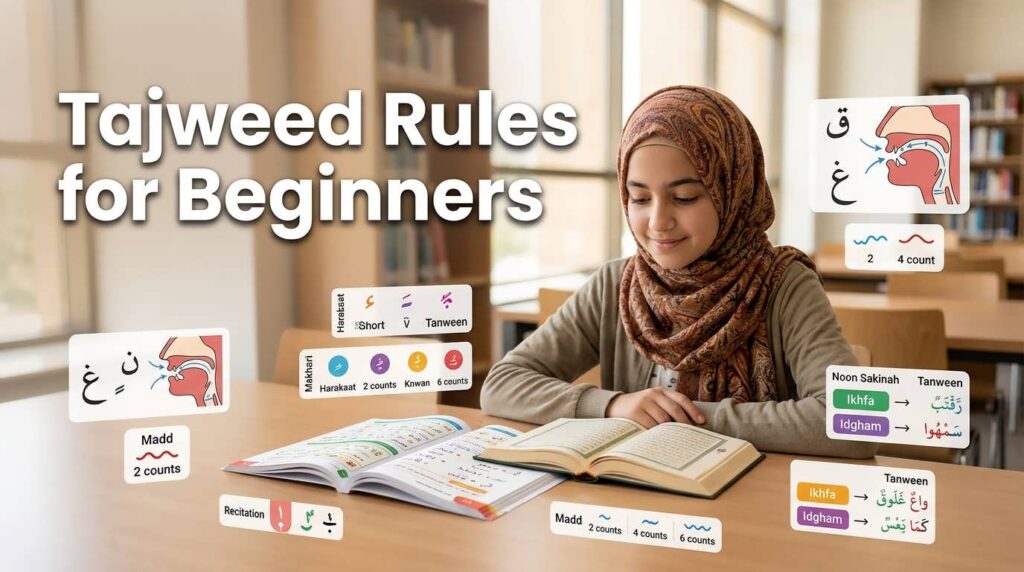
Tajweed rules for beginners include learning correct letter pronunciation (Makharij), letter characteristics (Sifaat), Noon Sakinah and Tanween rules, Meem Sakinah rules, elongation (Madd), and proper stopping and starting points. These rules help Muslims recite the Quran accurately, preserve meanings, and improve recitation fluency.
Many Muslims begin reading the Quran at a young age, but not everyone learns the rules that govern proper recitation. This is where Tajweed becomes important.
For beginners, Tajweed may seem complicated at first because there are many Arabic terms and pronunciation concepts. However, once the basics are understood, Tajweed becomes a practical skill that gradually improves through regular recitation and teacher guidance.
This guide explains the most important Tajweed rules beginners should learn and how they help improve Quran recitation.
- What Is Tajweed?
- Why Should Beginners Learn Tajweed?
- The Most Important Tajweed Rules for Beginners
- 1. Makharij (Articulation Points)
- 2. Sifaat (Characteristics of Letters)
- 3. Noon Sakinah and Tanween Rules
- 4. Meem Sakinah Rules
- 5. Madd (Elongation)
- 6. Qalqalah
- 7. Heavy and Light Letters
- 8. Waqf and Ibtida (Stopping and Starting)
- Which Tajweed Rules Should Beginners Learn First?
- Common Tajweed Mistakes Beginners Make
- How Long Does It Take to Learn Basic Tajweed?
- The Best Way to Learn Tajweed as a Beginner
- Tajweed for Children
- Tajweed and Quran Memorization
- Beyond Tajweed: Understanding What You Recite
- Conclusion
- Frequently Asked Questions
What Is Tajweed?
Tajweed is the science of reciting the Quran correctly.
The word “Tajweed” comes from an Arabic root meaning “to improve” or “to make better.”
Tajweed ensures that every letter of the Quran is pronounced properly according to the rules passed down through generations of Quran reciters.
Its purpose is to:
- Preserve correct pronunciation
- Protect Quranic meanings
- Improve recitation quality
- Beautify Quran recitation
Allah says:
“And recite the Quran with measured recitation.” (Quran 73:4)
You can listen to authentic recitations and explore Quranic translations through Quran.com.
Why Should Beginners Learn Tajweed?
Many beginners ask whether Tajweed is necessary if they can already read the Quran.
The answer is yes.
Tajweed helps students:
- Pronounce words correctly
- Avoid common mistakes
- Improve fluency
- Gain confidence
- Preserve the meaning of Quranic verses
Without Tajweed, students may unintentionally develop habits that become difficult to correct later.
The Most Important Tajweed Rules for Beginners
Beginners do not need to learn every advanced rule immediately.
Instead, they should focus on the foundational concepts that have the greatest impact on recitation accuracy.
1. Makharij (Articulation Points)
Makharij refers to the points from which Arabic letters originate.
Every Arabic letter has a specific place of pronunciation.
For example:
- ق (Qaf) originates deeper in the mouth
- ك (Kaf) originates slightly forward
- ع (Ayn) originates from the throat
- ح (Haa) originates from the throat but differently than ع
Learning Makharij helps students distinguish between letters that may sound similar to non-Arabic speakers.
Why Makharij Matters
Incorrect articulation can:
- Change pronunciation
- Alter meanings
- Affect recitation quality
Makharij is often considered the foundation of Tajweed.
2. Sifaat (Characteristics of Letters)
While Makharij explains where letters originate, Sifaat explains how letters are pronounced.
Examples include:
- Heavy letters (Tafkheem)
- Light letters (Tarqeeq)
- Whispered sounds
- Strong sounds
Understanding Sifaat helps students produce more accurate and natural recitation.
3. Noon Sakinah and Tanween Rules
Noon Sakinah (نْ) and Tanween appear frequently throughout the Quran.
Beginners should become familiar with four primary rules:
| Rule | Purpose |
|---|---|
| Izhar | Clear pronunciation |
| Idgham | Merging sounds |
| Iqlab | Sound conversion |
| Ikhfa | Partial concealment |
These rules affect how certain letters interact during recitation.
Because they occur often in the Quran, they are among the first Tajweed rules most students learn.
4. Meem Sakinah Rules
The letter Meem (مْ) also follows specific recitation rules.
The three primary Meem Sakinah rules are:
Izhar Shafawi
Clear pronunciation of Meem.
Idgham Shafawi
Merging Meem sounds together.
Ikhfa Shafawi
Partial concealment of Meem before specific letters.
Learning these rules improves recitation smoothness and accuracy.
5. Madd (Elongation)
Madd refers to stretching certain sounds during recitation.
This is one of the easiest Tajweed concepts for beginners to notice because it directly affects how long a sound is held.
Examples include:
- Natural Madd
- Connected Madd
- Separated Madd
Different types of Madd require different elongation lengths.
Correct application improves both fluency and rhythm.
6. Qalqalah
Qalqalah creates a slight echoing or bouncing sound on certain letters.
The letters of Qalqalah are:
ق ط ب ج د
When these letters appear in specific situations, they are pronounced with a slight vibration.
Why Beginners Learn Qalqalah Early
Qalqalah occurs frequently in Quran recitation and is relatively easy to identify and practice.
7. Heavy and Light Letters
Some Arabic letters are pronounced heavily, while others are pronounced lightly.
Examples of Heavy Letters
- ص
- ض
- ط
- ظ
- ق
- غ
- خ
These letters require a fuller pronunciation.
Why This Rule Matters
Many beginners pronounce all letters similarly, which can reduce recitation accuracy.
Learning heavy and light letters improves pronunciation significantly.
8. Waqf and Ibtida (Stopping and Starting)
Reciting the Quran involves more than reading continuously.
Students must learn:
- Where to stop
- When to continue
- How to resume recitation properly
Stopping incorrectly can affect the meaning of a verse.
This is why Waqf and Ibtida become important as students progress.
Which Tajweed Rules Should Beginners Learn First?
The best learning sequence is usually:
- Arabic letter recognition
- Makharij
- Basic Sifaat
- Madd
- Noon Sakinah and Tanween
- Meem Sakinah
- Qalqalah
- Waqf and Ibtida
This progression allows students to build strong foundations before moving to more advanced topics.
Common Tajweed Mistakes Beginners Make
Many beginners struggle with:
Mispronouncing Similar Letters
Examples include:
- ص and س
- ض and د
- ح and ه
Ignoring Madd
Students often shorten sounds that should be elongated.
Reading Too Quickly
Speed frequently causes mistakes.
Neglecting Makharij
Incorrect articulation can affect pronunciation accuracy.
If you’d like to learn more, our guide on Common Tajweed Mistakes explores these errors in greater detail.
How Long Does It Take to Learn Basic Tajweed?
Most students can understand basic Tajweed concepts within a few months.
The exact timeline depends on:
- Learning frequency
- Practice consistency
- Teacher guidance
- Prior Quran reading experience
For a detailed breakdown, see our guide on How Long Does It Take To Learn Tajweed?
The Best Way to Learn Tajweed as a Beginner
While books and videos can be helpful, Tajweed is primarily a practical skill.
A qualified teacher can:
- Listen to recitation
- Identify mistakes
- Correct pronunciation
- Provide structured progression
This is why many students choose a structured Online Tajweed Course rather than relying entirely on self-study.
Tajweed for Children
Children often learn Tajweed more naturally because pronunciation habits are still developing.
Many young students begin through a structured Nazara Quran Course that combines Quran reading with proper recitation training.
Parents may also find these articles useful:
Tajweed and Quran Memorization
Strong Tajweed skills support effective memorization.
Students who memorize Quran with correct pronunciation are less likely to develop recitation errors.
Learners pursuing memorization goals may benefit from a structured Hifz Ul Quran Course.
Beyond Tajweed: Understanding What You Recite
Tajweed helps students recite correctly, but understanding Quranic meanings adds depth to the learning experience.
Students interested in deeper Quran study can explore a structured Dars-e-Quran Course.
Authentic Prophetic teachings can also be studied through a Dars-e-Hadith Course and trusted resources available at Sunnah.com.
If you’re ready to begin learning Tajweed, a free Trial Class can help assess your current recitation level and create a personalized learning plan.
You can also learn more about the academy through the About Us page or discuss your learning goals through the Contact Us page.
Conclusion
Learning Tajweed rules for beginners does not have to be overwhelming. By focusing on foundational concepts such as Makharij, Sifaat, Madd, Noon Sakinah, Meem Sakinah, and stopping rules, students can gradually improve their Quran recitation and build confidence.
The key is consistency. With regular practice and qualified guidance, beginners can develop strong Tajweed habits that support accurate and beautiful Quran recitation for years to come.
Frequently Asked Questions
What are the basic Tajweed rules beginners should learn first?
Beginners should start with Makharij, Sifaat, Madd, Noon Sakinah and Tanween rules, Meem Sakinah rules, and proper stopping techniques.
Can I learn Tajweed without knowing Arabic?
Yes. Many students learn Tajweed while simultaneously developing their Arabic reading skills.
How long does it take to learn beginner Tajweed?
Most students can understand basic Tajweed concepts within 3 to 6 months with regular practice and teacher guidance.
Is Tajweed mandatory for Quran recitation?
Correct recitation is important, and Tajweed helps preserve proper pronunciation and meaning during Quran reading.
What is the easiest Tajweed rule for beginners?
Many students find Madd and Qalqalah easier to understand because they are noticeable during recitation.
Why is Makharij important?
Makharij ensures that Arabic letters are pronounced from their correct articulation points, improving recitation accuracy.
Can children learn Tajweed online?
Yes. Many children successfully learn Tajweed through structured online Quran classes with experienced teachers.
What is the best way to practice Tajweed?
The most effective method is regular recitation with feedback from a qualified Quran teacher.