Online Noorani Qaida classes are live lessons designed to help beginners learn the basic skills needed to read the Quran correctly.
The Noorani Qaida introduces students to Arabic letters, their sounds, joining letters, vowel signs, and progressively more advanced reading exercises. This makes it especially useful for children, adults who are starting from scratch, and people returning to Quran learning after a long break.
Instead of immediately asking a beginner to read complete Quranic passages, a teacher builds the necessary foundation step by step.
A typical learning path may move from:
Arabic letters → letter sounds → vowel signs → joined letters → words → reading practice → Quran reading
Online classes simply bring this learning process into a live digital classroom.
- Why Is Noorani Qaida Important for Quran Reading?
- Who Should Take Online Noorani Qaida Classes?
- How Do Online Noorani Qaida Classes Work?
- What Do Students Learn in Noorani Qaida?
- What Are Harakat?
- What Are Joined Letters?
- Why Is Pronunciation Important From the Beginning?
- What Are Makharij?
- Can Noorani Qaida Help With Tajweed?
- Online Noorani Qaida Classes for Kids
- Online Noorani Qaida Classes for Adults
- Can Beginners Learn Noorani Qaida Without Knowing Arabic?
- How Long Does It Take to Complete Noorani Qaida?
- Should Children Take Daily Noorani Qaida Classes?
- How Often Should You Practice Noorani Qaida?
- Why One-on-One Noorani Qaida Classes Can Be Useful
- Can Group Noorani Qaida Classes Work?
- Interactive Online Noorani Qaida Classes
- What Equipment Do You Need?
- Can Noorani Qaida Be Learned on a Phone?
- How Should Parents Prepare a Child for Online Qaida Classes?
- How Can Parents Know Whether a Child Is Improving?
- Common Mistakes Beginners Make While Learning Noorani Qaida
- Should You Finish Noorani Qaida Before Reading the Quran?
- What Happens After Noorani Qaida?
- Can Noorani Qaida Help Reverts Learn Quran?
- Can Noorani Qaida Help Someone Who Learned Quran Years Ago?
- Is Online Noorani Qaida Better Than Learning From a Book Alone?
- How to Choose the Right Online Noorani Qaida Teacher
- Questions Parents Should Ask Before Enrolling
- How to Make Online Qaida Classes More Effective
- Is Noorani Qaida Only for Children?
- Can Seniors Learn Noorani Qaida Online?
- Why Correct Pronunciation Matters Before Fluency
- What Makes a Good Online Noorani Qaida Class?
- Start Noorani Qaida With a Trial Class
- Final Thoughts
- Frequently Asked Questions
Why Is Noorani Qaida Important for Quran Reading?
Learning to read the Quran requires more than recognizing Arabic letters.
A student also needs to understand how letters are pronounced and how they behave when combined with other letters.
Noorani Qaida helps establish these basic skills before the student moves into regular Quran reading.
This foundation can help students develop:
- Arabic letter recognition
- Correct pronunciation
- Familiarity with vowel signs
- Letter joining
- Reading confidence
- Basic Tajweed awareness
- Better Quran reading habits
The purpose is not to make the student memorize a booklet.
The purpose is to build the reading skills needed to approach the Quran correctly.
Who Should Take Online Noorani Qaida Classes?
Noorani Qaida is particularly suitable for beginners.
Children
Young children who are learning Arabic letters for the first time can start with the basics and progress gradually.
Adult Beginners
Adults who never learned to read Arabic can begin from the alphabet without feeling embarrassed about their starting level.
Muslims Returning to Quran Learning
Someone who learned Quran reading years ago but has forgotten the basics may benefit from reviewing Qaida.
Reverts to Islam
New Muslims who want to learn how to read the Quran can use Noorani Qaida as a structured starting point.
Students With Weak Foundations
Some students can technically read the Quran but struggle with pronunciation or basic reading rules. Revisiting Qaida can help identify and strengthen those weaknesses.
How Do Online Noorani Qaida Classes Work?
A live online class usually follows a simple structure.
Step 1: Assess the Student
The teacher first determines what the student already knows.
A complete beginner may start with individual letters.
Someone with previous experience may begin at a more advanced lesson.
Step 2: Introduce the Lesson
The teacher explains the letters, signs, or reading pattern being taught.
Step 3: Student Practice
The student reads aloud while the teacher listens.
Step 4: Correct Mistakes
The teacher immediately corrects pronunciation or reading mistakes.
Step 5: Repeat
The student reads the same material again.
Step 6: Review
Previous lessons are revisited to make sure the student remembers them.
Step 7: Practice at Home
The student receives material to review before the next lesson.
This makes online learning more than simply watching a recorded Qaida lesson.
What Do Students Learn in Noorani Qaida?
The exact sequence varies by curriculum, but beginner Qaida instruction commonly covers areas such as:
- Arabic alphabet
- Letter shapes
- Letter sounds
- Joining letters
- Harakat
- Fatha
- Kasra
- Damma
- Tanween
- Sukoon
- Shaddah
- Madd
- Basic pronunciation
- Reading simple combinations
- Gradually reading words
More advanced lessons can introduce additional pronunciation and Tajweed concepts.
The objective is to gradually move the learner from recognizing individual letters toward confident Quran reading.
What Are Harakat?
Harakat are vowel signs that help determine how Arabic letters are pronounced.
Beginners commonly encounter:
- Fatha
- Kasra
- Damma
For someone unfamiliar with Arabic, these signs can initially seem confusing.
A teacher can demonstrate the sound, have the student repeat it, and then combine it with different letters.
This repeated practice helps the learner recognize patterns instead of trying to memorize everything at once.
What Are Joined Letters?
Arabic letters can change their appearance depending on their position and connection within a word.
This is an important step for Quran beginners.
A student may first learn to recognize individual letters.
Later, the student learns how those letters connect.
Then the student gradually learns to read combinations and words.
This progression makes the transition toward Quran reading more manageable.
Why Is Pronunciation Important From the Beginning?
Pronunciation is one of the most important reasons to study Qaida properly.
A beginner may recognize a letter visually but pronounce it incorrectly.
If the incorrect pronunciation becomes a habit, correcting it later can be more difficult.
A teacher can listen to the student’s recitation and correct problems immediately.
This is particularly useful for Arabic letters whose pronunciation may be unfamiliar to non-Arabic speakers.
What Are Makharij?
Makharij refers to the articulation points from which Arabic letters are produced.
Learning correct articulation helps students distinguish between letters that may sound similar to an inexperienced reader.
For example, students need to learn how different Arabic sounds are produced from the throat, tongue, lips, and other parts of the mouth.
A qualified teacher can demonstrate these sounds and listen to the student reproduce them.
This is one reason a live teacher can be especially useful for beginners.
Can Noorani Qaida Help With Tajweed?
Yes, but Qaida should be understood as a foundation rather than the complete study of Tajweed.
Students can encounter basic pronunciation and reading rules during Qaida lessons.
As their reading develops, they can move into more systematic Tajweed study.
If a student is struggling with pronunciation or wants to improve recitation after completing the basics, a dedicated Quran recitation academy can provide more focused instruction.
Students can also learn practical strategies to improve Tajweed as they progress.
Online Noorani Qaida Classes for Kids
Children often benefit from short, focused, interactive lessons.
A teacher may:
- Show one letter.
- Pronounce it.
- Ask the child to repeat it.
- Test recognition.
- Combine it with another letter.
- Review previous material.
- Move to the next exercise.
This keeps the child involved.
Parents should not expect a child to master everything in a few lessons.
Learning Quran reading is a gradual process.
The goal is steady progress.
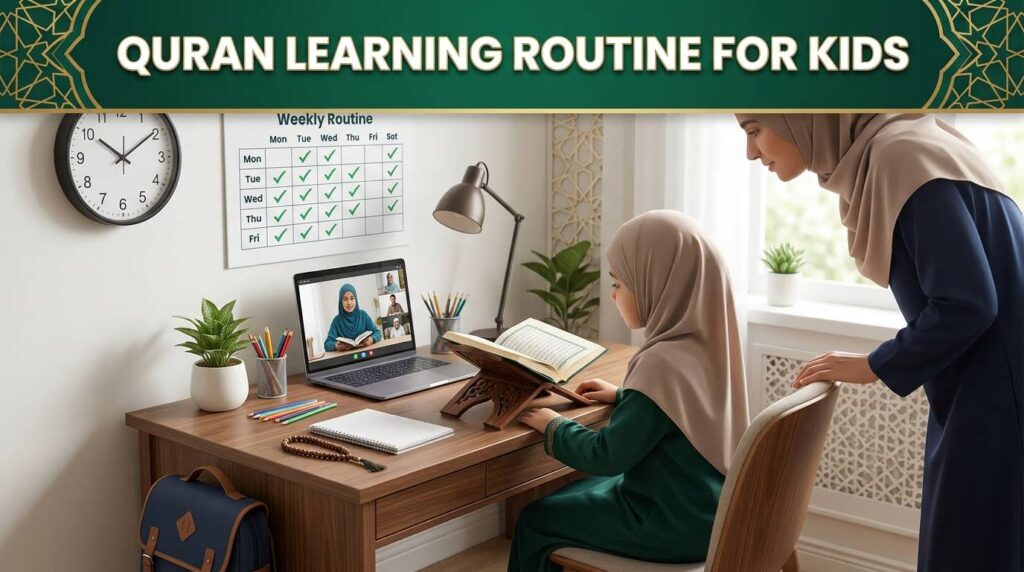
A consistent Quran learning routine for kids can help reinforce what the child learns during live classes.
Online Noorani Qaida Classes for Adults
Adults sometimes hesitate to start because they feel they are “too old” to learn Quran reading.
There is no need for embarrassment.
Adults can start from the same foundation as children.
The difference is that an adult teacher may adapt the pace and explanation to the learner’s previous experience.
For someone who already recognizes Arabic letters, the teacher may move quickly through familiar lessons.
For a complete beginner, the teacher can start from the alphabet.
Can Beginners Learn Noorani Qaida Without Knowing Arabic?
Yes.
A person does not need to speak Arabic to begin learning Quran reading.
Noorani Qaida is primarily concerned with learning how Arabic letters and reading patterns work.
A student can learn the sounds and reading rules without first becoming fluent in conversational Arabic.
However, learning Arabic vocabulary later can help students understand the meaning of what they recite.
As learners progress, they may also become interested in understanding the Arabic language behind the Quran. The Quranic Arabic Corpus provides useful linguistic information and Quranic Arabic resources for students who want to explore the language more deeply.
How Long Does It Take to Complete Noorani Qaida?
There is no universal completion time.
It depends on:
- Student age
- Previous experience
- Class frequency
- Lesson duration
- Practice between classes
- Pronunciation ability
- Learning pace
- Consistency
A complete beginner may need considerably more practice than someone who already recognizes Arabic letters.
The important goal is not to finish the book as quickly as possible.
The goal is to master the skills in each lesson before moving forward.
Should Children Take Daily Noorani Qaida Classes?
Not necessarily.
The ideal schedule depends on the child’s age, attention span, school schedule, and learning ability.
Some students may benefit from several shorter lessons each week.
Others may have a different schedule.
What matters most is consistency.
A child who attends lessons regularly and practices between classes may progress more effectively than a child who attends irregularly for long sessions.
How Often Should You Practice Noorani Qaida?
Short, consistent practice is generally easier to maintain than occasional long sessions.
For example, a student may review:
- Today’s lesson.
- Yesterday’s lesson.
- Difficult letters.
- Pronunciation corrections.
- Previously completed exercises.
Even a few minutes of focused review can reinforce what was taught.
The exact routine should be adjusted to the student’s level and schedule.
Why One-on-One Noorani Qaida Classes Can Be Useful
One-on-one classes give the teacher direct access to the student’s reading.
The teacher can immediately notice:
- Incorrect letter sounds
- Confusion between letters
- Weak recognition
- Difficulty joining letters
- Problems with vowel signs
- Repeated pronunciation mistakes
The teacher can then slow down or move ahead according to the student’s actual ability.
This is different from a large class where the teacher has limited time to listen to each student.
Can Group Noorani Qaida Classes Work?
Yes.
Group classes can work when they are carefully structured.
The teacher should give every student enough opportunity to:
- Read aloud.
- Answer questions.
- Practice.
- Receive correction.
The challenge is that students may progress at different speeds.
A student who needs additional practice may feel rushed, while another student may become bored.
For beginners who need significant pronunciation correction, one-on-one learning can therefore be particularly useful.
Interactive Online Noorani Qaida Classes
Online Qaida lessons can be interactive rather than passive.
The teacher can:
- Display the Qaida page.
- Point to a specific letter.
- Ask the student to identify it.
- Demonstrate pronunciation.
- Listen to the student’s response.
- Correct the mistake.
- Ask the student to repeat it.
- Review previous exercises.
The student should spend a meaningful part of the class actively reading.
Simply watching a teacher explain the Qaida is not enough.
What Equipment Do You Need?
You generally do not need expensive equipment.
A basic setup can include:
- Laptop, tablet, or smartphone
- Stable internet connection
- Headphones if helpful
- Quran or Qaida book
- Quiet learning space
A larger screen can make Arabic letters easier to see, especially for young children, but a phone or tablet can also work depending on the class platform.
The most important requirement is clear communication between teacher and student.
Can Noorani Qaida Be Learned on a Phone?
Yes.
Online classes can often be accessed from a smartphone or tablet.
However, beginners may find a larger screen more comfortable because Arabic letters and exercises are easier to see.
If a phone is the most convenient option, students can still combine live classes with independent practice.
The important thing is that the student can clearly see the lesson and hear the teacher.
How Should Parents Prepare a Child for Online Qaida Classes?
Parents can make lessons easier by creating a consistent learning environment.
Before class:
- Prepare the Qaida.
- Check the internet connection.
- Keep the device charged.
- Choose a quiet place.
- Remove unnecessary distractions.
- Make sure the child is ready before the teacher joins.
During the lesson, parents should allow the teacher to teach while remaining available if technical help is needed.
How Can Parents Know Whether a Child Is Improving?
Look beyond the number of pages completed.
Signs of improvement may include:
- Recognizing letters more quickly.
- Making fewer pronunciation mistakes.
- Reading combinations more confidently.
- Understanding vowel signs.
- Joining letters more easily.
- Needing fewer corrections.
- Reading without constant prompting.
A good teacher should also be able to explain the student’s strengths and areas that still need work.
Common Mistakes Beginners Make While Learning Noorani Qaida
Rushing Through Lessons
Finishing pages is not the same as mastering them.
Ignoring Pronunciation
Recognizing a letter visually is not enough.
Practicing Only During Class
Regular home practice reinforces the lesson.
Skipping Difficult Exercises
Difficult sections often require additional practice.
Moving to Quran Reading Too Early
Students should have enough foundation before progressing.
Comparing Progress With Others
Every learner has a different starting point.
Focusing Only on Speed
Accuracy should come before speed.
Should You Finish Noorani Qaida Before Reading the Quran?
For a complete beginner, it is generally useful to establish the foundational skills first.
However, learning does not always happen in a rigid sequence.
A teacher may introduce short Quranic words or passages as soon as the student has enough knowledge to benefit from them.
The important thing is that the student does not move ahead while major reading foundations remain weak.
What Happens After Noorani Qaida?
Noorani Qaida is a starting point.
After developing the necessary reading foundation, students can progress toward:
Quran reading → Tajweed → Fluency → Hifz or other Quran studies
The next step depends on the student’s goals.
Someone may want to focus on fluent Quran reading.
Another student may want to study Tajweed.
Someone else may want to begin memorization.
The teacher can help determine the appropriate next stage.
Can Noorani Qaida Help Reverts Learn Quran?
Yes.
A new Muslim may have no previous experience with Arabic script.
Starting with Noorani Qaida provides a structured way to learn:
- Arabic letters.
- Basic sounds.
- Reading signs.
- Letter combinations.
- Quran reading foundations.
An encouraging teacher can also answer beginner questions and make the learning process less intimidating.
Can Noorani Qaida Help Someone Who Learned Quran Years Ago?
Yes.
Some adults learned Quran reading as children but have not practiced for years.
They may still remember the basics but struggle with fluency or pronunciation.
Instead of assuming they need to start from the beginning, a teacher can assess their level.
They may only need a review of selected Qaida lessons before moving back into Quran reading.
Is Online Noorani Qaida Better Than Learning From a Book Alone?
A book can be useful for independent practice.
However, a live teacher provides something a book cannot:
personalized correction.
A student may read a letter incorrectly without realizing it.
A teacher can hear the mistake and demonstrate the correct pronunciation immediately.
For this reason, many beginners can benefit from combining the Qaida book with live instruction.
How to Choose the Right Online Noorani Qaida Teacher
Before enrolling, consider:
Teaching Experience
Does the teacher have experience with complete beginners?
Pronunciation Knowledge
Can the teacher explain Arabic letter pronunciation clearly?
Patience
Does the teacher allow the student enough time to practice?
Interaction
Does the student actively read during the lesson?
Progress Tracking
Does the teacher know what was covered previously?
Communication
Can the teacher communicate comfortably with the student or parents?
Class Format
Is the class one-on-one or group-based?
Trial Class
Can you observe the teaching style before committing?
For girls and women who prefer female instruction, you may also want to explore how to choose a female Quran teacher.
Questions Parents Should Ask Before Enrolling
Parents can ask the academy:
- Is the Noorani Qaida course suitable for complete beginners?
- How are pronunciation mistakes corrected?
- Are classes one-on-one?
- How long is each class?
- How frequently are classes held?
- How is student progress monitored?
- Can parents receive feedback?
- What happens if the child misses a class?
- Is there a trial lesson?
- Can the teacher adjust the pace for the child?
These questions can help parents understand what the actual learning experience will be like.
How to Make Online Qaida Classes More Effective
Create a Regular Schedule
Try to attend lessons at consistent times.
Practice Between Classes
Review what the teacher covered.
Read Aloud
Silent practice does not allow you to hear your own pronunciation.
Repeat Corrections
If the teacher corrects a sound, repeat it several times.
Avoid Rushing
Master the lesson before moving ahead.
Ask Questions
If something is confusing, ask the teacher to explain it again.
Review Previous Lessons
New material becomes easier when the foundation remains strong.
Is Noorani Qaida Only for Children?
No.
Noorani Qaida can be useful for anyone who needs to build or rebuild basic Quran reading skills.
It can be suitable for:
- Children
- Teenagers
- Adults
- Seniors
- Complete beginners
- Reverts
- People returning to Quran study
The teaching pace should simply be adapted to the learner.
Can Seniors Learn Noorani Qaida Online?
Yes.
Older learners may need a little more repetition or a slower pace, but online learning can still be effective.
A teacher can enlarge the lesson material, repeat sounds, and give the learner additional practice when needed.
There is no requirement to learn at the same pace as younger students.
Why Correct Pronunciation Matters Before Fluency
A student may become fluent at reading while still making the same pronunciation mistakes repeatedly.
That is why the foundation matters.
It is better to establish correct pronunciation early than to develop fast reading habits that later require significant correction.
A patient teacher should therefore focus on accuracy first.
Once the correct patterns become familiar, fluency can develop naturally.
What Makes a Good Online Noorani Qaida Class?
A strong class should include:
- Clear teaching.
- Active student participation.
- Pronunciation correction.
- Regular review.
- Appropriate pacing.
- Individual attention.
- A structured learning plan.
- Practice between lessons.
- Progress monitoring.
The technology itself is secondary.
A high-quality online class should feel like a real lesson, not simply a video playing on a screen.
Start Noorani Qaida With a Trial Class
If you are unsure whether online learning will suit your child or yourself, a trial class is a practical way to find out.
During the trial, pay attention to:
- How the teacher communicates.
- Whether the student gets enough reading time.
- How pronunciation is corrected.
- Whether the teacher assesses the student’s level.
- Whether the pace feels comfortable.
- Whether the student feels encouraged.
You can start a Quran trial class and use the experience to decide whether the teaching approach is suitable before making a longer-term commitment.
Final Thoughts
Online Noorani Qaida classes can provide beginners with a structured path toward confident Quran reading.
The biggest benefit is not simply being able to complete the Qaida.
The real objective is to develop the foundation needed to recognize Arabic letters, pronounce them correctly, understand basic reading signs, connect letters, and gradually move toward Quran recitation.
For children, a patient and interactive teacher can make the process easier.
For adults, online learning provides a convenient way to start from the beginning without feeling uncomfortable about their level.
For reverts and complete beginners, Noorani Qaida can provide a clear starting point.
The most important principle is simple:
Do not rush the foundation. Build it correctly, and Quran reading becomes easier to develop afterward.
Frequently Asked Questions
What is Noorani Qaida?
Noorani Qaida is a foundational method used to teach beginners the basic skills needed to read Arabic and the Quran, including letters, sounds, vowel signs, joining letters, and progressive reading exercises.
What are online Noorani Qaida classes?
They are live online lessons in which a teacher guides a student through Noorani Qaida, listens to their reading, corrects pronunciation, and gradually builds their Quran reading skills.
Is Noorani Qaida suitable for complete beginners?
Yes. It is particularly useful for people who are starting Quran reading from the Arabic alphabet.
Can adults learn Noorani Qaida?
Yes. Adults can start from the beginning regardless of age or previous Quran learning experience.
Can children learn Noorani Qaida online?
Yes. Online lessons can be suitable for children when the teacher uses age-appropriate, interactive teaching methods.
Do I need to know Arabic before learning Noorani Qaida?
No. You can begin learning the Arabic letters and Quran reading foundations without knowing conversational Arabic.
How long does it take to complete Noorani Qaida?
There is no fixed duration. It depends on the student’s age, starting level, class frequency, practice, and learning pace.
Is Noorani Qaida the same as Tajweed?
No. Noorani Qaida is primarily a foundation for learning to read Arabic and the Quran. Tajweed is the systematic study and application of rules governing Quranic pronunciation and recitation.
Can Noorani Qaida improve Quran pronunciation?
Yes. It can help students develop correct letter recognition and pronunciation from the beginning, particularly when a qualified teacher provides live correction.
Can I learn Noorani Qaida on my phone?
Yes. Many online classes can be accessed using a smartphone or tablet, although a larger screen may be more comfortable for viewing Arabic letters.
Is one-on-one Noorani Qaida better than group classes?
One-on-one classes can provide more individualized attention and pronunciation correction. Group classes can also work when every student receives sufficient opportunities to participate.
What should I learn after Noorani Qaida?
Most students move toward regular Quran reading and then may study Tajweed, improve fluency, or begin Hifz depending on their goals.
Can reverts learn Noorani Qaida?
Yes. It can provide a structured starting point for new Muslims who want to learn how to read the Quran.
Can someone relearn Noorani Qaida after many years?
Yes. Someone who learned Quran reading as a child can review Qaida to strengthen forgotten or weak foundations.
Should I practice Noorani Qaida every day?
Regular practice is helpful, but the ideal schedule depends on your age, level, class frequency, and available time. Consistency is generally more important than forcing very long practice sessions.
Can I take a trial class before enrolling?
If an academy offers a trial, it is a useful way to evaluate the teacher, class format, interaction, and suitability for the learner.